
Syria transitional parliament holds first session, elects speaker
 3 Min Read
Syria’s Transitional People’s Assembly holds its first session, electing Abdul Hamid al-Awwak as speaker and preparing to draft a new constitution.
-
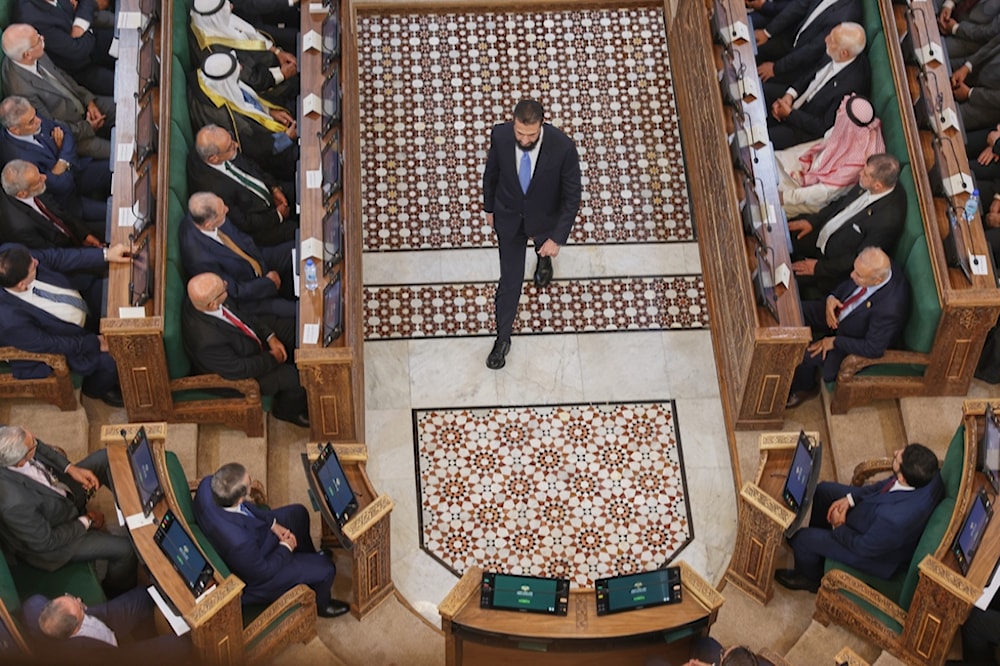
Transitional Syrian President Ahmad al-Sharaa walks through the chamber after addressing the inaugural session of Syria's newly formed People's Assembly in Damascus, Syria, Sunday, July 12, 2026 (AP)
Syria’s Transitional People’s Assembly held its first official session on Sunday, electing a speaker as it began its legislative duties, including the formation of a committee tasked with drafting a new constitution for the country.
At the opening of the session, transitional President Ahmad al-Sharaa called on members of the assembly to serve as "a model of responsibility and competence" and contribute to strengthening a culture of dialogue, the rule of law, and respect for institutions.
The inaugural session was chaired by the oldest member of the assembly, Osama al-Assaf. A total of 206 members took the constitutional oath in the presence of al-Sharaa and several ministers, while seats representing Suwayda Governorate remained vacant, along with the seat of a deputy who died before the session began.
Abdul Hamid al-Awwak elected speaker
Following a secret ballot, lawmakers elected legal expert Abdul Hamid al-Awwak as president of the assembly after he received 99 votes.
Al-Awwak was followed by Mouayed al-Qablawi, who received 75 votes, and Ramez Kourj, who secured 31 votes. One blank ballot was also recorded.
The newly elected speaker, Abdul Hamid al-Awwak, is from Syria’s eastern Hasakah Governorate. He previously participated in the committee responsible for drafting the constitutional declaration approved by Syrian authorities in 2025.
Syrian transitional assembly appointed
Syrian authorities announced last week the appointment of the remaining members of the country's transitional People's Assembly, completing the formation of the legislative body months after the political process began following the collapse of Bashar al-Assad's government.
Self-appointed interim President Ahmad al-Sharaa appointed 70 lawmakers to fill the remaining seats in the 210-member parliament, allowing the chamber to convene for its inaugural session next week. According to Mohammad Taha al-Ahmad, head of the Higher Judicial Committee for Parliamentary Elections, the Assembly is scheduled to hold its first meeting on Monday.
The appointments complete a process in which roughly two-thirds of the legislature had already been selected through regional electoral bodies established under the transitional authorities.
The formation of the Assembly has been closely watched as an indicator of how Syria's new authorities intend to structure political institutions after more than five decades of Assad family leadership.
Representation remains a point of debate
The latest appointments increased female representation in the chamber, with 15 women named by al-Sharaa. Combined with the six women selected during the earlier phase, women now occupy 21 seats in the Assembly.
Authorities did not specify how many of the newly appointed members belong to Syria's religious and ethnic communities. During the initial selection process, minority communities, including Kurds, Christians, and Alawites, received ten seats.
Meanwhile, parliamentary representation for the predominantly Druze governorate of Sweida remains unresolved. Officials said appointments for the province have been postponed until "conditions become suitable" following last year's clashes between government forces, allied armed groups, and local Druze factions.
The process has also drawn criticism from Syrian civil society organizations and political figures, who argue that the mechanism used to establish the legislature grants excessive influence to the presidency.


