
Territorial issue most difficult in Ukrainian settlement: Kremlin
 3 Min Read
The Kremlin has backed a trilateral Putin-Trump-Zelensky summit to finalize a peace deal, as US and Ukrainian negotiators prepare for fresh talks in Geneva.
-
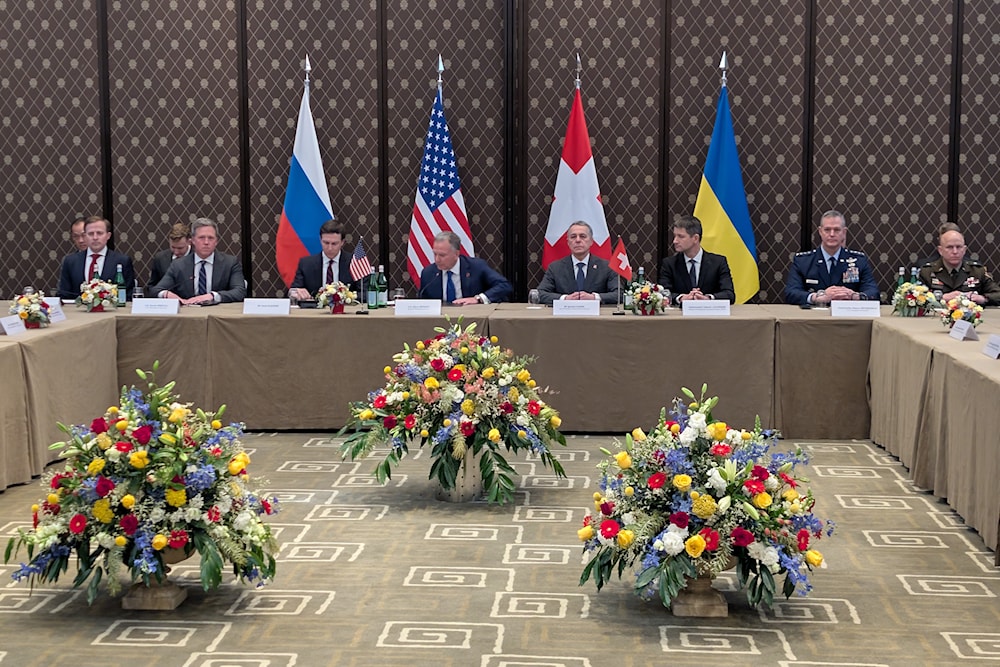
US delegation attends a round of trilateral talks between the United States, Ukraine, and Russia on the Ukraine war in Geneva, Switzerland, Tuesday, Feb 17, 2026 (Ukrainian National Security and Defense Council press office via AP)
Diplomatic activity around the Ukraine conflict intensified on Wednesday, with the Kremlin endorsing a trilateral peace summit, Trump and Zelensky speaking by phone, and fresh US-Ukraine talks set for Geneva, all against the backdrop of unrelenting battlefield pressure.
The Kremlin said on Wednesday that a meeting between Vladimir Putin, Donald Trump, and Volodymyr Zelensky would be appropriate to finalize a peace deal. Kremlin spokesperson Dmitry Peskov said the three leaders "should meet only if they need to finalize the agreements, or, as the Americans say, the deal."
He reiterated that an earlier offer for Zelensky to visit Moscow remains open, insisting Putin "always keeps his word." Peskov identified the territorial question as the most difficult obstacle to any settlement.
Four years into the Russia-Ukraine war, the conflict has transformed global politics. From Kiev to Mariupol, Kharkov to Bakhmut, shifting front lines, NATO expansion, sanctions, and rising East-West tensions have expanded the war’s impact far beyond Ukraine, with no clear end in… pic.twitter.com/Zu9bZUsiCm
— Al Mayadeen English (@MayadeenEnglish) February 24, 2026
Trump-Zelensky call ahead of Geneva
Trump spoke with Zelensky on Wednesday, a White House official told AFP, ahead of a fresh round of negotiations. Further details of the call were not immediately made available.
The conversation sets the tone for Thursday's bilateral meeting in Geneva, where Ukrainian Defense Minister Rustem Umerov will lead his country's delegation in talks with US envoys Steve Witkoff and Jared Kushner. Economy Minister Yulia Svyrydenko will also attend.
Zelensky said the Geneva talks will focus on a "Prosperity Package", with both sides set to work through its details. He also instructed Umerov to raise a potential prisoner exchange, calling it a priority on the humanitarian track.
The bilateral meeting is intended as preparation for a broader trilateral format involving Russia, which Zelensky said he expects to convene in early March.
'Incremental but significant progress'
The latest US-Ukraine-Russia round in Geneva concluded on February 17-18, with Russian negotiator Vladimir Medinsky describing it as "tough but businesslike." Despite friction on the political track, the military side has yielded more concrete results.
A source familiar with the talks told CNN that negotiators made "incremental but significant progress" on ceasefire terminology and technical details. Zelensky confirmed that negotiators are close to completing a full draft on ceasefire monitoring arrangements.
War continues unabated
The diplomatic momentum comes as the war shows no signs of slowing on the ground. A new assessment by the International Institute for Strategic Studies found that Russia will be able to sustain its war effort throughout 2026, having allocated at least $186 billion to defense in 2025, accounting for 7.3% of GDP and more than double the proportion spent by the United States.
IISS director general Bastian Giegerich said there was "little indication" that Russia's capacity to continue high-intensity operations is diminished.
Ukraine, meanwhile, is pressing ahead with defensive measures. Defense Minister Mykhailo Fedorov announced Wednesday that Ukraine would install 4,000 kilometers of anti-drone nets along frontline roads by year's end, with an additional $37 million allocated from the state budget for the effort.
On the diplomatic front, the US abstained last week from a UN General Assembly resolution titled "Support for lasting peace in Ukraine," which passed with 107 votes in favor. Trump also quietly extended existing US sanctions on Russia for another year, citing an ongoing threat to American national security and foreign policy.


