Al Mayadeen English

  • Ar
  • Es
  • x
Al Mayadeen English

Slogan

  • News
    • Politics
    • Economy
    • Sports
    • Arts&Culture
    • Health
    • Miscellaneous
    • Technology
    • Environment
  • Articles
    • Opinion
    • Analysis
    • Blog
    • Features
  • Videos
    • NewsFeed
    • Video Features
    • Explainers
    • TV
    • Digital Series
  • Infographs
  • In Pictures
  • • LIVE
News
  • Politics
  • Economy
  • Sports
  • Arts&Culture
  • Health
  • Miscellaneous
  • Technology
  • Environment
Articles
  • Opinion
  • Analysis
  • Blog
  • Features
Videos
  • NewsFeed
  • Video Features
  • Explainers
  • TV
  • Digital Series
Infographs
In Pictures
  • Africa
  • Asia
  • Asia-Pacific
  • Europe
  • Latin America
  • MENA
  • Palestine
  • US & Canada
BREAKING
Military source to Fars: We foiled CENTCOM's scenarios to breach the Strait's control and management system through continuous monitoring and effective strikes
Military source to Fars: Last night witnessed one of the most intense levels of Iranian military confrontation in the heart of the Strait of Hormuz
Military source to Fars: In the past 24 hours, Iran conducted one of its fiercest and most diverse offensive and defensive operations against violating ships and US aircraft
Brigadier General Majid Mousavi, receiving the IRGC Commander-in-Chief: Our combat system today possesses astonishing, effective, terrifying, and destructive equipment
IRGC Aerospace Force Commander: We are fully prepared to carry out the orders of the Supreme Leader and IRGC leadership across all operational theaters
Iran's IRGC Commander Major General Ahmad Vahidi tours new missile city: What the enemy is facing is only the beginning
Al-Moussawi: Sovereignty cannot be restored or safeguarded by undermining the nation's strength or threatening civil peace
Al-Moussawi: Those seeking to put the resistance on trial today are either unaware or deliberately ignoring that they are offending a people's memory, while challenging a cause written in blood
Hezbollah's Ammar al-Moussawi at the 35th Arab National Congress in Beirut: Resistance in Lebanon would not have emerged had it not been for aggression and occupation
Al-Hayya: The Israeli enemy has moved into the implementation phase of its 'Greater Israel' project

THAAD interceptors show limits despite massive US investment

  • By Al Mayadeen English
  • Source: Military Watch Magazine
  • 4 Feb 2026 19:03
  • 1 Shares
3 Min Read

Despite spending $2.35 billion on THAAD interceptors during the 12-day war, extensive damage occurred across the entity as Iranian hypersonic missiles challenged system viability.

Listen
  • x
  • THAAD
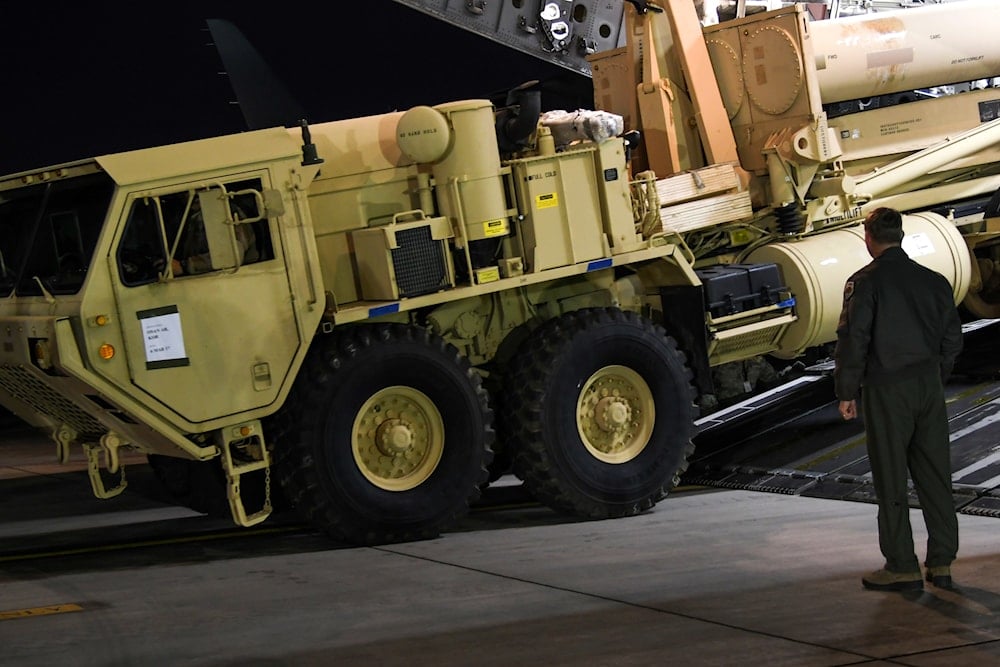
    In this March 6, 2017 file photo provided by US Forces Korea, a truck carrying parts of US missile launchers and other equipment needed to set up the Terminal High Altitude Area Defense (THAAD) missile defense system arrive at Osan air base in Pyeongtaek, South Korea. (US Force Korea via AP)

The United States Army is confronting serious budgetary challenges following plans to drastically expand production of interceptors for its Terminal High Altitude Area Defense (THAAD) anti-ballistic missile system, amid growing questions about the system's effectiveness against modern threats.

Defense contractor Lockheed Martin recently announced a framework agreement to quadruple annual THAAD interceptor production from 96 to 400 missiles. The expansion comes after the system's first high-intensity combat deployment exposed critical vulnerabilities in both capacity and capability.

In June 2025, US Army THAAD batteries covering Israeli airspace expended over 150 interceptors during the 12-day Israeli aggression on Iran. According to the Wall Street Journal, this represented nearly a quarter of all interceptors ever purchased by the Pentagon. Demand proved so overwhelming that officials considered diverting interceptors purchased by Saudi Arabia to Israeli systems.

The financial implications are staggering. With each THAAD interceptor costing approximately $15.5 million, interception efforts during the June 2025 war exceeded $2.35 billion. Annual procurement of 400 interceptors would cost roughly $6.2 billion, straining an already overstretched defense budget competing with other critical programs, including the M1E3 Abrams tank development and enhancements to the lower-tier Patriot air defense system.

Limited effectiveness despite massive expenditure

Despite this massive expenditure and support from US Navy AEGIS systems and Israeli defenses, THAAD's protective capabilities proved limited. US sources confirmed extensive damage to Israeli military and strategic targets, and even President Donald Trump acknowledged days after hostilities ended that "Israel was hit really hard. Those ballistic missiles, boy, they took out a lot of buildings."

The deployment followed Washington's October 2024 decision to station THAAD systems in "Israel" after Iran and Yemen's Ansarullah demonstrated capabilities to strike sensitive military targets across the entity with long-range missiles.

Pentagon officials cite intensifying ballistic missile threats as justification for expanded procurement. However, the system's viability against modern arsenals is increasingly questioned by defense analysts.

THAAD deployments span multiple theaters, from Hawaii (2009) and Guam (2013) to South Korea (2016), ostensibly countering threats from the Democratic People's Republic of Korea and China, whose arsenals dwarf Iran's in size and sophistication.

Hypersonic technology challenges system viability

The emergence of hypersonic glide vehicles poses an existential challenge to THAAD's operational relevance. These weapons, now deployed by China, Russia, DPRK, and Iran, achieve extreme reentry speeds and exceptional maneuverability while striking from unexpected trajectories, rendering interception by systems like THAAD effectively impossible.

DPRK fielded its first intermediate-range ballistic missile with hypersonic glide capability, the Hwasong-16B, in mid-2024, while Russia deployed the Oreshnik system in December 2025.

Iran's limited use of its Fattah hypersonic missile during June engagements, believed to have been developed with DPRK support, caused significant concern among Israeli military leadership, spurring calls for a fundamental revision of the entity's missile defense strategy.

As Washington pursues massive THAAD expansion, the system's prohibitive costs and diminishing effectiveness against evolving threats raise fundamental questions about the sustainability and strategic wisdom of continued investment in conventional missile defense architectures.

  • United States
  • Israel
  • THAAD interceptor missiles
  • interception
  • THAAD
  • THAAD Missile Defense System

Most Read

A view of Iran's nuclear enrichment facility in Natanz, Iran, on April, 9, 2007 (AP)

Iran announces first nuclear fusion reactor, set to operate soon

  • Technology
  • 15 Nov 2026
Yemen’s Armed Forces engage Saudi forces, south of Taiz, Yemen, October 14, 2026. (Yemeni Military Media)

Field sources: YAF secure large areas of Dhubab at Bab al-Mandab

  • Politics
  • 15 Nov 2026
People watch as two cooling towers of the Scholven Power Station are demolished due to Germany's Energy Transition, in Gelsenkirchen, Germany, May 9, 2026. (AP)

Germany drafts law to bring coal power plants amid gas shortage fears

  • Environment
  • 14 Nov 2026
A document that was included in the U.S. Department of Justice release of the Jeffrey Epstein files, photographed Wednesday, Feb. 4, 2026, shows an April 2012 International Driving Permit for Epstein. (AP)

Epstein was strangled, forensic expert says after file review: BBC

  • Miscellaneous
  • 16 Nov 2026

Coverage

All
US Midterm Elections 2026

Read Next

All
Ukrainian President Volodymyr Zelensky gives a press conference in Kiev, Feb. 19, 2025. (AP)
Politics

Zelensky urges Pentagon to unlock stalled patriot missile deliveries

Palestinian inspects his scrapyard where vechiles were scorched during and Israeli settler attack in the West Bank Village of Burqa, east of Ramallah, July 15, 2025. (AP)
Politics

'Israel' plans settler 'mega-city' to split Palestinian land in two

US Senate Majority Leader John Thune heads to the Senate chamber as Republicans debate President Donald Trump’s tax and spending bill in Washington, June 29, 2025. (AP)
Politics

Trump's $350bln Pentagon bid could reopen Medicaid fight

US President Donald Trump watches as War Secretary speaks with reporters at the White House, April 6, 2026, in Washington. (AP)
Politics

Hegseth curbs military ties with Canada, Trump feud deepens: WashPo

Al Mayadeen English

Al Mayadeen is an Arab Independent Media Satellite Channel.

All Rights Reserved

  • x
  • Privacy Policy
  • About Us
  • Contact Us
  • Authors
Android
iOS