
Those who sent suicide bombers are now sending missiles: Al-Amiri
 3 Min Read
Badr Organization chief Hadi al-Amiri condemns the recent strikes on Iraqi forces, pledges retaliation, and says Iraq will remain united amid escalating tensions.
-
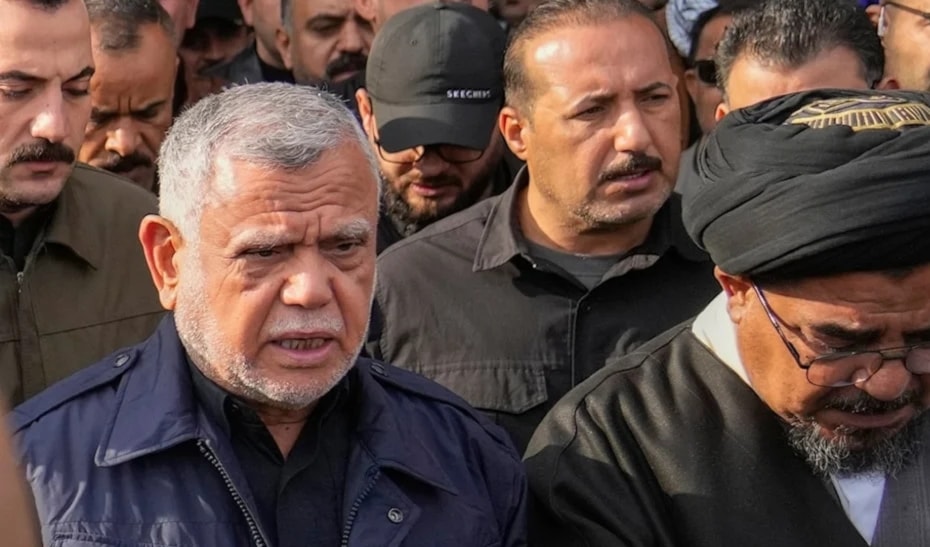
The Secretary-General of the Iraqi Badr Organization, Hadi al-Amiri, left, attends a funeral for the group members who were killed by a US airstrike in Iraq, February 4, 2024 (AP)
The Secretary-General of the Iraqi Badr Organization, Hadi al-Amiri, vowed that those killed in the recent US-Saudi aggression would be avenged, saying their killing would not go unanswered, while stressing that Iraq would remain resilient, victorious, and united.
Al-Amiri said that “those who were sending car bombs and suicide bombers to Iraq yesterday have returned today to send missiles.”
The statement followed the US-Saudi aggression that targeted positions belonging to the Popular Mobilization Forces in several Iraqi provinces, killing 20 personnel and injuring 32 others. The attack was carried out under the pretext of responding to strikes on oil facilities in Saudi Arabia, while the Islamic Resistance in Iraq denied the Saudi accusations, considering them an attempt to justify the inability to respond to Yemeni strikes.
Al-Amiri's remarks echo Iraqi political and armed factions, which also voiced strong opposition to the aggression, with several groups denouncing the attacks.
Iraqi groups condemn US-Saudi attacks, demand foreign troop withdrawal
The PMF said that the attacks were a "joint US-Saudi aggression" and said the casualty figures were preliminary.
The Islamic Resistance in Iraq rejected Saudi Arabia's accusations that it had attacked Saudi territory. It stated that the claims were "an attempt to justify Riyadh's inability to respond to damaging Yemeni strikes against infrastructure in the Eastern Province and Riyadh, amid concerns over the nature of a potential future Yemeni response."
What was the real justification behind the US-Saudi strikes on Iraq?
— Al Mayadeen English (@MayadeenEnglish) July 29, 2026
From Washington and Riyadh's official claims to the legal status of the PMF and the questions raised by Iraqi political analyst Jumaa al-Atwani, this deep dive dissects the narratives surrounding the attacks… pic.twitter.com/ogHq3n0oYv
Baghdad reaffirms PMF's role, says no proof of Iraq-based attacks
Iraq has rejected claims that attacks originated from its territory, with the spokesperson for the Commander-in-Chief of the Armed Forces, Sabah al-Numan, saying on Thursday that no evidence had been presented to support such allegations.
Speaking to the Iraqi News Agency (INA), al-Numan said the security establishment was preparing a comprehensive security plan to prevent any recurrence of attacks and preserve Iraq’s sovereignty.
Furthermore, he stressed that only state security forces are responsible for safeguarding the country’s sovereignty and controlling arms, adding that security responsibilities rested exclusively with the official state forces, which would not permit the presence of weapons beyond the control and authority of the state.
PMF recognized as an integral force in Iraq’s national defense
Al-Numan said Prime Minister and Commander-in-Chief of the Armed Forces Ali Al-Zaidi’s visit to the Popular Mobilization Forces (PMF) headquarters, where he received a detailed briefing on attacks targeting PMF personnel in several provinces, reaffirmed that the PMF remained an integral part of Iraq’s national defense system.
He added that the Commander-in-Chief had immediately ordered support for the families of those killed in the attacks and instructed that comprehensive medical care be provided to the wounded, including treatment abroad if required.
Al-Numan also called on those claiming that attacks had originated from inside Iraq to provide evidence supporting their allegations, saying that no party had so far presented proof to substantiate such claims.
He stressed that just as the government would not tolerate any unilateral actions originating from within Iraq, it also rejects any violations of the country’s sovereignty from beyond its borders.
Read more: Why did the US and Saudi Arabia target Iraq? A deep dive


