
True Promise waves 35-36: Regional security for all or for none
 4 Min Read
Iran's IRGC says Operation True Promise 4's 35th wave has pushed the war into a new phase, as a senior official warns Tehran could block regional oil exports and expand the conflict if US-Israeli strikes on civilian infrastructure continue.
-
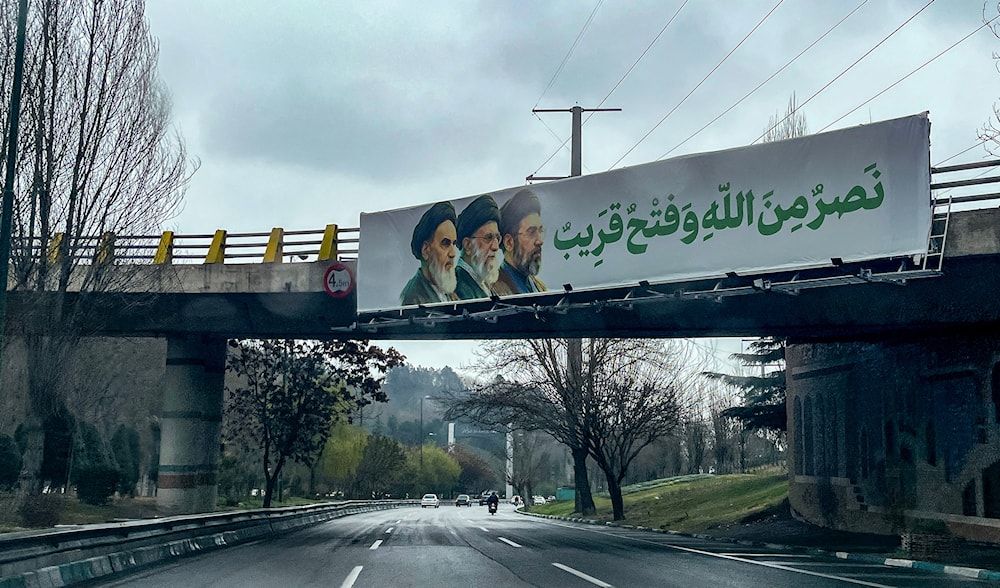
A billboard depicting Iran's Leaders since 1979, next to a quote from the Quran reading in Arabic "victory from God and imminent conquest," is displayed above a highway in Tehran on March 10, 2026. (AFP)
In the 36th wave of Operation True Promise 4, carried out on the 21st night of Ramadan’s Laylat al-Qadr under the slogan “O Ali ibn Abi Talib (peace be upon him),” Iranian forces launched a large number of Qadr, Kheybar, and Emad missiles.
The attacks targeted the US Fifth Fleet naval base in the region, as well as Al Udeid base, Al Adidri, and the Harir base in Iraq’s Kurdistan Region, destroying what the statement described as operational infrastructure belonging to US forces.
The IRGC called on senior US political and military officials in Washington to visit the region instead of what it described as “empty rhetoric,” saying they would witness firsthand the conditions of US bases and forces in the field.
The statement added that 70 years of US achievements in the region have evaporated in less than 11 days, stressing that the war is ongoing.
Strikes expand to US bases and Israeli targets
Iran's Islamic Revolutionary Guard Corps (IRGC) said Tuesday that the launch of strategic missiles in the 34th wave of Operation True Promise 4 has pushed the war with US and Israeli forces into a new phase.
Qadr, Emad, Fattah and also Kheybar missiles were also launched in this wave.
In a statement, the IRGC warned that "unconventional, illegitimate, and unlawful actions" by US and Israeli aggressors would not go unanswered, adding that Iran's target bank for striking US and Israeli military assets across the region is 10 times larger than targets currently engaged.
The IRGC said Aerospace Force missiles and drones effectively struck gatherings of US soldiers at Abu Dhabi's Al Dhafra and Bahrain's Al Juffair bases.
In the occupied Palestinian territories, the statement said Ramat David Airbase and Haifa's civilian airport sustained direct hits, while concealed rocket-launch platforms belonging to the Israeli army in Bnei Brak, east of Tel Aviv, were also struck.
Oil exports and the Strait of Hormuz
A senior Iranian military official told Al Mayadeen on Monday that Iran would not allow a single liter of oil to reach hostile parties and their partners for as long as US-Israeli aggression continues.
The official warned that maritime traffic through the Strait of Hormuz would be governed by wartime rules, signalling potential disruption to one of the world's most critical energy corridors.
The remarks follow Israeli strikes on at least five major fuel and oil storage facilities in Tehran, which triggered extensive fires and what environmental experts described as an ecological disaster in the capital.
Shekarchi: Washington using regional populations as human shields
Brigadier General Abolfazl Shekarchi, spokesperson for Iran's Armed Forces General Staff, accused US President Donald Trump of launching "a brutal aggression" against Iran to protect the Israeli regime under the pretence of defending the Iranian people.
He said that once US forces found themselves outmatched, Washington resorted to bombing civilians, "innocent women, men, and children," in an attempt to compensate for military failure.
Shekarchi added that some American commanders had begun using regional populations as human shields to escape a "quagmire of death" in the face of Iran's offensive.
The senior official who spoke to Al Mayadeen said continued attacks on Iranian civilian infrastructure would widen the circle of regional insecurity. "Either there is security for everyone or security for no one," the official said, warning that Tehran remains prepared to significantly expand the scope of the war if aggression persists.
The IRGC statement closed with the same warning: "Security and stability in the region will either be for everyone, or for no one."


