
Trump admin. labels its European ally as 'incubator' for terrorism
 4 Min Read
The administration of Donald Trump has unveiled a new counter-terrorism strategy, accusing Europe of fostering terrorism through mass migration.
-
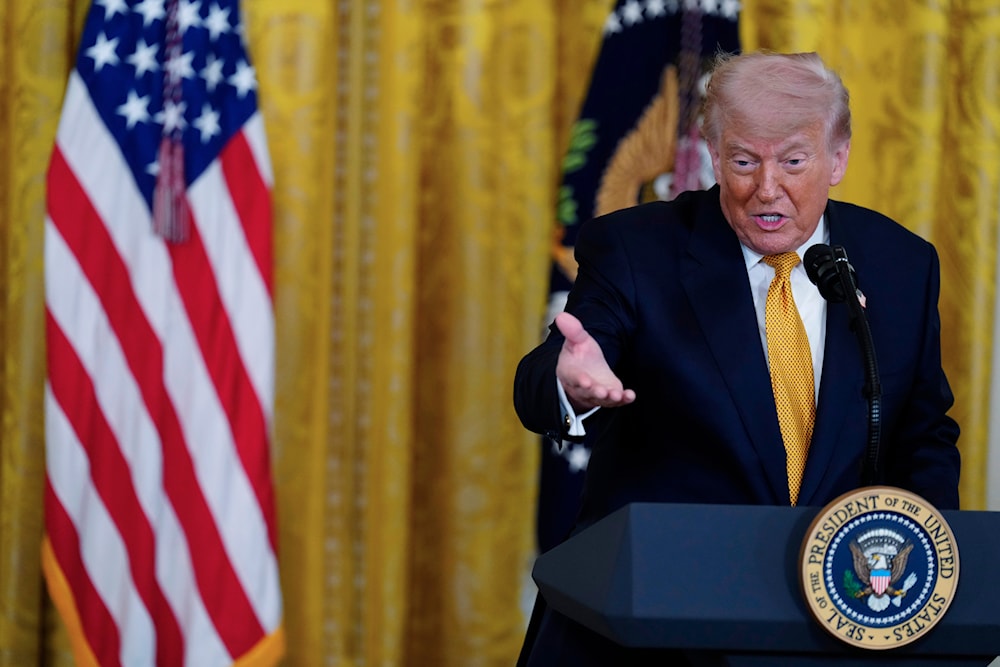
US President Donald Trump speaks during a Mother's Day event for members of the military, Wednesday, May 6, 2026, in the East Room of the White House, in Washington (AP)
US President Donald Trump's administration has accused Europe of becoming an “incubator” for terrorism fueled by mass migration, The Guardian reported, citing a new counter-terrorism strategy unveiled on Wednesday.
The 16-page report prioritizes efforts to combat what it described as “violent left-wing extremists,” as Trump’s conservative administration intensifies its political attacks against domestic opponents. The document further places drug cartels across the Americas at the center of US counter-terrorism operations.
Some of the strategy’s strongest language was directed at Europe, home to several key US allies, warning that the continent faces mounting internal threats linked to migration and border policies.
“It is clear to all that well-organised hostile groups exploit open borders and related globalist ideals. The more these alien cultures grow, and the longer current European policies persist, the more terrorism is guaranteed,” the strategy stated.
“As the birthplace of Western culture and values, Europe must act now and halt its willful decline,” it added. The report, led by counter-terrorism coordinator Sebastian Gorka, nevertheless described European nations as the United States’ “preeminent and long-term counterterrorism partners.”
“The world is safer when Europe is strong, but Europe is greatly threatened and is both a terror target and an incubator of terror threats,” the report said.
Trump digs a rift in the Atlantic
Tensions between the United States and Europe have deepened in recent months over defense spending, troop deployments, and the US-led war on Iran. Trump has repeatedly accused European allies of relying too heavily on Washington while refusing to support American military operations fully.
On May 1, 2026, the Pentagon announced plans to withdraw around 5,000 US troops from Germany, a move widely viewed as pressure on Berlin after Chancellor Friedrich Merz criticized Washington’s Iran strategy. Trump has also threatened troop reductions in Spain and Italy amid disputes over military cooperation and access to bases.
European leaders have responded cautiously while emphasizing the importance of NATO unity. French President Emmanuel Macron has pushed for greater European strategic independence and called for diplomacy over escalation with Iran. British Prime Minister Keir Starmer has resisted some US demands while trying to preserve Britain’s relationship with Washington.
Merz, meanwhile, has sought to balance criticism of Trump with support for the transatlantic alliance. On May 3, 2026, he said he was “not giving up on working with Trump” despite disagreements over Iran and NATO policy. Germany has also accelerated discussions about strengthening Europe’s independent defense capabilities as concerns grow over Washington’s reliability.
Not an overnight rift
The rift between the US and Europe did not emerge overnight but has steadily widened since Trump’s return to office in early 2025.
From the outset of his renewed presidency, tensions resurfaced over NATO defense spending targets, as his administration revived long-standing complaints that European allies were not contributing enough to collective security. Washington quickly pressured members to significantly increase military budgets, reigniting disputes that had defined Trump’s earlier term.
Alongside these disputes, tensions have been fueled by Trump’s renewed interest in Greenland, a semi-autonomous territory of Denmark and a NATO ally. His administration has signaled strategic interest in the Arctic, raising concerns in Copenhagen about sovereignty and alliance cohesion. Danish officials and European partners have firmly rejected any suggestion of territorial transfer.
Combined with disputes over defense spending, this has reinforced fears in several European capitals that Washington is reshaping its role within NATO in ways that could alter the post–Cold War security order.


