
Trump backs off 'Trump Strait' remark
 3 Min Read
Trump says his proposal to rename the Strait of Hormuz was merely an idea he floated, as Iran maintains control over navigation amid US aggression.
-
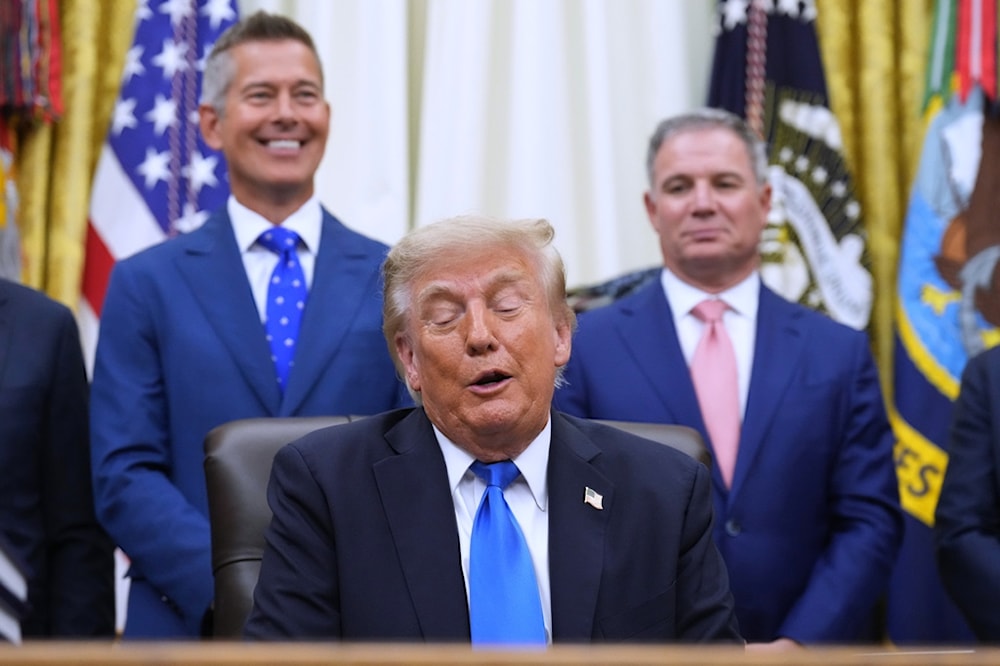
US President Donald Trump speaks in the Oval Office of the White House during a meeting with travel executives on Wednesday, Sept. 2, 2026. (AP Photo/Jacquelyn Martin)
US President Donald Trump has backed away from his suggestion to rename the Strait of Hormuz to "Trump Strait", saying Wednesday evening that he was “just throwing that out."
The White House subsequently published a map on social media labeling the waterway the “Trump Strait,” reinforcing Trump’s claim as the US continued its military escalation against Iran.
It's got a nice ring to it pic.twitter.com/Fmzc9iUu8u
— The White House (@WhiteHouse) September 2, 2026
Regardless of Trump's claims, navigation in the strait remains under the continuous monitoring and control of Iran, with commercial vessels, oil tankers, and cargo ships remaining beholden to the maritime laws imposed by the Islamic Republic following the joint US-Israeli aggression that led to the waterway closing.
Iranian officials have repeatedly stressed that the strait will remain closed to general navigation, with passage permitted only to commercial vessels under the terms of an approved memorandum of understanding.
Tehran has also made clear that a full reopening of the waterway is contingent on an end to the war on all fronts, the lifting of the blockade, and Washington fulfilling its commitments under the memorandum.
Read more: US Navy stretched thin in West Asia as supply routes collapse: NYT
Two oil tankers hit after using unauthorized route
The confrontation over navigation intensified Wednesday after Iran’s Islamic Revolution Guard Corps (IRGC) announced that two oil tankers had exploded and caught fire after striking mines in the Strait of Hormuz.
The IRGC said the tankers had entered an unauthorized route after being encouraged by the US military to move through the passage. According to the force, the vessels had earlier unloaded their crews at the urging of the US military and were placed under the control of US-linked personnel.
The IRGC said its naval forces had previously warned of the dangers of crossing through the mined route.
It also warned that shipping companies following US orders instead of established procedures and authorized routes could face additional penalties, which it said would be implemented soon.
Read more: US SLAM-ER missile identified at site of Sirik wedding strike
US aggression on Iran drives regional escalation
The US launched a series of hostile strikes across Iran on Tuesday, targeting Bandar Abbas, the vicinity of Masan village on Qeshm Island, Jask port, Minab, the ports of Chabahar and Konarak, Lengeh port, and residential areas in Hormozgan Province.
The US military also struck a wedding ceremony in Sirik, leaving 70 civilians martyred or wounded, most of them women and children, according to Iran’s Foreign Ministry.
Iran responded with missile and drone strikes targeting US military positions across the region, including bases in Jordan, Bahrain, Kuwait, the UAE, and Erbil. The IRGC also announced the downing of the 50th US MQ-9 drone.
The escalation has pushed oil prices above $95 a barrel, with Brent crude trading near $96, amid mounting concerns over energy supplies and maritime traffic through the Strait of Hormuz.
Trump’s retreat from his “Trump Strait” proposal does not change the central dispute: Washington claims control over the strategic waterway, while Iran continues to exercise authority over navigation and determine the conditions for vessels seeking passage.
Read more: Iran vows crushing response to US aggression


