
Trump claims Iran 'obliterated', yet urges allies to secure Hormuz
 7 Min Read
Trump outlined US strikes on Iranian targets and acknowledged that several allies remain reluctant to deploy naval forces to help secure shipping.
-
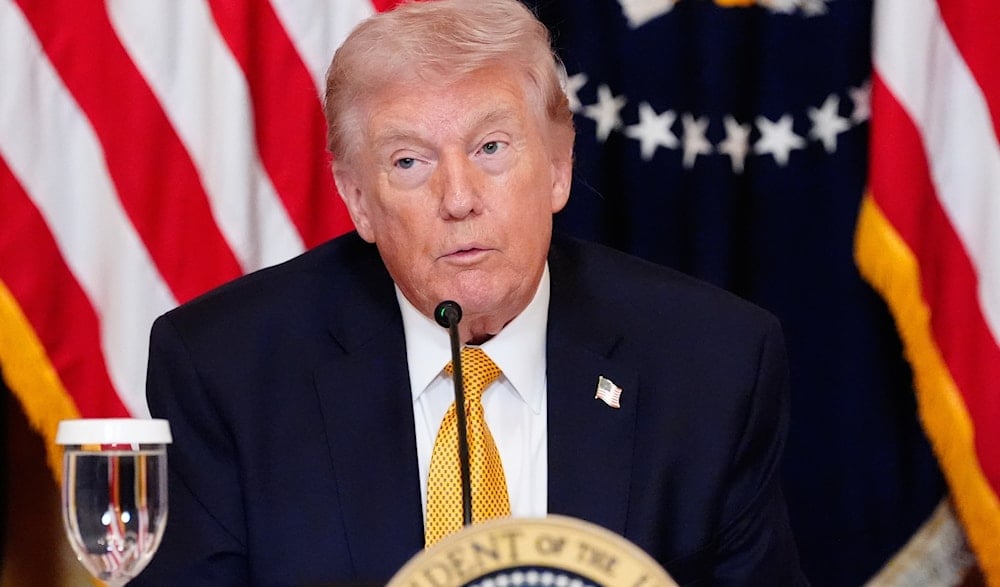
US President Donald Trump speaks during a board meeting of the John F. Kennedy Memorial Center For The Performing Arts in the East Room of the White House, March 16, 2026, in Washington (AP)
US President Donald Trump began a press conference with an update on what he termed the United States’ “powerful military campaign” against Iran.
“They have been literally obliterated,” he alleged, repeating previous claims that Iran’s air force, navy, and leadership structure had been severely weakened. “Other than that, they’re doing quite well,” he added.
Trump claimed the US military has struck more than 7,000 targets across Iran, which he termed as “mostly commercial and military targets.”
He also claimed the strikes had led to a 90% drop in Iranian ballistic missile launches and a 95% reduction in drone attacks.
“The missiles are trickling in now because they don’t have too many missiles left,” he claimed.
Trump claimed that the US had targeted Iran’s missile and drone production facilities and that more than 100 Iranian naval vessels had been sunk or destroyed during the past week and a half.
US claims strikes on Iran’s mine-laying vessels in Strait of Hormuz
Trump said the United States is “hammering” Iran’s ability to threaten commercial shipping in the Strait of Hormuz, a critical global energy route.
He claimed US forces had destroyed more than 30 Iranian mine-laying vessels, but acknowledged uncertainty about whether any naval mines had actually been deployed.
“We hit, to the best of our knowledge, all of their mine-laying ships … but we don’t know that any have even been dropped in, we’re not sure that any have been,” the US president emphasized.
“We don’t know that they have dropped any in, but we’ve hit all 30 of their ships,” he further alleged.
The president again urged other countries to help reopen and secure the strait after Iran responded to US-Israeli aggressions with drones, missiles, and mines, effectively disrupting tanker traffic that normally carries about one-fifth of the world’s oil and liquefied natural gas.
“Some are very enthusiastic about it, and some aren’t. Some are countries that we’ve helped for many, many years. We’ve protected them from horrible outside sources, and they weren’t that enthusiastic," he claimed, ending with a menacing tone, "And the level of enthusiasm matters to me."
Read next: Trump Hormuz coalition call met with tepid responses, rejections
Trump begs for international support to reopen shipping route
When asked why the United States could not simply reopen the strait if Iran’s mine-laying ships had been destroyed, Trump said the situation also depends on shipping companies’ willingness to return.
“It takes two to tango. We have to get people to take their billion-dollar ship and, you know, drive it up,” he said.
“These ships are very expensive,” Trump added. “They don’t want to take a chance.”
He said some companies remain reluctant to use the waterway because of the possibility that mines could still be present.
“We don’t know if they even set any mines. But the thought that they may have is enough to keep people saying, ‘we don’t need it,'” the US president added.
Trump also recounted a conversation with an unnamed country about assistance in clearing mines from the strait, suggesting the request was declined.
"We have some countries where we have 45,000 soldiers ... protecting them from harm's way and we have done a great job. And well, we want to know, do you have any mine sweepers? Well, would rather not get involved, sir," he said.
Elsewhere in his remarks, Trump said he spoke with French President Emmanuel Macron about helping reopen the Strait of Hormuz.
“Yeah, I mean, sure, he’s going to, I think, he’s going to help. I mean, I’ll let you know.”
He also said he was “not happy” with the United Kingdom’s response but suggested Britain could still participate.
According to Trump, US Secretary of State Marco Rubio is expected to announce which countries are prepared to "assist the United States in securing the waterway."
Allies hesitant to send naval support
Military strikes by the United States and "Israel" on Iran have shaken global energy markets, pushing oil prices higher and increasing gasoline costs for American consumers. The rise in energy prices could complicate the domestic economic agenda of Donald Trump and potentially affect Republican chances in the November midterm elections.
Several US allies said on Monday they do not currently plan to deploy ships to help reopen the Strait of Hormuz.
Germany, Spain, and Italy were among the countries that ruled out joining a naval mission in the Gulf for now.
Other governments took a more cautious position. The United Kingdom and Denmark said they would review possible ways to assist, while stressing the importance of reducing tensions and avoiding deeper involvement in the conflict.
France has indicated it will likely participate in efforts to help secure the waterway.
Earlier Monday, US Treasury Secretary Scott Bessent said Washington was “fine” with certain vessels from Iran, India, and China continuing to pass through the Strait of Hormuz for the time being.
Trump dismisses possibility of Israeli nuclear strike on Iran
During the briefing, Trump rejected a reporter’s question about whether "Israel" might use a nuclear weapon against Iran if the war escalates. The question followed comments by one of his advisors, David Sacks, who had mentioned the possibility in an interview.
“Israel would never do that,” Trump claimed.
“You’ve pounded them to hell, and you could just leave now, and it’ll take 10 years for them to build back not nearly what they have right now,” he added.
US President comments on Iran's leadership and negotiations
Trump also addressed reports about Iran’s new leader, Sayyed Mojtaba Khamenei, saying he had heard claims that Khamenei may have been injured during a US-Israeli aggression on February 28.
“We don’t know if he’s dead or not. Nobody’s seen him which is unusual,” he said.
Asked about possible negotiations with Iran in the third week of the war, Trump declined to outline what a deal might look like and criticized what he called misinformation from Iranian sources.
“They showed buildings in Tel Aviv burning to the ground, high rises burning. They showed buildings in Qatar, they showed buildings in Saudi Arabia burning. And they weren’t burning. They weren’t hit,” he added.
“I talk to everybody because sometimes good things come out of it. But, I don’t know if they’re ready yet. They’re taking a pounding … and we don’t even know their leaders,” Trump further claimed.
Trump repeats debunked claim about predicting 9/11
Trump also repeated a long-standing claim that he predicted the attacks on the World Trade Center by Osama bin Laden before the September 11 attacks.
“I predicted Osama bin Laden would knock out the World Trade Center. I made that prediction a year before he did it,” he said.
However, Trump’s 2000 book did not mention bin Laden, and the claim has been repeatedly debunked by news organizations.
Read next: No legal basis: More experts, lawmakers question US war on Iran


