
Trump continues to threaten Iran with 'far worse' attack amid buildup
 4 Min Read
US President Donald Trump warns Iran that a massive naval fleet, led by the USS Abraham Lincoln, is en route, demanding that Tehran negotiate its nuclear program.
-
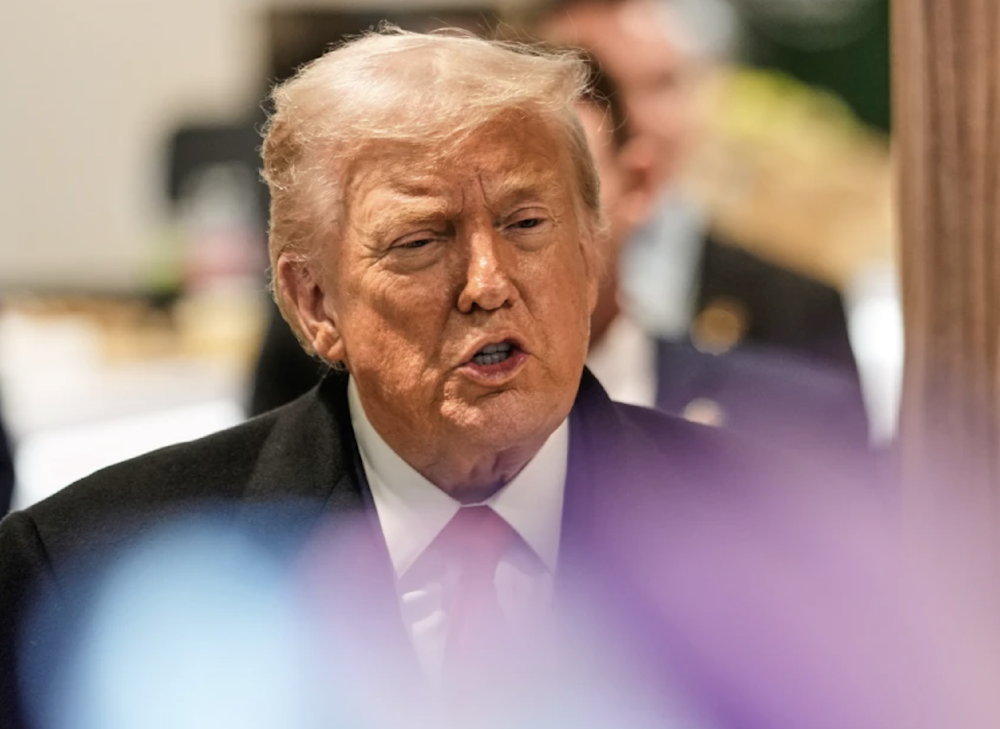
President Donald Trump talks to media after meeting about Greenland during the Annual Meeting of the World Economic Forum in Davos, Switzerland on January 21, 2026. (AP)
US President Donald Trump has renewed his threats to Iran, declaring that a "massive armada" is en route and demanding that Tehran negotiate a new nuclear deal or face a devastating military strike.
In a series of posts on Truth Social, Trump warned Iranian authorities that they must return to the negotiating table to agree to “a fair and equitable deal” on the country’s nuclear program. He claimed that “time is running out” and suggested that failure to comply would trigger a more severe attack than any previously launched by the US.
“A massive Armada is heading to Iran. It is moving quickly, with great power, enthusiasm, and purpose,” Trump wrote. He highlighted that the naval deployment is larger than the one previously sent to Venezuela and is led by the aircraft carrier USS Abraham Lincoln.
“Like with Venezuela, it is, ready, willing, and able to rapidly fulfill its mission, with speed and violence, if necessary,” he added, reinforcing the seriousness of the military move.
Trump says: Negotiations, or else
Trump recalled the so-called "Operation Midnight Hammer", the US-led offensive in June 2025 that targeted several Iranian nuclear facilities.
“As I told Iran once before, MAKE A DEAL! They didn’t, and there was ‘Operation Midnight Hammer,’ a major destruction of Iran. The next attack will be far worse! Don’t make that happen again,” Trump warned.
While claiming that a potential deal would be “fair and equitable,” Trump expressed hope that Iran would agree to negotiations over its nuclear activities, which Tehran maintains are entirely peaceful and pose no threat.
However, by simultaneously escalating military threats, Trump continues to pressure Iran into talks under the guise of diplomacy.
Iran-US talks ruled out under threats
It is worth noting that the Islamic Republic of Iran has consistently expressed openness to indirect negotiations with Washington, emphasizing the importance of de-escalation and diplomacy. However, it has been the United States that has dismissed all calls for diplomatic engagement and instead chosen military threats and sanctions.
Moreover, Iranian Foreign Minister Abbas Araghchi confirmed earlier today that several mediating countries are currently engaged in consultations between Tehran and Washington.
Speaking on the sidelines of the weekly cabinet meeting, Araghchi reaffirmed Iran’s long-held position that negotiations cannot occur under threats. "The United States must realize this if it wants to negotiate," Araghchi said, adding: "Negotiations have rules and must be based on equality and mutual respect."
Araghchi dismissed claims that Iran had approached US officials for talks, saying no contact had occurred with Witkoff or any other American representative in recent days. He did confirm that third-party states are engaged in mediation efforts, though no formal negotiation process has been initiated. “There are different parties seeking to mediate,” Araghchi said, “but negotiations cannot succeed in conjunction with threats.”
Iran raises defensive readiness
Meanwhile, an Iranian security source told Al Mayadeen on Wednesday that Tehran is taking the prospect of war "very seriously" and will raise its defensive readiness to the highest level, amid an expanding US military buildup in the region.
The source highlighted that Iran cannot be distracted by messages from Washington while the enemy's military mobilization continues.
"Military action is not an easy option for the United States," the source said, stressing that US decision-makers are fully aware Iran's response would be decisive and carefully calibrated, not merely proportional. According to the source, Iran's response doctrine has been "designed in a way that would make them think twice even about launching limited strikes."
The source warned that any US base in the region used to carry out air operations against Iran would be directly targeted. "We would strike the same point and the same base," the source added, underscoring that Iran does not consider neighboring countries hostile and would not target them unless their territory, airspace, or waters were used against Iran.


