
Trump mail-in ballot order faces uncertainty amid Supreme Court ruling
 4 Min Read
The US Supreme Court lifted one injunction blocking Trump’s mail-in ballot order, while a separate ruling against USPS remains in place.
-
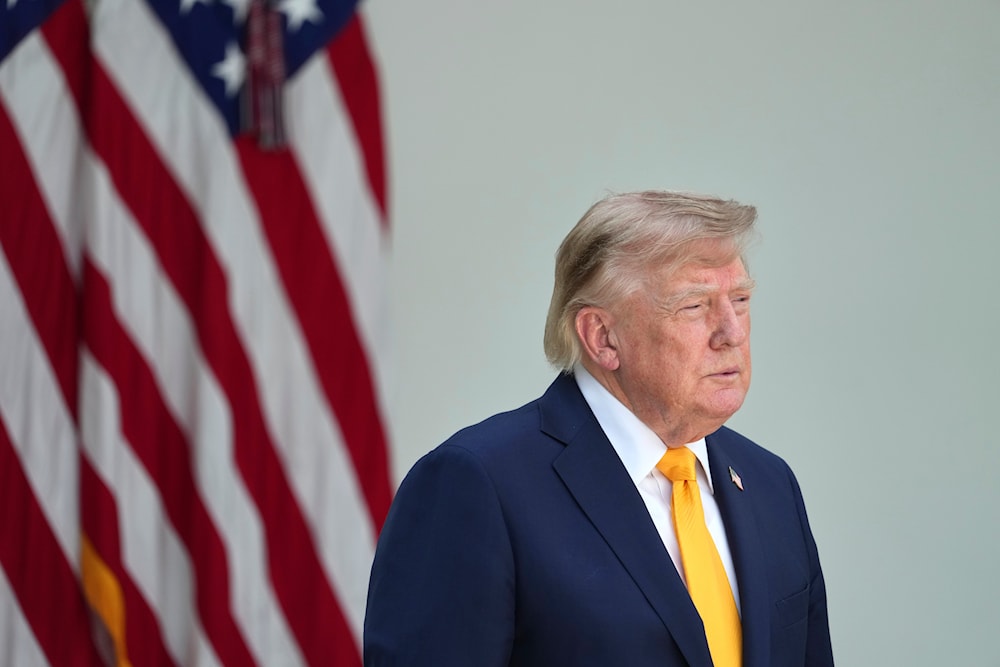
President Donald Trump listens during a back-to-school event in the Rose Garden of the White House on August 24, 2026, in Washington (AP)
The US Supreme Court on Monday lifted one court order blocking US President Donald Trump's administration from implementing an executive order restricting the use of mail-in ballots ahead of the November midterm elections.
But the fate of Trump's order remains uncertain, as a separate injunction blocking a key part of the plan remains in place.
Republicans are locked in a tight battle to retain control of Congress in the midterms. Restricting mail-in ballots would disproportionately benefit Republicans, since Democratic voters have traditionally been more likely to use mail-in ballots.
Justices say 'not yet' to states' challenge
Monday's ruling from the Supreme Court's 6-3 conservative majority applied to a June injunction from Boston-based US District Judge Indira Talwani.
A coalition of 23 mostly Democratic-governed states and the District of Columbia had sued to stop the executive order over mail-in ballots. The Supreme Court on Monday said it was too soon for the states to challenge the order but left the door open for them to sue again as the midterm contest approaches.
In Monday's decision, the conservative majority agreed with the Justice Department that the lawsuit challenging Trump's directive was premature and that the states lacked the required legal standing at this stage to sue.
"The agencies have not yet taken concrete actions that impact the states and so any harm they allege is speculative," the court said.
Inside the President's election directive
Trump's executive order, issued in March, directed the Department of Homeland Security to compile and transmit to the states a list of US citizens eligible to vote in each state and the Justice Department to prioritize investigating and prosecuting state and local election officials who issue ballots to people deemed "not eligible" to vote in federal elections.
It also required the US Postal Service to deliver ballots only to voters on each state's approved mail-in ballot list.
Trump has vowed to end the use of mail-in ballots nationwide before the midterms, and has long cast doubt on the security of such ballots, although evidence of voter fraud is rare.
A second injunction still stands
The court on Monday did not act on another injunction from Talwani that blocked the USPS nationwide from enforcing the directive's tighter rules for voting by mail. The judge issued that order on August 11 in a separate lawsuit filed by voting-rights groups.
Trump's executive order is part of his wider efforts to make fundamental changes in US elections. Trump, who has made false claims of widespread fraud in US elections, including his 2020 loss to former Democratic President Joe Biden, has pressed the Republican-controlled Congress to pass a contentious package of voting restrictions called the SAVE America Act.
In June, Talwani ruled that the president lacked the authority to order changes in how states administer federal elections, noting that under the US Constitution, states have the role of determining voter-eligibility requirements. The judge also noted that federal agencies lack the ability to compile accurate citizen lists for each state.
Postal service pushes forward despite legal cloud
Despite Talwani's action, USPS on Friday released a finalized rule to implement Trump's order, which would require states to provide it with lists of voters who received mailed ballots, as well as unique barcodes on outbound and return ballot mail envelopes.
In Monday's decision, the conservative majority agreed with the Justice Department that the lawsuit challenging Trump's directive was premature and that the states lacked the required legal standing at this stage to sue.
Trump's order itself "does not harm the states," the court added.


