
Trump outlines his three strategies for 'dealing with Iran'
 2 Min Read
US President Donald Trump outlines three strategies for dealing with Iran, including escalation and economic pressure, as efforts toward a deal are scaled back.
-
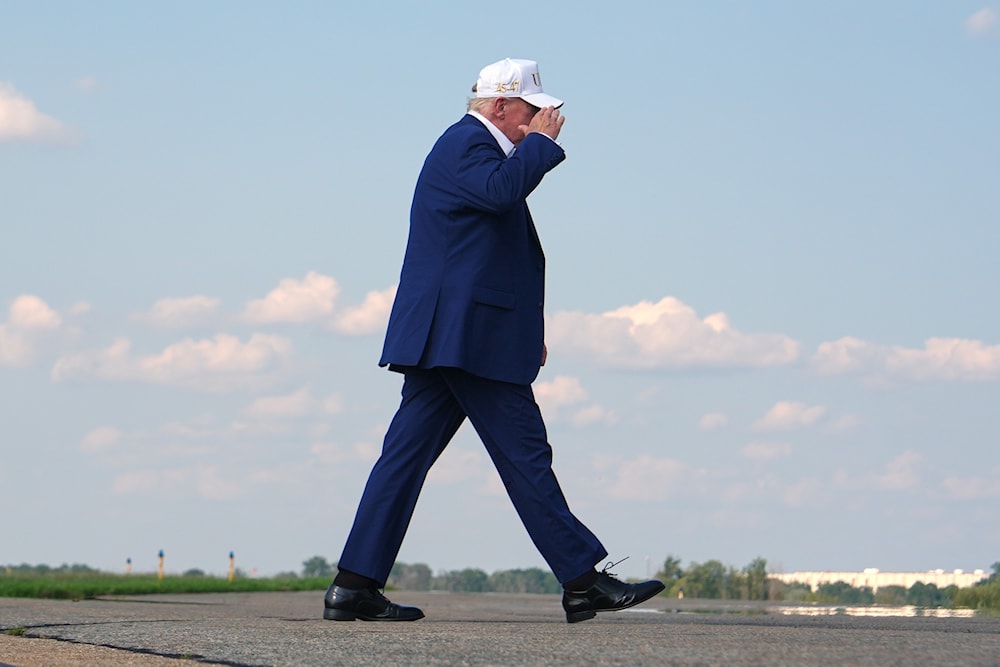
President Donald Trump walks to board Air Force One at Morristown Airport, Sunday, Aug. 9, 2026, in Morristown, N.J. (AP)
US President Donald Trump said on Tuesday that the United States has three strategies for dealing with Iran, including escalation and economic pressure.
In an interview with US television and radio host Wayne Allyn Root, Trump detailed the options available to his administration. "We have three strategies. Do what I'm doing now ... hit them really really hard ... Or beat them economically, but we're doing that anyway," Trump said.
The US president's remarks follow his admission on Sunday that his administration had scaled back efforts to agree a deal with Iran. Trump said at that time that the process was being "low-keying" in the hope that economic pressure would take its toll.
Analysts question viability of Trump's Iran strategy
Analysts have raised doubts about the effectiveness of the president's approach. Richard Nephew, a senior research scholar at Columbia University who helped direct Iran sanctions strategy under the Obama administration, told the Associated Press that sanctions cannot produce results as quickly as the impact of a largely shuttered strait.
Nephew also argued that the value of sanctions is limited because Trump has not articulated clear strategic goals.
"Economic pressure is a possible element in his strategy, but he's yet to explain the purpose," Nephew said. "Trump has systematically weakened his own hand through his inadequate use of force, inarticulate elucidation of an objective, and vacillation on negotiations."
Meanwhile, Juan Zarate, a deputy national security advisor in the George W. Bush administration, said sanctions and the ongoing US naval blockade give the US economic and financial leverage, though he acknowledged that such measures take time.
"The ultimate question will be how far the United States is willing to go to constrict Iran's oil trade and threaten third countries with severe sanctions, and whether it has the patience to test whether the economic pain will change the regime's behavior," Zarate told the AP.


