
Iran's Hormuz leverage pushes oil higher, dents stocks as talks stall
 6 Min Read
Oil prices climb as stalled US-Iran negotiations and uncertainty over the Strait of Hormuz underscore Tehran’s continued leverage over global energy markets.
-
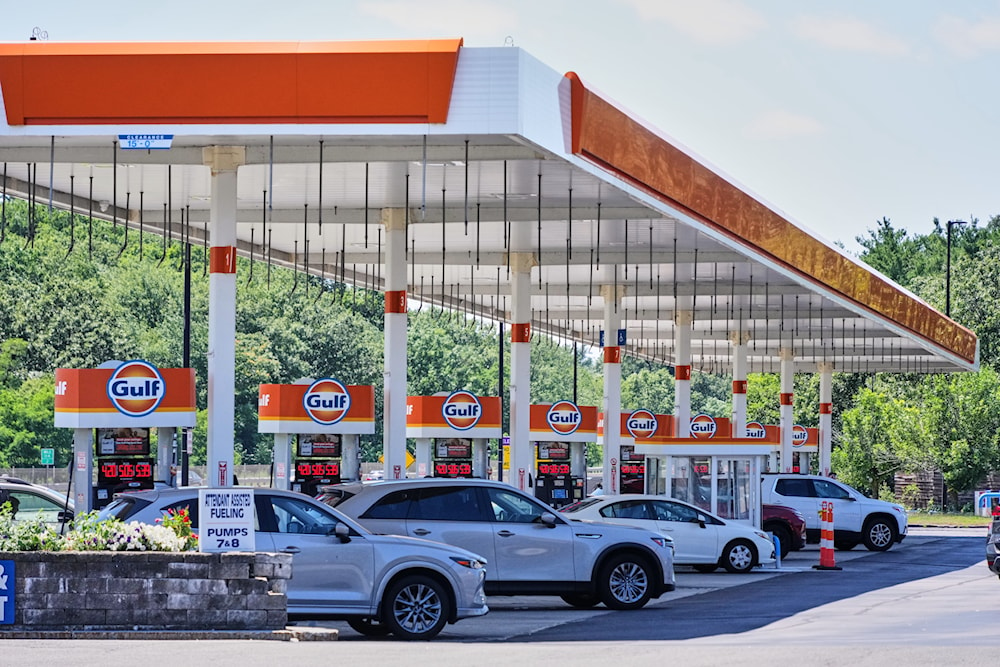
Cars line up at the pumps of a Gulf Oil station on the Massachusetts Turnpike near Boston Sunday, July 19, 2026 (AP)
Oil prices climbed on Tuesday as uncertainty surrounding the reopening of the Strait of Hormuz persisted amid stalled US-Iran negotiations, Reuters reported, citing market data.
Brent crude rose 5% in two days to around $88 a barrel, its highest level since July 31. Prices are now nearly 25% above the near-four-month lows recorded in early July.
The rise came as Iran maintained its conditions for fully reopening the strategic waterway while US President Donald Trump responded with additional demands of his own, reinforcing Tehran’s leverage over a route critical to global energy supplies and increasing economic pressure on Washington.
Trump demands compensation for war of his own making
Trump on Monday demanded that Iran compensate people he claimed had been killed or injured as a result of Iranian actions in wars, attacks, and protests, countering Tehran’s insistence that the United States and "Israel" provide compensation for damage inflicted during the war.
The US demand has added another obstacle to negotiations at a time when Iran has made clear that technical discussions with Oman over ensuring safe commercial navigation do not, by themselves, amount to an agreement to fully reopen the Strait.
Iranian officials have instead tied a broader normalization of traffic to unresolved disputes with Washington, including the US naval blockade, sanctions, violations of the Islamabad memorandum, and compensation for damage caused during the war.
Tehran has also argued that the security crisis surrounding Hormuz stems from US military actions and foreign intervention in the region, rejecting Washington’s attempt to dictate the conditions under which the waterway should operate.
Hormuz gives Tehran economic leverage
The latest reaction in energy markets highlights the pressure Iran is able to exert while the dispute remains unresolved.
Rather than returning to the conditions that existed before the war, Tehran has sought a new framework governing navigation through the Strait, with Iranian officials insisting that regional states should have the central role in securing and managing the waterway.
From Tehran's perspective, the continued sensitivity of oil prices to developments surrounding Hormuz demonstrates the strategic leverage the waterway provides: Washington may maintain sanctions and military pressure on Iran, but prolonged instability at one of the world's most important energy corridors carries substantial economic costs well beyond Iran itself.
"We're now in a bit of a Mexican standoff, if you'd like, in terms of who blinks first," said Tony Sycamore, a market analyst at IG.
"This is going to be almost a war of attrition now," he said. "You probably can see the (oil) market sitting around the $75 to $95 range while we wait to see who blinks first."
Immediate consequences increasingly visible in US
The immediate consequences are increasingly visible in the United States, where another rise in energy prices risks aggravating already persistent inflation and narrowing the Federal Reserve's room to maneuver.
Investors are awaiting Wednesday's US consumer price report for July, which will not yet reflect the latest increase in oil prices but could nevertheless influence expectations ahead of the Federal Reserve's September meeting.
Money markets currently put the probability of another interest-rate hike at roughly 50%.
"We think the risks are skewed towards a hot print, which would probably drive a rebound in rate expectations and, potentially, renewed worries about stagflation," said Jonas Goltermann, chief markets economist at Capital Economics.
The combination of higher commodity prices and inflation concerns pushed US Treasury yields higher in European trading. The two-year yield rose one basis point to 4.253%, while the 10-year benchmark climbed two basis points to 4.72%.
"After last week when it felt like the doves were in the ascendant again, the latest news has pushed things in a more hawkish direction, with yields and commodity prices both moving higher," Deutsche Bank strategist Jim Reid said.
Higher energy costs ripple through global markets
The uncertainty extended beyond energy and bond markets.
Europe's STOXX 600 was little changed in early trading, remaining close to last week's record highs, while MSCI's global equity index slipped 0.1%. Nasdaq futures gained 0.1%, while S&P 500 futures were flat following losses in both major US benchmarks on Monday.
Investors were simultaneously assessing another source of financial-market risk after Nvidia announced that it was working with six major financial institutions, including BlackRock, Apollo, and Goldman Sachs, on financing arrangements worth more than $500 billion for artificial intelligence infrastructure.
The company provided few details regarding financial terms, binding investment commitments or how the proposed financing would interact with existing arrangements.
"A small part of me was left wondering whether this is how it felt when sub-prime mortgages first became a mainstream product - the innovation that eventually helped trigger the GFC," Sycamore added.
Nvidia's debt also came under renewed selling pressure, with its 2% bond maturing in 2032 yielding 4.887%, nearly seven basis points higher than on Monday.
Intel, meanwhile, raised $20 billion through a share sale, its first stock offering since the chipmaker's 1971 listing. Its shares rose around 1% in European trading.
Currency markets hit too
Pressure was also visible in currency markets, where the Japanese yen weakened beyond 159 against the dollar after strengthening to 155.20 last week following several suspected rounds of intervention, including a joint operation by Japan and the United States.
A Japanese holiday reduced market liquidity, potentially magnifying currency movements and renewing speculation over further intervention.
The Australian dollar slipped 0.07% to $0.7049 after the Reserve Bank of Australia left its cash rate unchanged at 4.35% for a second consecutive meeting but indicated that another increase remained possible if inflation required it.
Gold fell 0.6% to $4,365 an ounce after gaining around 8% so far this month.
Read more: Central banks increase gold purchases for third straight month


