
US-Japan yen intervention signals strain on dollar reserve system: FT
 5 Min Read
The US-Japan intervention to support the yen has exposed Washington’s growing concern over large-scale Treasury sales, raising questions about the dollar’s long-term appeal as the dominant global reserve currency.
-
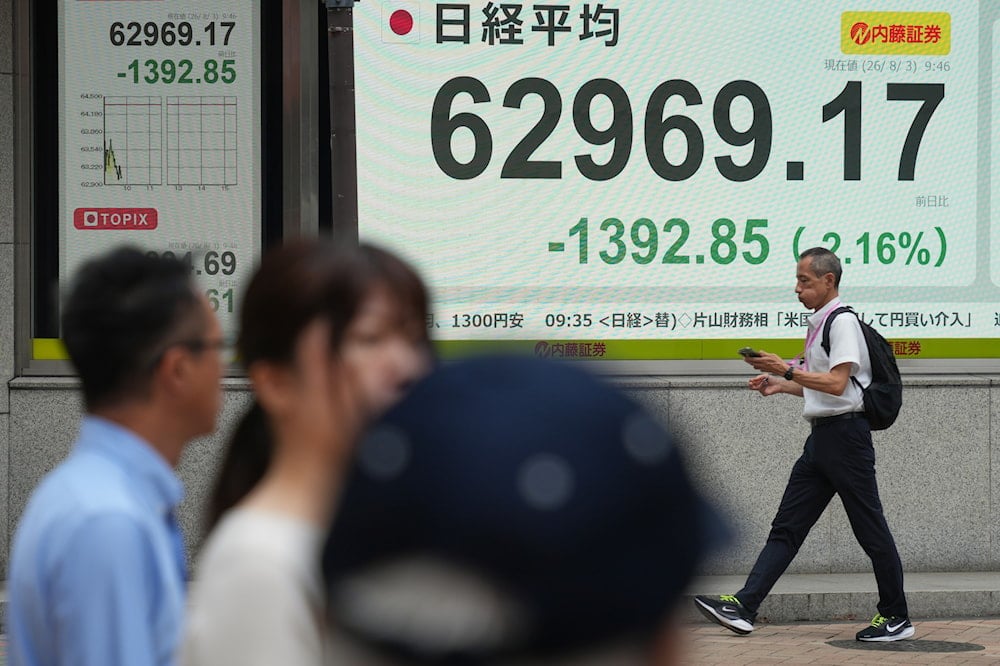
A person walks past an electronic board showing the U.S. dollar and Japanese yen exchange rate at a securities firm in Tokyo on Monday, Aug. 3, 2026 (AP)
A coordinated effort by the United States and Japan to support the yen has raised broader questions about the strength of the dollar-centered global reserve system, according to The Financial Times (FT) analysis.
The intervention, carried out last week by the US Treasury and Japan’s Finance Ministry, marked the first joint operation between the two countries in more than 15 years.
Japanese authorities are estimated to have spent around ¥14 trillion, or $88 billion, over two days in an attempt to strengthen the yen. The intervention may provide temporary support to the Japanese currency, but its impact is unlikely to last unless the underlying economic conditions change, the report argued.
Foreign exchange intervention allows the Bank of Japan, under the direction of the Finance Ministry, to purchase yen and related securities in an effort to lift the currency. However, investors can offset those purchases by selling yen-denominated assets if they remain unconvinced that Japan’s economic fundamentals have improved.
A more durable strengthening of the yen would likely require tighter monetary policy.
Japan’s inflation could exceed the Bank of Japan’s 2% target, which has led some investors to argue that interest rates should rise more quickly. The central bank has nevertheless maintained its benchmark rate at 1%, citing concerns over weak consumer demand.
While currency intervention can sometimes signal that policymakers are prepared to take stronger action later, the FT analysis questioned whether Bank of Japan Governor Kazuo Ueda has demonstrated sufficient concern over the yen to indicate a major shift in monetary policy.
US avoids selling dollars during intervention
The more significant development, according to the report, was the manner in which Washington participated in the operation. Rather than selling dollars to purchase yen, the US Treasury used euros.
The move came as the long end of the US Treasury market was already facing pressure following Federal Reserve Chair Kevin Warsh’s poorly received press conference last week.
The analysis suggested that Washington was reluctant to sell dollar-denominated securities because doing so could have added further pressure to the US Treasury market.
Part of the decision to use euros reflected the assets available in the US currency stabilization fund. At the same time, it reduced the need to sell additional Treasury securities and increase the supply of US debt entering the market.
Japan also announced plans to use the Federal Reserve’s Foreign and International Monetary Authorities Repo Facility, known as FIMA. The facility allows foreign monetary authorities to obtain temporary dollar liquidity against their holdings of US Treasury securities rather than selling those assets outright.
According to the FT, the use of both mechanisms points to growing sensitivity in Washington over large-scale sales of US Treasuries.
Dollar reserve appeal comes under question
The report argued that the developments carry broader implications for the dollar’s position as the dominant global reserve currency.
Central banks have traditionally accumulated dollar reserves in large part because US Treasury markets are considered highly liquid, allowing governments to buy and sell securities quickly when they need to intervene in foreign exchange markets or access liquidity. However, the latest intervention indicates that Washington may now be concerned about the consequences of foreign central banks selling substantial quantities of those holdings.
The US Treasury’s decision to use euros reduced the amount of dollar assets that had to be sold during the effort to support the yen, while Japan’s planned reliance on FIMA similarly limited the need for outright Treasury sales.
The FT analysis described those steps as evidence that the advantages traditionally associated with dollar reserves may be weakening. The intervention was also presented as an example of cooperation between two allied governments.
US Treasury Secretary Scott Bessent emphasized the close relationship between Washington and Tokyo when explaining the coordinated action. The report argued, however, that Washington could respond differently if a government with which it has more strained relations attempted a similar intervention involving large-scale sales of dollar reserves.
In such a case, the analysis suggested that US President Donald Trump could resort to economic pressure, including tariffs, in an effort to discourage the move.
The article concluded that growing US concern over foreign governments using their dollar holdings could encourage central banks to accelerate efforts to diversify their reserves into other assets and currencies. "The bottom line is that Washington, fearing the consequences for US financial markets, is reluctant to see foreign central banks use their dollar reserves", the author wrote.
"This is telling us that the dollar is not the attractive reserve currency it once was. When this message sinks in, other countries will redouble their search for more attractive, readily usable alternatives. Reserve diversification is apt to gather steam".
Read more: Japan, South Korea prop up yen, won amid US coordination


