
Gold overtakes US Treasuries as top reserve asset, ECB says
 4 Min Read
ECB data confirm a historic crossover driven by sanctions fallout, record prices, and a quiet sovereign exodus from dollar debt.
-
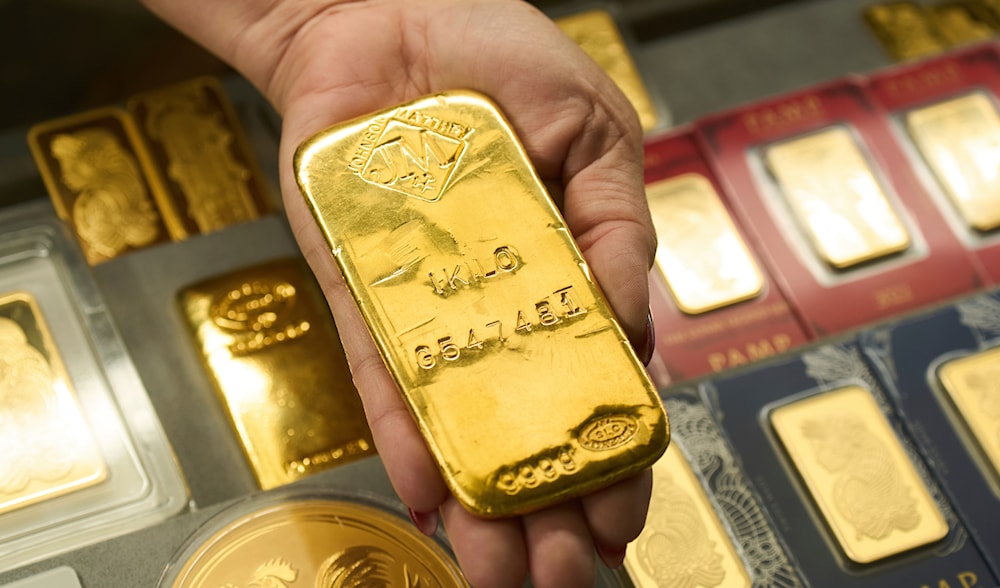
Sam Nguyen shows a gold bar at her shop in the St. Vincent Jewelry Center in the Jewelry District of Los Angeles, Wednesday, April 30, 2025 (AP)
For the first time in roughly three decades, gold has surpassed US government bonds as the single largest reserve asset held by central banks worldwide.
According to a report published Tuesday by the European Central Bank, gold now accounts for 27 percent of all global central bank reserves, up from 20 percent a year earlier, while the share held in US Treasuries has slipped to 22 percent from 25 percent over the same period.
The dollar, however, remains the world's dominant reserve currency. When all dollar-denominated assets are counted together - Treasuries, corporate bonds, agency securities, and cash - they still represent 42 percent of global reserves. What has changed is the internal hierarchy within that landscape, and the reasons behind the shift matter as much as the numbers themselves.
Why central banks are turning to gold
The acceleration traces back to a single decision. When Washington froze roughly 300 billion dollars in Russian foreign exchange reserves following the onset of the Russia-Ukraine war in 2022, it sent an unambiguous message to governments around the world that assets held in dollars abroad are not beyond reach.
Since that moment, central banks have bought gold at historically elevated rates, exceeding a thousand tonnes per year for three consecutive years before slowing slightly to 850 tonnes in 2025. Gold stored domestically carries no counterparty risk and cannot be frozen through international payment systems.
Price appreciation has also done significant work. Gold has nearly doubled in value over the past two years, hitting more than 5,500 dollars per troy ounce in January, meaning that a large portion of gold's rising reserve share reflects valuation gains rather than new purchases alone.
A geopolitical fault line in the Treasury market
Foreign holdings of US Treasuries tell a similarly divided story, whereby Western allies remain the anchors of demand.
Japan holds 1.2 trillion dollars in US government debt, the United Kingdom holds around 900 billion, and European Union member states collectively account for roughly a quarter of all foreign Treasury holdings.
China, by contrast, has reduced its exposure from a peak of around 1.3 trillion dollars to approximately 650 billion as of March 2026, the lowest level since 2008. Other BRICS members have followed a similar trajectory.
The outbreak of the US-Israeli war on Iran in early 2026 accelerated the retreat further, as Asian central banks sold dollar-denominated assets to defend their currencies against surging energy prices.
Even Tether, the private stablecoin company, purchased more gold in 2025 than most sovereign central banks, a detail that underscores how reserve dynamics are no longer an exclusively government affair.
Turkey's case
Ankara spent years building up gold reserves as a strategic hedge, accumulating steadily through 2022, 2023, and 2024. Then the war on Iran triggered an energy price shock that sent the Turkish lira into freefall.
Within weeks of the war's outbreak, Turkey had sold or swapped roughly 130 tonnes of gold and liquidated nearly all of its US Treasury holdings, cutting them from 16 billion to under 2 billion dollars in a single month.
By mid-April, with pressure on the lira easing following a ceasefire, the central bank had already begun rebuilding its gold reserves. Turkey did not abandon its gold strategy, but under severe economic stress, it used gold as emergency liquidity, which is, in some ways, exactly what a reserve asset is supposed to do.
According to World Gold Council data, 76 percent of central banks expect to increase their gold holdings over the next five years, while 73 percent expect to reduce their dollar reserves. The dollar will not be displaced any time soon, and nothing in the ECB report suggests otherwise.
What the data do show is that the architecture of unquestioned dollar dominance, built over decades and accelerated after World War Two, is being quietly and deliberately renegotiated, one tonne at a time.


