
Trump's DOJ interference threatens cases, Blanche confirmation
 4 Min Read
The US president’s direct interference in Justice Department cases has weakened prosecutions, raised allegations of political retaliation, and complicated Todd Blanche’s confirmation as attorney general.
-
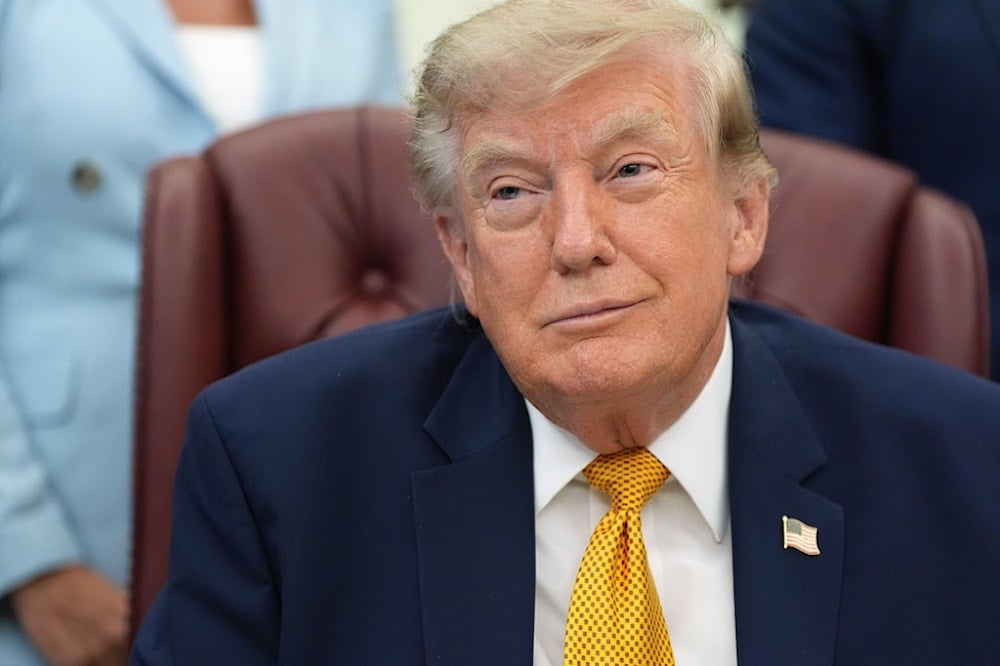
US President Donald Trump listens during a meeting about military families, in the Oval Office of the White House, Monday, Aug. 3, 2026, in Washington (AP)
US President Donald Trump’s repeated intervention in Justice Department affairs has created fresh legal and political complications, weakening criminal prosecutions and threatening the confirmation of his preferred attorney general, The New York Times reported.
Several developments over the past week illustrated how the president’s attempts to influence federal law enforcement have disrupted cases involving political adversaries and individuals accused of damaging government property.
Norman L. Eisen, a lawyer involved in some of the proceedings and a former Obama administration official, warned that presidential involvement can undermine the department’s work.
“When presidents meddle in the department,” Mr. Eisen said, “it tends to disrupt its normal functioning.”
Comey lawyers allege political retaliation
Lawyers representing former FBI Director James B. Comey disclosed on Wednesday that Secret Service agents were instructed to rapidly provide Trump with a summary of an interview conducted with their client.
Comey had been questioned over an image he posted showing seashells arranged on a beach to form the numbers “86 47.”
According to the court filing, the interview became “a hot topic on the plane,” while Trump was described as “very interested” in the information gathered by the agents.
The president reportedly wanted to refer to the interview notes during an upcoming media appearance, despite the material containing potentially sensitive and unverified investigative information.
Comey’s legal team cited the episode as evidence that the charges against him, which accuse him of threatening the president, were driven by political retaliation rather than legitimate law-enforcement considerations.
A court finding that the prosecution was vindictive could result in the indictment being dismissed.
Reflecting Pool prosecution collapses
Trump’s involvement also came under scrutiny after prosecutors abandoned a case against former Olympic canoeist David Hearn.
Hearn had been accused of vandalizing the Lincoln Memorial Reflecting Pool, a site associated with one of Trump’s favored renovation projects.
When Washington US Attorney Jeanine Pirro announced the indictment, she openly linked the prosecution to the president’s priorities.
“This is not only a priority for the president,” she told reporters, “but for myself.”
The case unraveled on Friday after Pirro acknowledged that newly obtained information from the Interior Department showed that faulty construction, rather than Hearn’s actions, had damaged the pool’s lining.
Trump rejected that conclusion in a social media post the following morning.
“I don’t know what she was thinking?” Mr. Trump wrote.
His continued insistence that vandalism had occurred could strengthen arguments from Hearn’s lawyers that the prosecution was pursued in bad faith or lacked a reasonable legal basis.
A successful challenge could allow Hearn to recover the legal expenses incurred while defending himself.
The failed prosecution adds to Pirro’s previous unsuccessful efforts to pursue figures targeted by Trump, including six Democratic lawmakers whom the president accused of sedition after they reminded military personnel that they were required to reject illegal orders.
Blanche nomination faces renewed uncertainty
The president’s interventions have also complicated efforts to confirm Todd Blanche, Trump’s former personal lawyer, as attorney general.
Blanche had reportedly made progress in addressing concerns raised by Republican Senators John Cornyn and Thom Tillis over a proposed $1.8 billion compensation fund and personal tax protections connected to Trump’s agreement to abandon a lawsuit against the Internal Revenue Service.
The fund could potentially be used to compensate participants in the January 6, 2021, Capitol riots.
Blanche had indicated that the proposal was no longer moving forward. Trump, however, issued contradictory statements, first appearing to retreat from a threat to withdraw Blanche’s nomination and later suggesting that the fund could still be revived if the Senate failed to confirm him.
Tillis said the president’s shifting position had endangered the nomination.
“It’s unfortunate that Todd Blanche, who I consider qualified for the job, will not be confirmed because of this reversal,” Tillis wrote on social media. “Hopefully, we can resolve this by Tuesday.”
Late Sunday, Blanche published a signed Justice Department memorandum formally rescinding the order that established the compensation fund. He also released an unsigned statement clarifying the disputed tax protections.
Blanche said the documents resulted from “good faith discussions” with senators.
Trump had not publicly endorsed the arrangement as of Monday morning, leaving Blanche’s confirmation uncertain as the Senate approached its summer recess.
Read more: Trump's own words may undermine case against Comey, experts say


