
Trump's Iran deal leaves Netanyahu balancing Washington and allies
 4 Min Read
Israeli Prime Minister Benjamin Netanyahu faces mounting pressure as Donald Trump's reported agreement with Iran exposes tensions between Washington and Tel Aviv over Lebanon and regional policy.
-
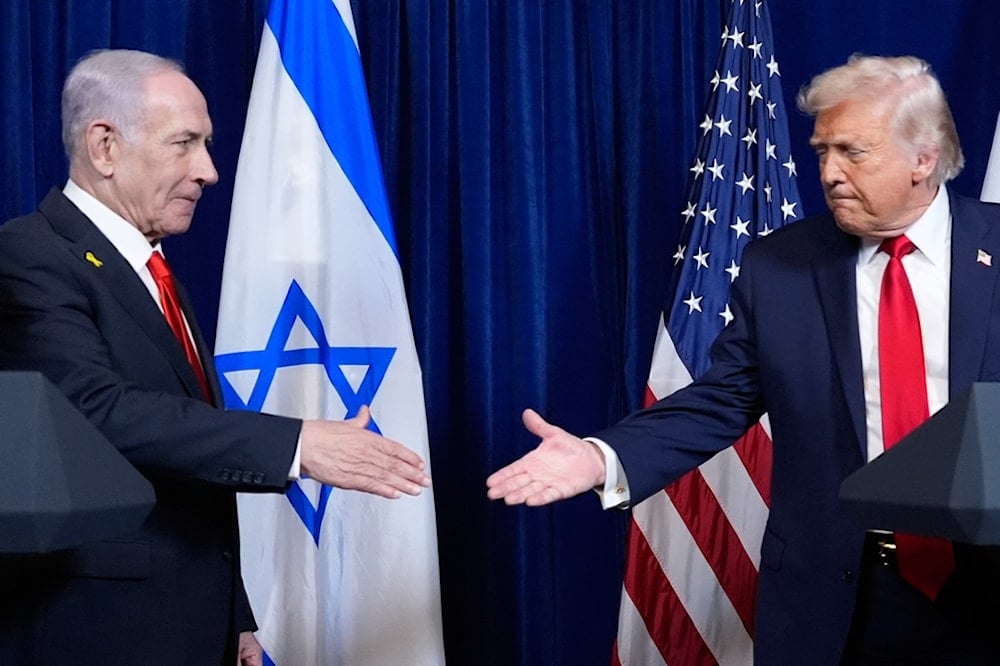
US President Donald Trump shakes hands with "Israel's" Prime Minister Benjamin Netanyahu at the end of a news conference at Mar-a-Lago, Dec. 29, 2025, in Palm Beach, Florida. (AP Photo/Alex Brandon)
Israeli Prime Minister Benjamin Netanyahu has so far remained publicly silent on the reported US-Iran memorandum of understanding, despite growing criticism from members of his political camp who have described the agreement as harmful to Israeli interests.
Since the announcement of the reported deal, Netanyahu's only public message directed at US President Donald Trump was a social media post marking the US leader's 80th birthday, avoiding any reference to the emerging agreement or its potential implications for the region.
The silence comes as political and military figures in "Israel" debate the consequences of the reported understanding between Washington and Tehran, particularly regarding Lebanon and future regional security arrangements.
Growing divergence between Washington and Tel Aviv
The reported agreement has highlighted what analysts describe as widening differences between the Trump administration and "Israel" over the future of regional wars.
Trump has repeatedly signaled his desire to move beyond military escalation with Iran and pursue a broader de-escalation framework. His statements have also suggested support for ending hostilities on other fronts, including Lebanon.
Following "Israel's" aggression on South Lebanon and the Southern Suburb of Beirut and Hezbollah's retaliatory strikes, Trump downplayed Hezbollah's operations, describing them as limited in scope and urging restraint rather than escalation.
His comments contrasted sharply with calls from several figures within Netanyahu's governing coalition, who demanded a stronger military response.
The episode underscored the increasingly delicate position facing the Israeli prime minister, who must navigate between maintaining close coordination with Washington and responding to pressure from political allies advocating a more confrontational approach.
Read more: Pro-Netanyahu media lash out at Trump over reported Iran deal
Lebanon emerges as a central fault line
Questions continue to surround the role of Lebanon in the reported US-Iran understanding.
Iranian and regional officials have suggested that the framework include provisions related to ending hostilities across multiple fronts, including Lebanon.
Israeli officials have publicly insisted that military deployments will continue regardless of diplomatic developments.
On Monday, Israeli War Minister Israel Katz declared that Israeli forces would remain in occupied positions in southern Lebanon indefinitely, reinforcing Tel Aviv's position that its military posture will not be determined by agreements to which it is not a party.
Netanyahu caught between Trump and his base
The reported agreement places Netanyahu in a politically sensitive position.
Openly endorsing a framework that many of his allies view with skepticism could deepen criticism from within his governing coalition. At the same time, publicly challenging an initiative championed by Trump risks creating friction with "Israel's" most important international backer.
Several commentators aligned with Netanyahu's political camp have already criticized the agreement, while ministers and coalition figures have voiced concerns that emerging regional arrangements may not adequately address Israeli security demands.
For Netanyahu, remaining silent may offer temporary political flexibility, but it also reflects the difficult balancing act facing his government as Washington pursues a diplomatic track that appears increasingly at odds with the preferences of significant segments of "Israel's" political establishment.
Uncertain path ahead
The future trajectory of the reported agreement remains unclear, particularly regarding implementation and its implications for regional flashpoints.
While Washington appears focused on consolidating a broader de-escalation process, Israeli officials continue to signal their intention to continue their aggressive military pressure across multiple fronts, including Lebanon.
This divergence raises questions about whether the emerging diplomatic framework can be sustained without generating further tensions between the United States and "Israel".
For now, Netanyahu's public silence reflects a broader uncertainty surrounding the agreement and the political challenges it presents for a government attempting to balance domestic demands with shifting regional realities.
Read more: Trump says he saved 'Israel' from nuclear obliteration


