
Trump threatens 100% Canada tariffs over China, calls Carney governor
 4 Min Read
US President Donald Trump warned that Canada would face 100% tariffs on all exports to the United States if it deepens trade cooperation with China, intensifying already strained bilateral relations while the USMCA remains formally intact.
-
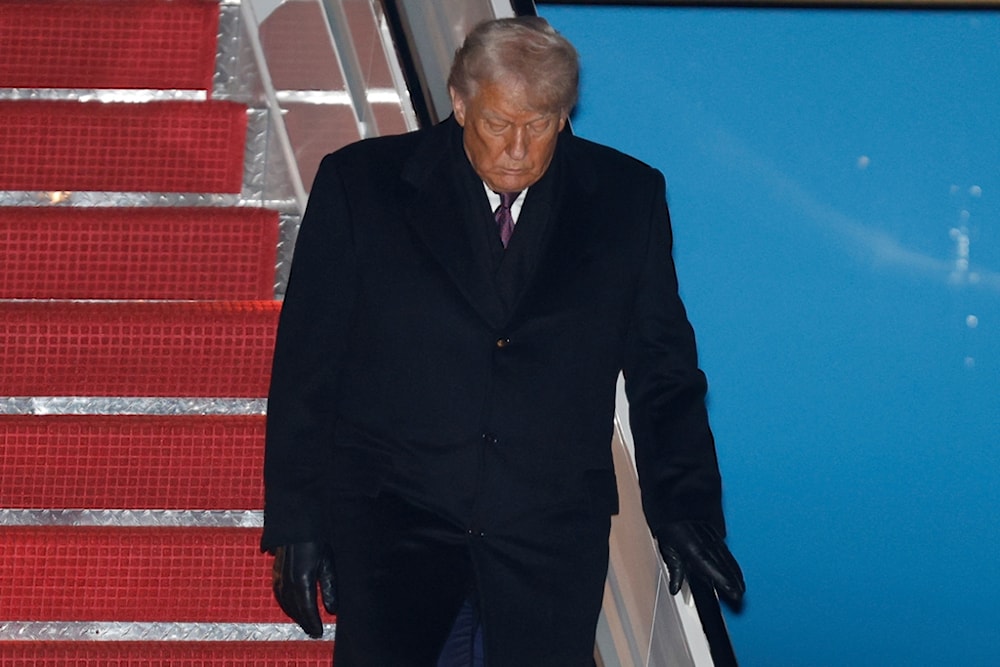
President Donald Trump walks down the stairs of Air Force One upon his arrival at Joint Base Andrews, Md., Thursday, Jan. 22, 2026, after returning from the World Economic Forum in Davos.(AP Photo/Luis M. Alvarez)
In a post on his Truth Social platform on Saturday, US President Donald Trump warned that Canada would face sweeping trade penalties if it moves to deepen economic ties with China, threatening a blanket tariff on all Canadian exports entering the United States.
"If Canada makes a deal with China, it will immediately be hit with a 100% Tariff against all Canadian goods and products coming into the U.S.A.," Trump wrote.
Interestingly, Trump deliberately referred to Mark Carney as “Governor Carney,” a loaded slight that frames Canada as a subordinate rather than a sovereign partner.
-
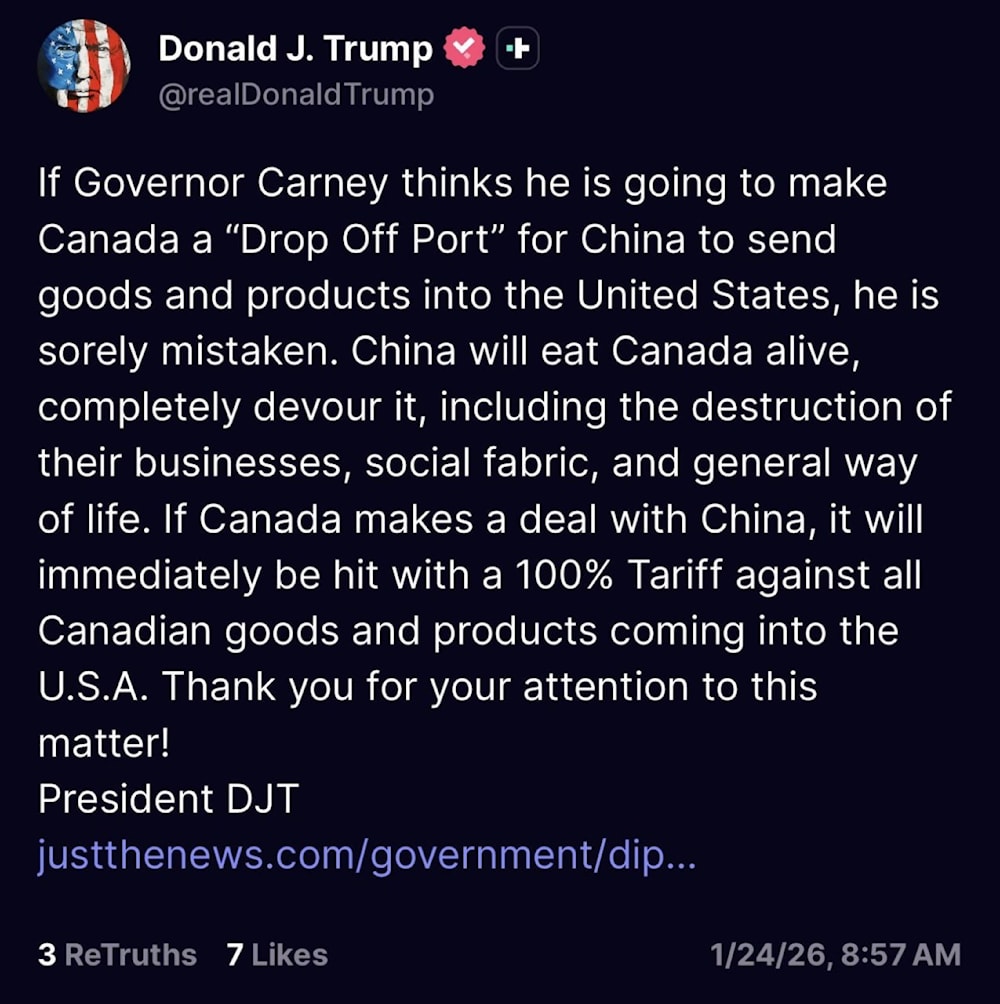
Donald Trump's post on his platform Truth Social
The warning comes amid a broader deterioration in US-Canada relations in recent months, marked by sharper rhetoric and renewed trade friction. Trump has repeatedly taken a confrontational tone toward Canada’s leadership and has on several occasions referred to former prime minister Justin Trudeau and current prime minister Mark Carney as “governor,” a remark widely seen as mocking Canada’s sovereignty and inflaming diplomatic tensions.
Trump’s comments reflect a long-standing approach in which tariffs are deployed as a geopolitical tool rather than a narrowly economic measure. Throughout his political career, he has framed access to the US market as conditional on political and strategic alignment with Washington, particularly with respect to China. By singling out Canada, one of the United States’ closest allies and largest trading partners, the warning appears intended not only for Ottawa but also as a signal to other US partners against pursuing independent trade or investment arrangements with Beijing.
Strategic Diversification
Canada’s renewed engagement with China follows its own recent trade dispute with Beijing, which included Canadian tariffs on Chinese electric vehicles and subsequent Chinese retaliation targeting Canadian agricultural exports such as canola and seafood. Ottawa has since sought to de-escalate tensions, restore market access for key export sectors, and diversify its trade relationships as a hedge against growing uncertainty in US trade policy.
Canadian officials have framed this outreach as a matter of economic diversification and defensive planning rather than a political realignment, citing repeated tariff threats and the increasing politicization of trade under Trump’s presidency. Analysts say the strategy reflects an effort to reduce Canada’s heavy reliance on the US market while preserving room for maneuver in a more coercive global trade environment.
USMCA Under Strain
While tensions have escalated, the United States–Mexico–Canada Agreement (USMCA) remains formally in place. However, the agreement is due for review, and ongoing tariff disputes, retaliatory measures, and political posturing have raised questions about how smoothly that process will unfold. Observers say Trump’s rhetoric adds further uncertainty to an already strained trade relationship rather than signaling an immediate legal withdrawal from the pact.
Trump has repeatedly argued that China-linked trade agreements undermine US economic and national security interests, claiming they allow Beijing to gain leverage over supply chains, technology flows, and strategic industries. In this framing, closer cooperation with China by US allies is portrayed as indirectly harming American workers and weakening Washington’s global position.
Canada’s economy is deeply integrated with that of the United States through cross-border supply chains in manufacturing, energy, and agriculture. Any move toward punitive tariffs on Canadian goods would risk significant disruption across North American trade, raising the prospect of renewed economic confrontation should Ottawa pursue deeper commercial engagement with Beijing.
Read more: Canada's Carney anticipates 'historic gains' with China


