
Trump to double down on immigration despite approval rating drop
 4 Min Read
The Trump administration plans aggressive immigration enforcement expansion in 2026 with $170 billion in funding, targeting workplaces despite growing political backlash.
-

A man holds his immigration paperwork while handcuffed after being detained by Immigration and Customs Enforcement agents outside an immigration courtroom, on June 17, 2025, at the Jacob K Javits federal building in New York. (AP Photo/Olga Fedorova)
US President Donald Trump is advancing plans for a significantly expanded immigration enforcement operation in 2026, backed by substantial new funding, even as political opposition mounts ahead of the midterm elections.
Immigration and Customs Enforcement (ICE) and Border Patrol secured $170 billion in supplementary funding through September 2029 following the Republican-controlled Congress's approval of a comprehensive spending package in July. This massive injection dwarfs their combined annual budget of approximately $19 billion, enabling ambitious expansion across multiple fronts.
Administration officials have outlined plans to recruit thousands of additional enforcement agents, establish new detention facilities, increase pickups from local jails, and contract with private entities to locate individuals lacking legal status. The expansion represents a fundamental shift in enforcement strategy compared to earlier operations this year.
From neighborhoods to workplaces
While federal agents have already deployed to major urban centers, conducting neighborhood sweeps that sparked confrontations with residents, workplace raids have remained relatively limited. Though ICE executed several high-profile business operations, agents largely steered clear of farms, factories, and other economically vital sectors known to employ undocumented workers.
This approach appears set to change. Border czar Tom Homan confirmed to Reuters that workplace enforcement will "absolutely" expand, predicting arrest numbers will "explode greatly next year" as new officers join the force and detention capacity grows.
The intensified workplace focus could generate substantially more arrests while potentially affecting the broader economy and Republican-aligned business owners. However, experts suggest this shift may finally prompt corporate pushback. Sarah Pierce, director of social policy at Third Way, noted to Reuters that while businesses have been reluctant to challenge the administration's immigration policies over the past year, employer-focused enforcement could change that calculation.
Political headwinds build
Signs of electoral backlash are emerging despite Trump's aggressive stance. Miami, heavily impacted by enforcement operations due to its large immigrant population, elected its first Democratic mayor in nearly three decades. The mayor-elect attributed the victory partly to reactions against presidential policies. Additional local elections and polling data indicate rising voter concerns about aggressive immigration tactics.
Trump's approval rating on immigration policy dropped from 50 percent in March, before major urban crackdowns began, to 41 percent by mid-December. This represents a significant decline from what had been his strongest policy issue.
"People are beginning to see this not as an immigration question anymore as much as it is a violation of rights, a violation of due process, and militarizing neighborhoods extraconstitutionally," explained Mike Madrid, a moderate Republican strategist. "There is no question that is a problem for the president and Republicans," he told Reuters.
Public unease has centered on masked federal agents employing controversial tactics, including tear gas deployment in residential areas and the detention of US citizens.
Expanding the deportation pool
Beyond ramping up enforcement actions, Trump has terminated temporary protected status for hundreds of thousands of Haitian, Venezuelan, and Afghan immigrants, dramatically expanding the population eligible for deportation.
The administration has pledged to remove one million immigrants annually, though current figures suggest this target will be missed. Approximately 622,000 immigrants have been deported since Trump assumed office in January.
Homan defended the administration's record, asserting Trump has delivered on promises of historic deportation operations while eliminating criminal elements and curtailing illegal border crossings.
-
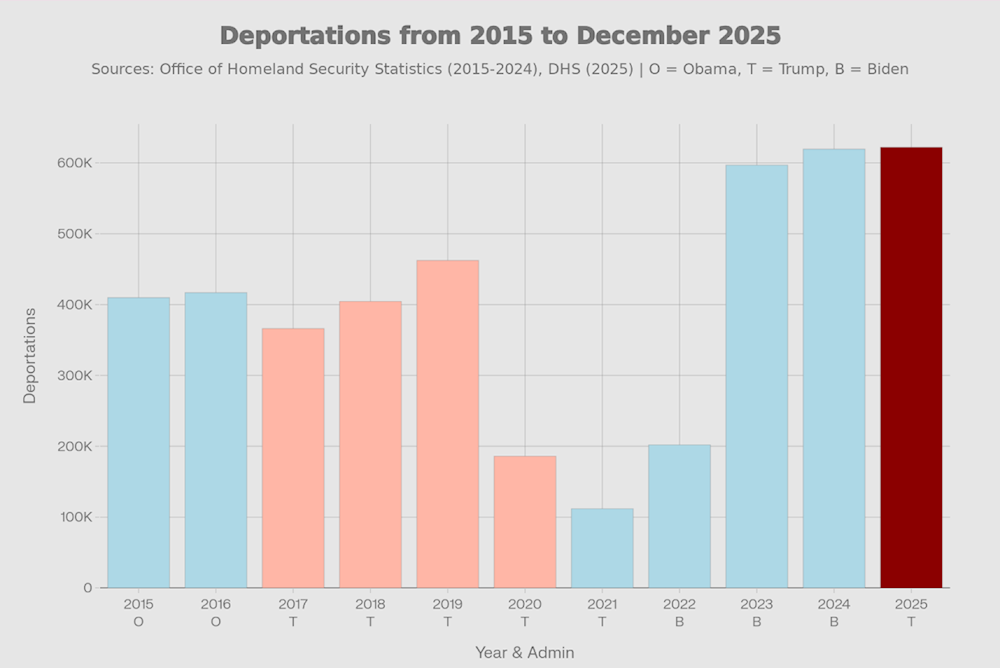
Despite aggressive rhetoric, Trump's 2025 deportations mirror Biden's final two years, indicating systemic rather than policy-driven limitations on removal capacity. (Sources: Office of Homeland Security Statistics, Department of Homeland Security; visualized by Al Mayadeen English)
Shifting enforcement priorities
Government data reveals a significant departure from previous enforcement patterns. By late November, approximately 41 percent of the roughly 54,000 individuals arrested and detained by ICE had no criminal record beyond suspected immigration violations. This contrasts sharply with early January figures, when only 6 percent of detained individuals lacked criminal charges or convictions beyond immigration-related offenses.
The Trump administration has also targeted legal immigrants. Agents have arrested spouses of US citizens during green card interviews, removed certain individuals from naturalization ceremonies moments before citizenship, and revoked thousands of student visas.
The planned workplace enforcement intensification could yield numerous arrests but carries economic risks. Replacing workers detained during raids would likely increase labor costs, potentially undermining Trump's anti-inflation efforts. That said, inflation is expected to be a critical issue in the closely watched November elections that will determine Congressional control.


