
Trump waged war on Iran after Netanyahu's false victory script: NYT
 3 Min Read
New reporting reveals how Trump decided to attack Iran after Netanyahu’s secret pitch, despite internal White House divisions and intelligence pushback.
-
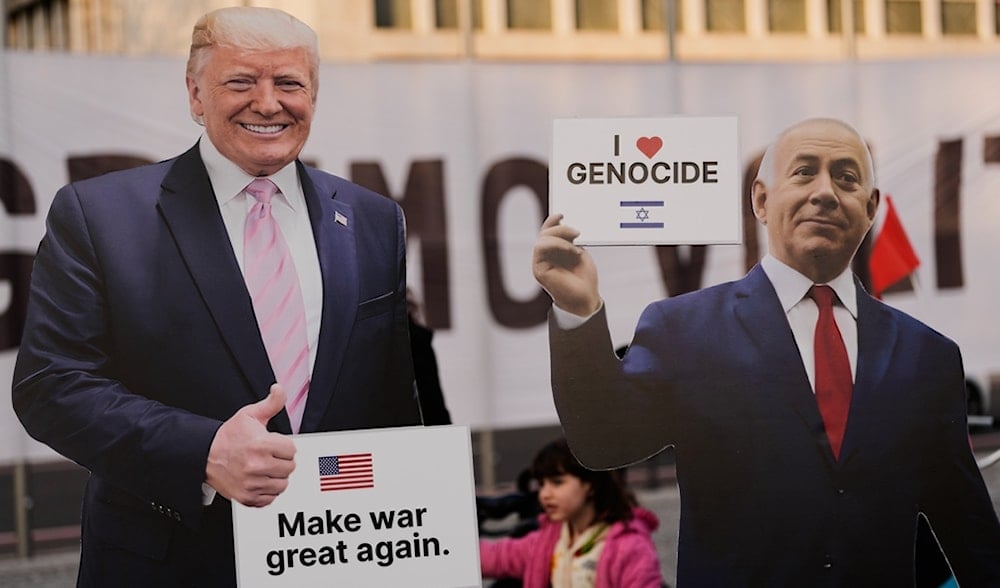
Life size effigies of President Donald Trump, left, and Israeli Prime Minister Benjamin Netanyahu, are set near the Parliament building by left wing protesters in Ljubljana, Slovenia, March 20, 2026 (AP)
A new report by The New York Times reveals how President Donald Trump decided to attack Iran after a private, closed-door presentation by Israeli Prime Minister Benjamin Netanyahu. The February 11 Situation Room meeting included a four-part plan for regime change, featuring a video montage of potential replacement leaders, including Reza Pahlavi. Vice President JD Vance was absent, stuck in Azerbaijan at the time.
Appearing alongside Mossad chief David Barnea and Israeli military officials, Netanyahu claimed that Iran’s ballistic missile program could be destroyed in weeks. He alleged the regime would be too weak to close the Strait of Hormuz, street protests could trigger an uprising with Mossad support, and Kurdish fighters from Iraq could open a ground front in the northwest.
Trump reportedly responded: “Sounds good to me.”
Intelligence, military pushback in vain
The next day, US intelligence officials reportedly pushed back sharply. CIA Director John Ratcliffe called the regime-change scenario “farcical,” while Secretary of State Marco Rubio said, “In other words, it’s bullshit.”
When Trump asked for General Dan Caine's input, he responded: “This is, in my experience, standard operating procedure for the Israelis. They oversell, and their plans are not always well-developed.”
Despite the criticism, Trump dismissed the regime-change plan as “their problem” but remained focused on targeting Iran’s leadership and military.
Admin decides to support war despite risks
By February 26, a final Situation Room meeting revealed clear but fractured opposition. Vice President JD Vance warned the war could spiral and drain US resources but ultimately said, “You know I think this is a bad idea… but I’ll support you.”
Rubio acknowledged regime change was unrealistic but considered destroying Iran’s missile program achievable, while War Secretary Pete Hegseth strongly supported immediate action. Since then, internal reports indicated that Hegseth was feeding Trump false information on the course of the war.
Military leadership outlined the risks, including depleted munitions and the threat to the Strait of Hormuz, but none opposed the plan outright. Key officials responsible for managing the fallout, including the Treasury Secretary and DNI Gabbard, were notably absent.
Trump makes the final call
After consulting his advisors, Trump made the decisive move: “I think we need to do it.”
Two days later, US attacks against Iran began, marking the culmination of a process driven by Netanyahu’s pitch, internal White House debates, and Trump’s personal decision-making.
But the situation rapidly backfired, after Iran's immediate response targeting not only the Israeli occupation, but also the regional US military, economic, and technological infrastructure. Reports have indicated that popular resistance to the US-Israeli aggression multiplied, while plots to involve Kurdish armed groups proved to be complete failures.
The Strait of Hormuz was effectively blocked, with Trump scrambling to reopen the key waterway after oil prices staggered to unprecedented rates, leaving irreversible impact on US and regional oil-dependent economies. The US president then failed to convince allies to secure the Strait of Hormuz, who opted for negotiations with the Islamic Republic for safe passage.
Iran now effectively controls Hormuz, while its allies have warned of blocking Bab al-Mandab in the event of continued escalation.
Read more: Matviyenko: US, 'Israel' committed grave geopolitical mistake in Iran


