
Allies question US reliability as war on Iran strains global alliances
 4 Min Read
Trump’s war on Iran deepens rifts with US allies as the war challenges trust in Washington and the US-led global order.
-
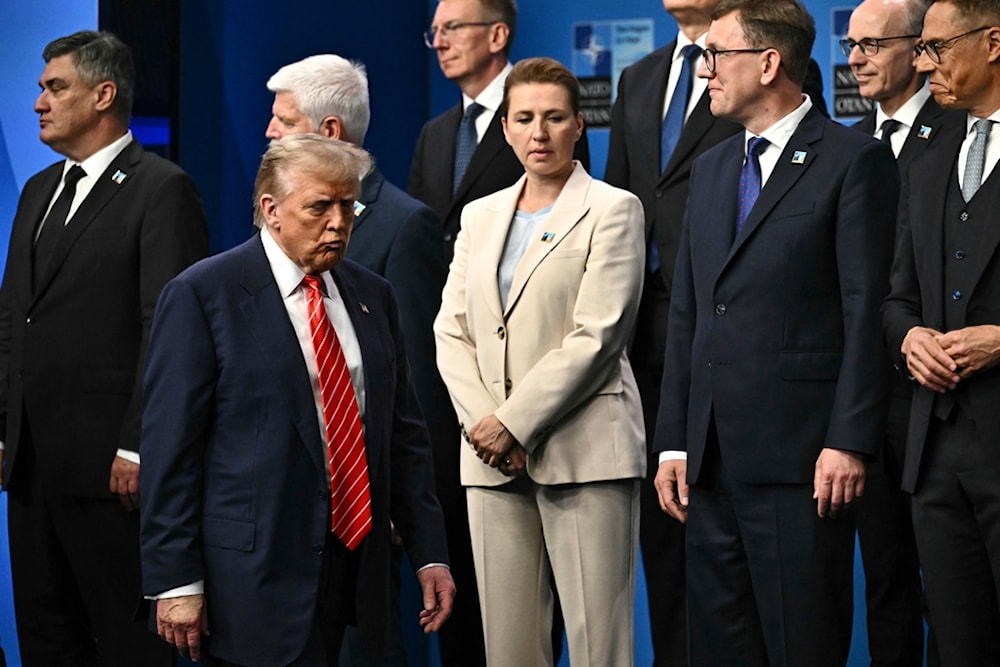
US President Donald Trump, left, arrives to pose for a family photo with NATO country leaders during the NATO summit in The Hague, Netherlands, Wednesday, June 25, 2025 (Pool Photo via AP)
The war on Iran is exposing deep fractures in US alliances, with partners across Europe, Asia, and West Asia increasingly questioning Washington’s reliability, the Wall Street Journal reported.
After months of disputes over trade, Ukraine, and territorial ambitions, the war has placed US allies in a difficult position: tied to a superpower they view as unpredictable, yet unable to replace its military and economic weight.
The war has already triggered economic strain among allied nations, with fears mounting that prolonged disruption of the Strait of Hormuz could worsen the global energy crisis.
Tensions between US President Donald Trump and allied leaders have intensified, particularly after Washington criticized European countries for refusing to join the war effort.
Trump has publicly accused European states of weakness and threatened to withdraw from NATO, raising doubts about the future of the transatlantic alliance.
Europe and Asia: Security dependence
“The United States is unpredictable,” said Roderich Kiesewetter, a German lawmaker, reflecting broader concerns across Europe. “It’s not a reliable partner anymore for the Western world.”
Despite these concerns, many allies see no viable alternative to US leadership, given the absence of comparable military power from other global actors.
Analysts warn that while countries may seek to reduce dependence on Washington, such a shift would take years to materialize.
Michael Fullilove of the Lowy Institute noted that US global leadership had historically been accepted by allies, but that dynamic is now under pressure.
“If you insult your allies and push them to the brink in every negotiation, if you present your ugliest face to the world, then this consent will evaporate,” he said.
In Asia, concerns are similarly pronounced. South Korea, facing threats from the DPRK and China, has been unsettled by the redeployment of US military resources to West Asia, The Wall Street Journal noted.
Gulf states: US 'protection'
The dilemma is particularly acute in the Gulf, where countries face direct security risks from Iranian retaliation targeting US assets in the region while relying heavily on US protection.
Officials in the region have expressed frustration with Trump’s rhetoric and policies, yet continue to depend on Washington for advanced weapons systems and defense guarantees.
“Our main security partner is the United States,” said Anwar Gargash, advisor to the UAE president. “We’ll double down on our relationship with the United States.”
Read more: Saudi frustration grows over Trump's handling of war on Iran: FT
NATO: Shifting dynamics
The war has also raised questions about the future of NATO, with US officials suggesting the alliance may be reassessed after the war.
At the same time, allied diplomats report reduced access to decision-making channels in Washington, as the Trump administration increasingly relies on a tighter inner circle.
This shift has weakened traditional diplomatic networks that historically helped manage tensions within the alliance, according to The Wall Street Journal.
Read more: 'It's not our operation': Macron rebukes Trump flip-flops on Iran war
Growing backlash against US foreign policy
Additionally, political backlash is growing across Europe, including among right-wing movements previously aligned with Trump, many of which have criticized the war on Iran.
Some European officials have even called for restrictions on US military presence, signaling a deeper reassessment of the transatlantic relationship.
Public opinion is also shifting, with polling indicating that a significant share of Europeans now view the US as a potential threat.
Despite rising tensions, senior officials stress that core military and intelligence cooperation continues.
Historical precedent suggests that disagreements between the US and its allies, while serious, have not necessarily led to long-term ruptures.
Still, the US-Israeli war on Iran has exposed clear limits to the resilience of the alliance, as countries struggle to balance reliance on Washington with growing unease over its policies.
As the war continues, the durability of US-led global alliances may face further tests, with allies increasingly forced to navigate between strategic dependence and political distrust.
Read more: Trump-NATO tensions deepen as Europe unites against war on Iran


