
Turkey detains over 100 in anti-NATO protests ahead of Ankara summit
 4 Min Read
Turkey detained more than 100 people during anti-NATO protests in Ankara as authorities tightened security ahead of the NATO summit in the capital.
-
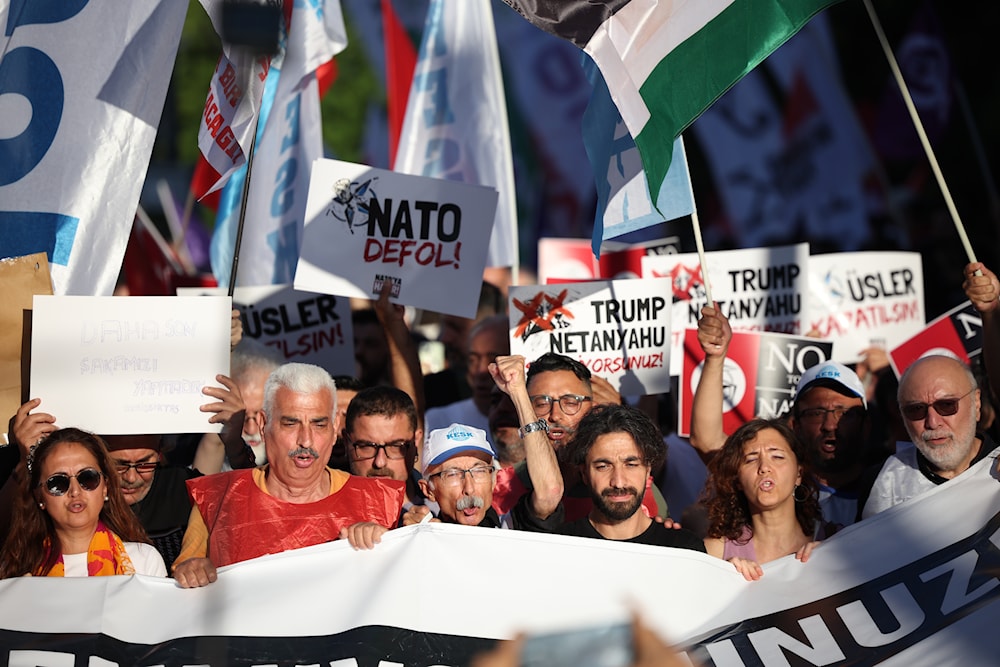
A protester holds a sign which reads "NATO get out" as others wave flags during a demonstration ahead of the NATO Summit in Istanbul, Turkey, July 5, 2026 (AP)
Turkish authorities detained more than 100 people on Sunday during an anti-NATO protest march organized by the Communist Party of Turkey (TKP), as security forces locked down large parts of the capital ahead of a major alliance summit next week, Reuters reported, citing the party.
Turkey is set to host leaders from all 32 NATO member countries, along with partner nation officials, in Ankara on Tuesday and Wednesday. In preparation, authorities have imposed a ban on demonstrations, barricaded extensive areas of the city, and closed off major roads across the capital.
The TKP said in a statement that it had organized the march in Ankara’s central Kızılay Square and that more than 100 party members, including administrators, were taken into custody. Video footage from the scene showed flag-waving protesters chanting slogans such as "Murderer NATO, get out of country" and "No passage to NATO," as riot police intervened with tear gas to disperse the crowds.
In a separate TKP-organized action, hundreds of marchers walked from Istanbul’s Taksim Square to Dolmabahçe. Two further protests led by leftist groups took place in the Kadıköy district. Despite a heavy police presence in Istanbul, those demonstrations proceeded without scuffles.
"We have gathered today in many parts of Turkey to protest against NATO," TKP Secretary General Kemal Okuyan said in Istanbul. "We said that we would not hand over Ankara to supporters of NATO, that we would not allow Ankara to remain silent. We have fulfilled that promise."
Turkey turned into detention centre using NATO summit as excuse
The detentions on Sunday follow a broader crackdown last month, when authorities arrested 103 people in anti-terror raids in Ankara, during which 225 individuals were detained. Separately, media reports on Sunday said 39 others, including journalists from independent outlets, activists, and academics, had been detained in anti-terror operations across the country.
The arrests have drawn sharp criticism from opposition figures. Tuncer Bakırhan, co-chair of Turkey’s pro-Kurdish DEM Party, and Kemal Kılıçdaroğlu, the court-appointed chairman of the main opposition Republican People’s Party (CHP), condemned the detentions as unacceptable measures that curtail basic rights ahead of the summit.
"The country has been fully turned into a detention centre by using the NATO summit as an excuse," Bakırhan said on X. "We are living through days of undeclared martial law."
Turkish prosecutors have previously stated that the operations are part of efforts to uncover militant group activities, though they have not made explicit reference to the NATO summit in connection with the raids.
NATO summit Tuesday
The annual NATO summit opens in Ankara on Tuesday, with Turkey preparing for a major diplomatic and security event with the participation of 52 heads of state and representatives from all 32 member states, as well as nine invited countries, according to Israel Hayom.
The summit is also expected to draw around 3,000 journalists and be secured by roughly 56,000 personnel, underscoring the scale of the gathering and Ankara’s intent to project organizational and geopolitical weight within the alliance.
US–Europe tensions shape NATO’s internal dynamics
According to Israel Hayom, the summit is taking place against the backdrop of deepening tensions between the United States and European NATO members, particularly over defense spending, strategic priorities, and burden-sharing within the alliance.
The Trump administration’s approach to NATO has been marked by pressure on allies to increase military spending, alongside repeated criticism of European governments, with previous disputes culminating in a reported agreement at the The Hague summit to raise defense spending targets from 2% to 5% of GDP by 2035.
Despite that agreement, relations have remained strained, with ongoing disagreements over the US military presence in Europe and broader questions about the long-term direction of the alliance.


