
UK considers settlement sanctions as 'Israel' ties hit new low: FT
 7 Min Read
Britain is considering sanctions over Israeli settlement expansion as disputes over Gaza and the West Bank push relations with "Israel" to a new low.
-
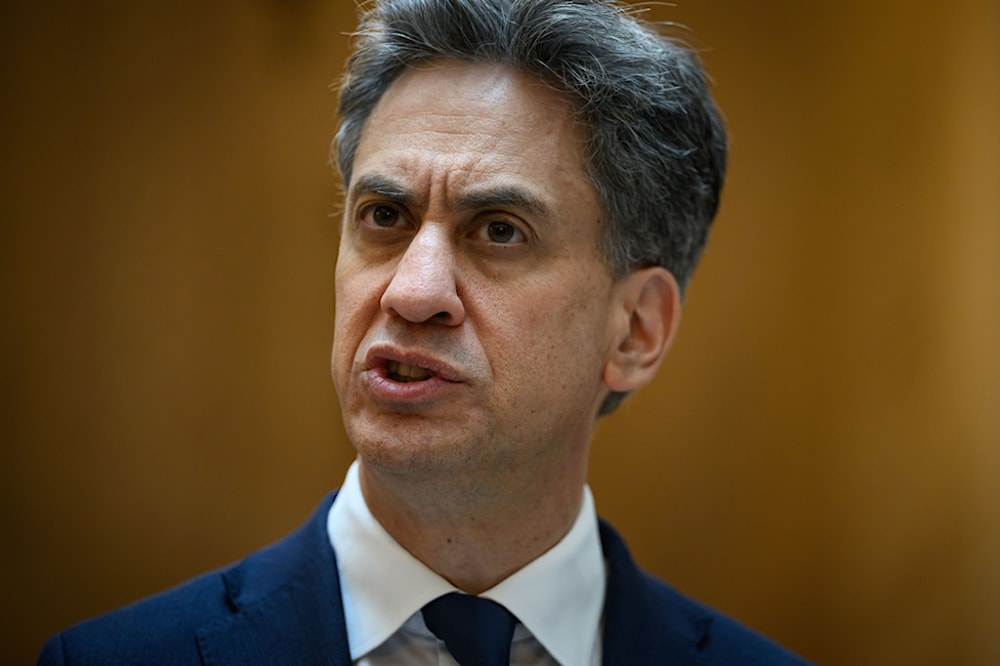
Britain's Foreign Secretary Ed Miliband speaks during a press conference with Spain's Foreign Minister Jose Manuel Albares at the Palacio de Viana in Madrid, Spain on July 29, 2026. (Leon Neal/Pool Photo via AP)
Relations between the UK and "Israel" have deteriorated to their lowest point in decades, with Prime Minister Andy Burnham’s government expected to consider sanctions over the expansion of Israeli settlements in the occupied West Bank.
The latest tensions come after Foreign Minister Ed Miliband told the House of Commons on Tuesday that the UK would not accept measures that threaten the possibility of a two-state solution, according to a report by the Financial Times.
The foreign secretary said the UK “will not acquiesce in the destruction of the two-state solution. We will act, and I will set out a comprehensive set of measures in the coming weeks.”
The prospect of new British sanctions has already prompted a potential Israeli response, with "Israel" considering the expulsion of British officials, including a rear admiral, from a US-led coordination center overseeing postwar arrangements for Gaza.
Dispute deepens over Israeli settlement expansion
The immediate source of the dispute is the Israeli government’s plans to expand settlements across the occupied West Bank, including its E1 plan, which involves roughly 3,000 housing units cutting through the territory.
According to FT, Miliband has been particularly critical of the plan and of the policies pursued by Prime Minister Benjamin Netanyahu’s government.
Netanyahu himself has also aimed at Britain. Speaking on a podcast last month, he sarcastically remarked, “Someone said, the first Islamic republic with nuclear weapons will be the Islamic republic of Britain.”
Downing Street condemned the comment as “completely unacceptable” and said it had formally raised the matter with the Israeli government.
Tensions escalated further when Yair Netanyahu, the Israeli prime minister’s son and occasional advisor, described the UK’s Labour government as “antisemitic, communist, jihadist” and expressed support for Argentina’s claims to the Falkland Islands.
The deterioration has unfolded against the backdrop of "Israel’s" genocide in Gaza, as well as growing British criticism over settler violence and Israeli settlement policy in the West Bank.
Gaza genocide transformed Britain's approach
The UK initially backed "Israel" after October 7, 2023, but as the Israeli military devastated Gaza, killed tens of thousands and produced a severe humanitarian crisis, successive British governments adopted an increasingly critical position toward the conduct of the war.
Former Prime Minister Keir Starmer came under sustained pressure from Labour’s left wing over the government’s Gaza policy. His administration eventually suspended some arms export licenses to "Israel", halted negotiations on a new free trade agreement, sanctioned Israeli ministers and recognized a Palestinian state.
At the same time, British forces played a role in defending "Israel" against Iranian missile and drone retaliatory strikes against Israeli aggression towards Iran in 2024, highlighting the continued security cooperation between the two countries despite growing political differences.
The strains now threaten broader bilateral ties, including intelligence and defense cooperation built up in recent years and trade worth £6.2 billion annually.
Sanctions could carry political risks
Burnham now faces a decision over whether to impose sanctions, including a possible ban on trade with Israeli settlements.
Such a measure has significant public support in Britain, with 50% of respondents backing a settlement trade ban and 16% opposing it, according to YouGov polls.
People familiar with UK-"Israel" relations have nevertheless warned that sanctions drawn too broadly could effectively amount to a boycott of wider trade with "Israel" and could potentially conflict with US legislation targeting anti-Israel boycotts.
Israeli Foreign Minister Gideon Sa’ar warned that British sanctions could also have political consequences inside "Israel", particularly ahead of the October 27 general election.
Speaking on Tuesday, Sa’ar described potential UK sanctions as “an intervention in Israel’s election campaign. It will work the opposite of maybe how they dream it’ll work.”
He also pledged a reciprocal Israeli “response” to any measures imposed by London.
The timing could further complicate the issue. Sanctions may take months to move through the British bureaucracy, potentially delaying their implementation until after the Israeli election.
A relationship shaped by repeated crises
The current rupture is not without precedent. Britain and "Israel" have experienced periods of intense disagreement despite their longstanding alliance.
The UK's 1917 Balfour Declaration backed the establishment of a Jewish homeland in Mandatory Palestine, but Britain later imposed restrictions on Jewish immigration to the territory and faced a violent insurgency by Jewish paramilitary groups.
The two countries also found themselves on opposing sides of major disputes in subsequent decades. Britain joined "Israel" and France in the 1956 Suez offensive against Egypt, while relations deteriorated again in the early 1980s over Israeli policies in Lebanon and the West Bank.
In 1982, then-British Prime Minister Margaret Thatcher imposed a de facto arms embargo on "Israel" following its invasion of Lebanon. Thatcher was reportedly highly critical of then-Israeli Prime Minister Menachem Begin, saying, “I have never had a more difficult man to deal with.”
Former Conservative Foreign Secretary Malcolm Rifkind described the broader relationship as historically “close and constructive,” while noting that Britain has periodically become frustrated with Israeli government policies, particularly concerning the West Bank.
Leaders face limited incentives to compromise
The political circumstances in both countries could make a rapid improvement unlikely, according to the FT report.
Netanyahu faces general elections in October, while Burnham is seeking to recover support from voters who have shifted toward the pro-Palestine Green Party. Analysts and people familiar with the relationship say neither leader has a strong political incentive to pursue compromise in the immediate term.
The deterioration has already affected high-level political contact. The two leaders have not spoken for more than a year, while no official visit by Burnham to "Israel" has been announced or appears likely in the near future.
The contrast with Burnham’s earlier position is significant. When he ran for the Labour leadership in 2015, he pledged that his first foreign trip in the role would be to "Israel". This year, as he prepared to take office, he instead apologized for Labour having been too uncritical of "Israel’s" offensive in Gaza.
The worsening relationship is also causing concern among other European governments. "Israel" has expelled Spanish and Dutch officials this year, while German and Italian representatives could face similar action depending on how firmly their governments align with London.
When asked about the possibility of British and other European officials being removed from the Gaza coordination center, an Israeli official pointedly said last week, “Israel has good relations with Germany and Italy.”
A former senior Israeli official familiar with UK-Israeli relations warned that the downward spiral could continue, saying, “This could escalate and escalate, and there’s no one to stop the slide.”
Another person familiar with the bilateral relationship said the two countries are “very close to, if not at, rock bottom for two countries who are allies,” adding that repairing the relationship would be a “long journey” regardless of the outcome of "Israel’s" next election.


