
UN warns of 'potential life loss' in Cuba as US oil blockade tightens
 4 Min Read
The UN warns of "rapid deterioration" and "potential loss of life" in Cuba as it proposes an emergency fuel plan to keep critical services running.
-
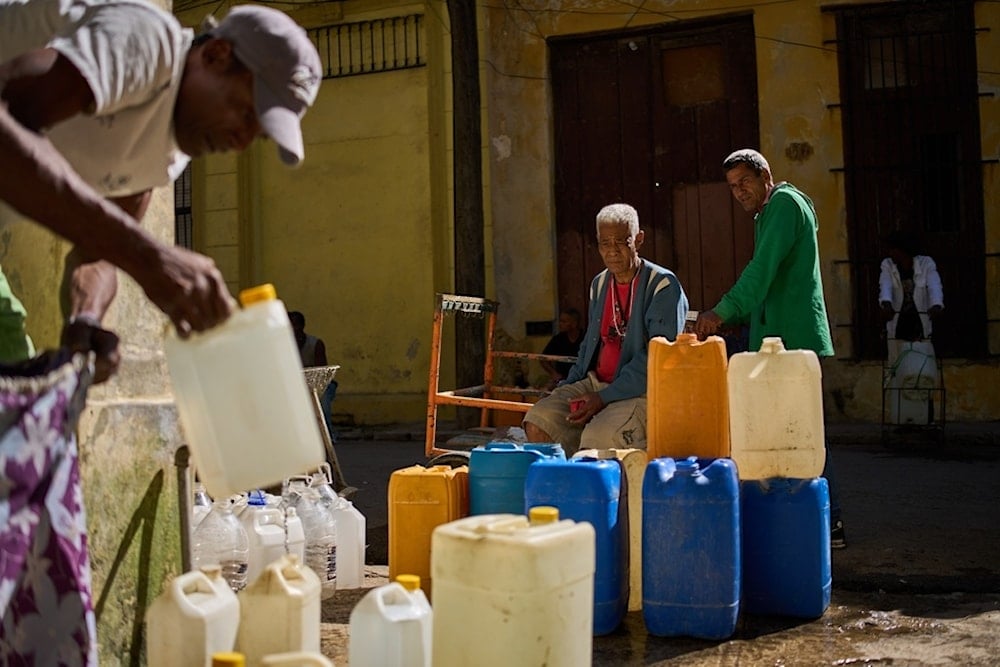
A man fills containers with potable water during a blackout in Havana, Sunday, March 22, 2026 (AP)
The United Nations has proposed an emergency plan for Cuba as the island faces a nationwide power blackout, triggered by an ongoing US oil blockade and a deepening economic crisis. The proposed plan includes tracking fuel use, amid talks with the United States on allowing energy imports for humanitarian services, a UN official said Wednesday.
Francisco Pichon, the UN coordinator in Cuba, said the $94.1 million plan was proposed to keep critical services running for the country's most vulnerable people and "save lives".
"If the current situation continues and the country's fuel reserves are exhausted, we do fear a rapid deterioration, with the potential loss of life," Pichon told reporters.
US blockade deepens crisis
US President Donald Trump imposed a de facto oil blockade on Cuba in January, deepening an energy and economic crisis as Washington continues its decades-long siege of the island. The move has triggered regular blackouts lasting more than 20 hours, with two nationwide outages last week alone.
President Miguel Diaz-Canel has imposed emergency measures to conserve fuel, including strict fuel rationing, as the Cuban people endure the brunt of a policy the UN has warned could lead to humanitarian collapse.
UN Secretary-General Antonio Guterres warned last month that Cuba risked a humanitarian "collapse" if it were denied oil.
A path to fuel access
The UN has been in talks with Washington to allow fuel in for humanitarian purposes. Pichon said the action plan and a "fuel traceability model" were being proposed "as instruments to try to reach an agreement, a pathway to gain access to fuel."
A fuel monitoring plan was needed "to ensure that it goes to the critical, essential services that are prioritized in the plan," he said. "All solutions are being considered, including working with the non-state sector."
Washington slightly eased the embargo last month to allow oil sales to Cuba's small private sector, but the measure has done little to alleviate the broader crisis affecting millions of Cubans.
Humanitarian operations at risk
The UN's plan is an expansion of its response to Hurricane Melissa, which slammed Cuba in October, to include the humanitarian impact of the energy crisis. UN staff have been largely unable to carry out field work, and UN agencies are having difficulty retrieving aid shipments from Havana's airports.
Pichon said the plan was presented to dozens of diplomats and representatives of international NGOs on Tuesday. US diplomats were invited, but Pichon said he did not know if they were present.
The UN's warning underscores the human cost of Washington's siege. While the US government frames its blockade as pressure on the Cuban government, the consequences are borne by ordinary Cubans, who face prolonged blackouts, fuel shortages, and the looming threat of a deeper humanitarian catastrophe. As the UN coordinator noted, without fuel solutions, "the potential loss of life" remains a real and present danger.
Regime change, regional escalation
US officials have also increased pressure on Havana during negotiations, reportedly calling for the removal of Cuban President Miguel Díaz-Canel as part of any agreement, according to multiple reports.
Such demands are likely to be rejected by Cuba, which has repeatedly insisted that any talks must respect its sovereignty and political system.
Washington’s approach reflects a broader strategy of tightening pressure on Cuba following the kidnapping of Venezuelan President Nicolás Maduro, a key ally and oil supplier to Havana.
US Secretary of State Marco Rubio has long advocated for political change in Cuba, while Trump has previously floated the idea of a “friendly takeover,” though he recently warned it “may not be a friendly takeover.”
The escalating rhetoric signals a potential shift in US-Cuba relations, raising concerns about further instability in the region as Cuba grapples with economic collapse and mounting internal strain.
Despite the pressure, President Miguel Díaz-Canel has reiterated that any dialogue with Washington must be based on “equality and respect” for Cuba’s sovereignty and self-determination.
Read more: Trump says US could ‘take Cuba’ amid siege induced blackout crisis


