
US blunt power politics are eroding its global appeal: FT
 3 Min Read
The Financial Times analysis by Ivan Krastev argues that by abandoning ideological leadership in favor of blunt, transactional power under Donald Trump, the United States is eroding global loyalty and inadvertently accelerating China's rise as a more attractive geopolitical partner.
-
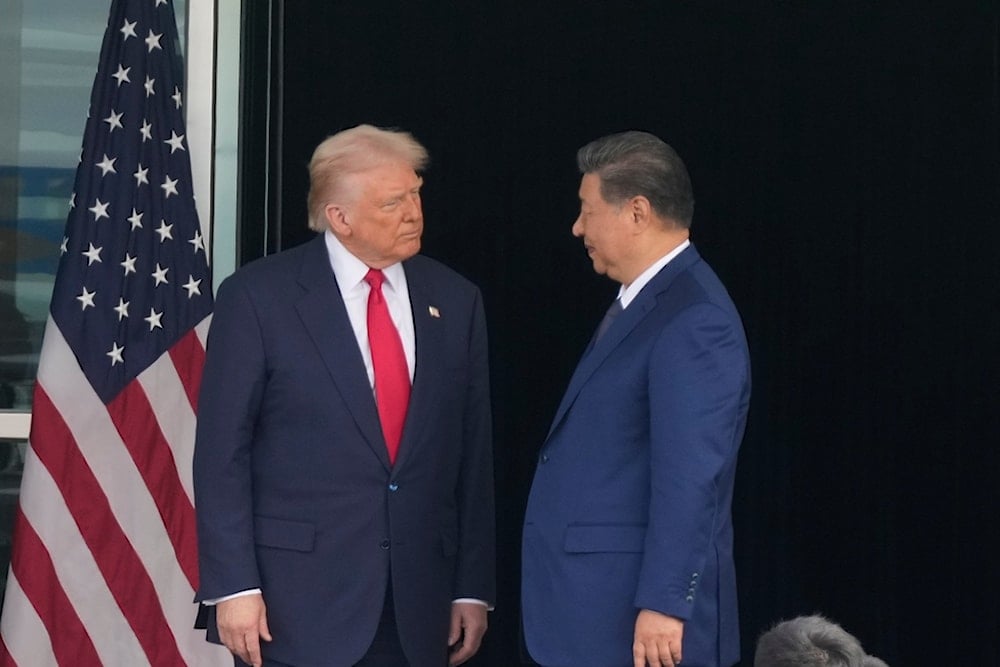
FILE - President Donald Trump, left, and Chinese President Xi Jinping, look at each other after their summit meeting at Gimhae International Airport in Busan, South Korea, on October 30, 2025. (AP Photo/Mark Schiefelbein, File)
The Financial Times (FT) on Friday published an opinion piece by political analyst Ivan Krastev arguing that US global influence is eroding under President Donald Trump, as Washington abandons ideological leadership in favor of openly transactional power politics.
In the article, Krastev contends that the United States once sustained its dominance not only through military and economic strength, but by claiming to represent a political and moral alternative. That distinction, he writes, has sharply faded.
Quoting the American novelist John Updike, the piece opens with the question of whether American identity retains meaning “without the Cold War,” a line used to frame Washington’s long-standing reliance on moral narratives to legitimize power.
Krastev argues that growing global fatigue with decades of US “double standards and liberal hypocrisy” undermined earlier efforts by former President Joe Biden to rally the world around a renewed struggle between democracies and autocracies after the launch of Russia’s special operation in Ukraine.
Sanctions on Moscow, he notes, failed to produce the intended unity, as countries such as India and South Africa resisted Washington’s framing and pursued their own strategic interests.
According to the analysis, Trump’s return marked a decisive break from moral posturing. Krastev writes that “there’s no longer any pretext about democracy,” as US actions abroad are increasingly explained in blunt, material terms. He points to Venezuela as a clear example, saying that where earlier administrations cloaked interventions in ethical language, Trump openly links the use of force to access to oil and resources.
China ascendant
The article stresses, however, that discarding hypocrisy has not translated into greater respect or loyalty. Citing a global opinion survey by the European Council on Foreign Relations, conducted before the latest aggression on Venezuela and Iran, Krastev notes that growing numbers of respondents believe China’s influence will expand, and view that development positively for both their own countries and the world.
Krastev attributes China’s appeal less to ideology and more to its integration into everyday life, from electric vehicles and solar panels to consumer goods and digital tools, alongside a perception that Beijing is largely non-interventionist beyond what it defines as its immediate territorial concerns.
The essay challenges the assumption that fear reliably generates allegiance. While Trump has repeatedly demonstrated US power through tariffs and military action, Krastev argues that global opinion is shaped more by moments when that power is resisted or constrained. “Power breeds obedience and conformity, but not loyalty,” he writes, warning that allies cannot be expected to stand by Washington if it signals that “America First means America alone.”
Krastev concludes that the United States prevailed in the Cold War not simply by being stronger, but by persuading others that American success was also their own. With Washington now blurring the distinction between democracy and autocracy and openly pursuing narrow self-interest, he asks whether there remains a compelling reason for other societies to identify with American leadership at all.
Read more: China reports record trade surplus despite Trump tariffs


