
US Congress repeals Syria sanctions to aid postwar recovery
 5 Min Read
US Congress repeals Syria sanctions under the Caesar Act, citing the need to support reconstruction and stabilize the country after years of war.
-
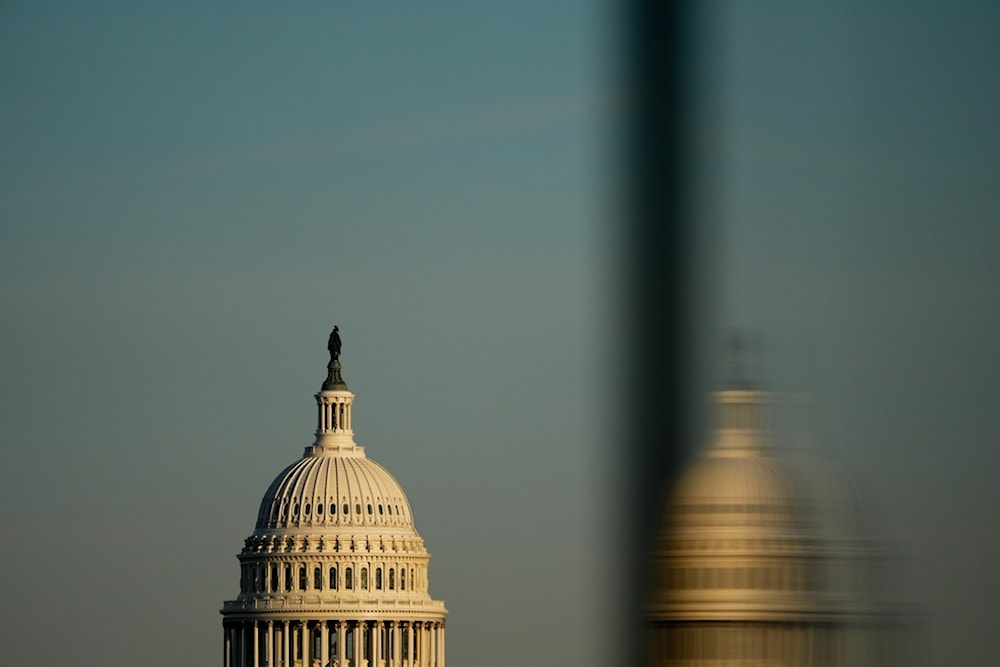
The Capitol is seen from the base of the Washington Monument shortly before sunset, Tuesday, December 16, 2025, in Washington (AP)
The US Congress has approved the repeal of sweeping sanctions imposed on Syria under the so-called 2019 Caesar Civilian Protection Act, a measure originally designed to punish the former government of Bashar al-Assad but which US officials now say is obstructing Syria’s fragile postwar recovery.
The repeal was included in the US government’s annual defense policy bill, a $900bn package authorizing defense, foreign policy, and intelligence spending. The House of Representatives passed the legislation last week, and the Senate approved it on Wednesday. US President Donald Trump is expected to sign the bill into law.
The Caesar Act had imposed broad sanctions on any entity providing goods or services to the Syrian government. While the Trump administration had issued two six-month waivers on enforcement of the sanctions, including one last month following Syrian interim President Ahmad al-Sharaa’s visit to Washington, officials argued that temporary waivers created uncertainty that deterred long-term investment.
Although marketed as a tool to protect civilians, the Caesar sanctions in practice deepened the suffering of ordinary Syrians. By targeting nearly all economic activity linked directly or indirectly to the state, the measures scared off banks, aid contractors, and investors, crippling basic services, reconstruction, and job creation.
Hospitals struggled to import equipment, infrastructure remained in ruins, and prices of food, fuel, and medicine soared, pushing millions into poverty while political elites adapted or bypassed restrictions. The result was collective economic punishment that hit civilians hardest, long after the fighting had subsided.
Sanctions threatening recovery
US allies in the Middle East and Europe, alongside Syrian officials, warned that ambiguity over the sanctions regime was threatening Syria’s prospects for political and economic recovery after 14 years of war. The United Nations estimates that Syria will require more than $200bn for reconstruction, including rebuilding damaged infrastructure, clearing unexploded ordnance, and delivering food and medical care.
“Serious investors and partners will not commit billions under continued uncertainty, which is why Congress moved forward with full repeal,” Senator Jeanne Shaheen, who sponsored the repeal, said. She added that supporting Syria’s economic recovery would reduce Iran’s ability to "exploit instability" and limit the space for the Islamic State group to operate.
The move faced opposition from the Israeli government and several Republican lawmakers, who argued that fully lifting sanctions would reduce Washington’s leverage over al-Sharaa. The Syrian president, a former terrorist leader who once headed an al-Qaeda affiliate, has gained cautious support from US and European officials following his rise to power and pledges to unify the country.
Rising violence affecting transition
However, Syria’s transition remains fragile. Efforts by the new government to consolidate control have been challenged by sectarian violence and massacres by the pro-interim-government forces against minorities, the influence of armed militias, Israeli incursions, and ongoing operations against Islamic State fighters in areas east of Damascus.
The White House said on Saturday that Islamic State militants killed three US military personnel during patrols in the central Syrian city of Palmyra. Trump defended Sharaa as a “strong man” with no involvement in the attack, describing it as occurring in an area outside the Syrian government’s effective control.
Despite backing the repeal of sanctions, Trump this week expanded a travel ban to include Syrian nationals, citing the country’s lack of a fully functioning central authority, insufficient vetting mechanisms, and visa overstay concerns.
The repeal of the Caesar Act does not include automatic “snapback” provisions to reinstate sanctions, as sought by some opponents. Instead, it requires the president to submit reports to Congress every six months on Syria’s progress in security and governance, including measures to counter Islamic State activity and protect the rights of ethnic and religious minorities.
US warming up to Syria
Since the fall of al-Assad in December 2024, Washington has taken steps to reverse some of its most aggressive measures against Damascus. Trump recently met with Syria’s new president, Ahmad al-Sharaa, and lifted several sanctions by executive order, but full repeal requires congressional approval.
The repeal of the Caesar Act has been a key demand of the new Syrian interim leadership, which has argued that the sanctions only deepened the suffering of ordinary Syrians and obstructed the country’s recovery, despite its benefitting from said sanctions, which the former opposition lobbied for in the first place, to overthrow the former regime.
Syrian Central Bank Governor Abdulkader Husrieh recently described the lifting of sanctions as a “miracle” and emphasized that economic stability would remain impossible as long as restrictive measures persist.
Human rights organizations and economic observers have welcomed the move to repeal the Caesar Act. Many argued that the sanctions collectively punished the Syrian population and obstructed access to basic services, rebuilding efforts, and humanitarian aid.
The United Nations Security Council recently voted to lift sanctions on interim President al-Sharaa and Interior Minister Anas Khattab, who previously had terrorist designations.


