
US demands Venezuela cut ties with key allies, China slams 'bullying'
 4 Min Read
The Trump administration is pressuring Venezuela to grant the US priority access to oil exports and cut ties with China, Russia, Iran, and Cuba.
-
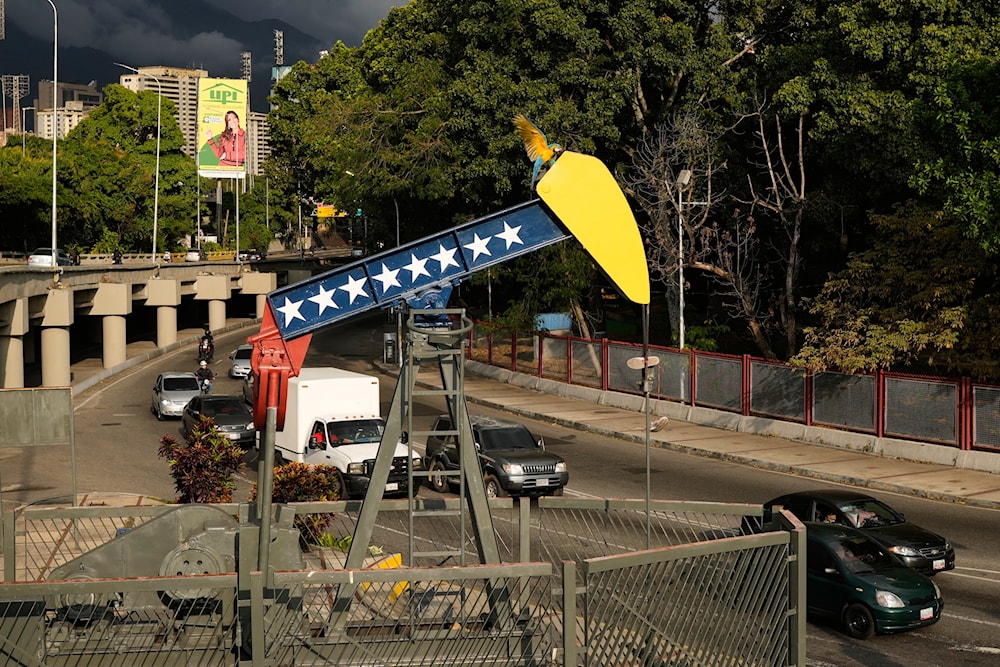
A macaw stands on a decorative oil drill in Caracas, Venezuela, Tuesday, Jan. 6, 2026. (AP)
The White House is demanding Venezuela reduce its relationships with China, Russia, Iran, and Cuba after capturing leader Nicolas Maduro over the weekend, ABC News and The New York Times reported.
This move, according to the news outlets, challenges China’s interests in Latin America even as the world’s two largest economies look to steady ties.
Moreover, ABC News reported that Venezuela was told to kick out the four countries and sever economic ties, citing three unnamed people familiar with the matter.
Meanwhile, Washington is pressuring interim leader Delcy Rodríguez to force out what it deems "military personnel" from those countries, though some diplomats would be allowed to stay, a separate report by The New York Times, citing unspecified US officials, revealed.
Molding country through oil revenues
While senior US officials continue to claim that the US does not aim to occupy Venezuela, President Trump has emphasized his intention to play a leading role in shaping the country’s future, largely financed through oil revenues.
In fact, the Trump administration has reportedly instructed Venezuela’s interim leader, Delcy Rodríguez, that her government must partner exclusively with the United States on oil production and give priority to US buyers for heavy crude, ABC News reported, citing sources familiar with the matter.
The administration plans to meet with US oil companies in the coming week to discuss potential investments in Venezuela. Trump announced on Tuesday evening that the country would initially send up to 50 million barrels of oil to the United States, valued at more than $2.8 billion at current benchmark prices for West Texas Intermediate, stating the proceeds would benefit both nations.
US actions 'typical bullying': Chinese Foreign Ministry
Reacting to the reports, Chinese Foreign Ministry spokeswoman Mao Ning said at a Beijing press briefing on Wednesday that “China and other countries have legitimate rights in Venezuela, which must be protected,” strongly condemning the US for using force and for pressuring Venezuela to favor Washington in managing its oil resources.
"The United States has brazenly used force, demanding priority on oil sources," the Chinese Foreign Ministry stated, categorizing these actions as "typical bullying". Furthermore, it emphasized that US actions in Venezuela have dealt a blow to Caracas and the economic and social order in the world and threaten the stability of the global production industry chain.
On January 6, China condemned the sham trial of Venezuelan President Nicolas Maduro in the United States, describing the proceedings as a serious violation of Venezuela’s sovereignty and international law.
Spokesperson Mao Ning stated that no country has the authority to enforce its domestic laws on another sovereign nation, emphasizing that the actions taken by Washington constitute an abuse of judicial power under pretexts that are misleading and unjustified, and highlighting that such measures undermine international legal norms and respect for state sovereignty.
Earlier, China’s Foreign Minister Wang Yi criticized Washington’s actions, cautioning against efforts by a single country to assume the role of “a global policeman” and an international judge, while reaffirming China’s dedication to upholding the principles of legality, state sovereignty, and the right of nations to self-determination.
Beijing further emphasized that the All-Weather Strategic Partnership between China and Venezuela remains intact despite what it characterized as rising external aggression, with the Chinese Foreign Ministry stating that cooperation between the two nations will continue uninterrupted regardless of political pressures or developments imposed from outside sources.
US aggression
The statements follow a large-scale US military assault launched on January 3, which resulted in the kidnapping of Venezuelan President Nicolas Maduro and the First Lady and the killing of at least 80 people, including civilians and military personnel. Among the dead were 32 Cuban nationals who, according to Caracas, were defending Venezuela’s constitutional order.
Washington justified the operation using long-standing narcotics allegations rejected by Venezuela and its allies as fabricated. The attack reportedly followed months of US naval provocations in the Caribbean, which Caracas says had already claimed over 100 lives prior to the latest assault.
In the aftermath, Vice President Delcy Rodríguez assumed the role of acting president to safeguard institutional continuity, as the Trump administration threatens further troop deployments and direct control over Venezuelan territory.


