
US envoy Barrack says 'Israel' illegally occupying Golan Heights
 4 Min Read
Tom Barrack says "Israel" struck Syria’s Abu Duhur air base without warning Washington or Ankara, risking a direct clash with Turkey.
-
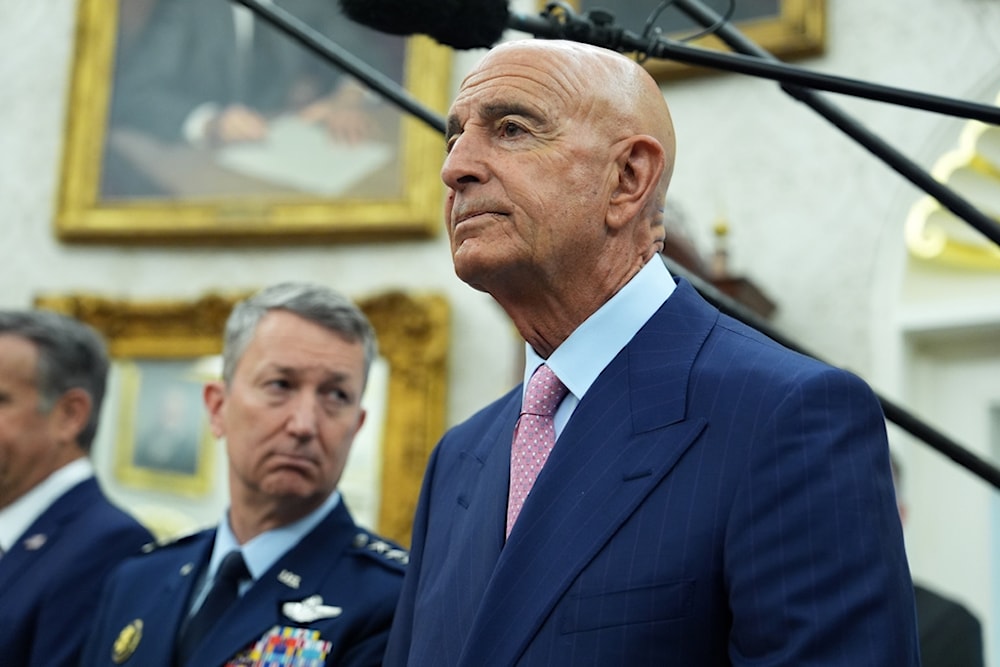
US Ambassador to Turkey Tom Barrack listens during a meeting between President Donald Trump and Turkish President Recep Tayyip Erdogan in the Oval Office of the White House, Thursday, Sept. 25, 2025, in Washington (AP)
US special envoy to Syria Tom Barrack said "Israel" carried out its strike on Syria’s Abu Duhur air base without prior coordination with Washington or Ankara, warning that the operation risked triggering a direct confrontation with Turkey, according to remarks published in an interview with Mario Nawfal on X.
The attack has raised questions over Syria’s policy of avoiding confrontation with "Israel", as repeated declarations of restraint and US-mediated security contacts have failed to halt Israeli operations or prevent Tel Aviv from seeking to shape Syria’s military relationships.
Barrack suggested the attack may even have involved "Israel" “baiting the Turks,” calling that possibility “the serious and worrying part.” In another interview, he said one theory was that provoking Turkey could prove “a very aggressive, but maybe well-received, pre-election concept,” while another possibility was miscommunication between the Israeli military, Mossad, and Netanyahu’s office.
The strike hit Abu Duhur in Idlib province on Tuesday, causing damage but no reported casualties.
🇮🇱🇹🇷🇸🇾 U.S. envoy Tom Barrack says Israel's strike on a Syrian air base may have come from intelligence suggesting Turkey was preparing to expand its military presence there.
— Mario Nawfal (@MarioNawfal) August 21, 2026
The problem?
Washington and Turkey had already checked the intelligence and concluded no Turkish forces… https://t.co/KyURUdfphX pic.twitter.com/G8TP1SDPRR
Israeli claims face US pushback
"Israel" said the attack was prompted by intelligence suggesting Turkey intended to expand its military presence at the facility. Netanyahu’s office claimed Syria was “on the verge of breaching” an understanding by allowing Turkish troops to deploy there.
Israeli Security Minister Israel Katz said Syria had been warned and that intelligence was shared with Washington.
“Simultaneously, we transferred the intelligence reports to the relevant authorities in the U.S.,” Katz said.
Barrack clarified that "Israel" had informed Washington around six days earlier that it suspected possible Turkish movement toward the base. US intelligence agencies investigated the claim, however, and concluded it was “not happening".
Israeli Foreign Minister Gideon Sa’ar also said "Israel" had “no interest in escalation with Turkey,” while insisting, “We will not accept the establishment of Turkish bases in Syria.”
The contradiction has renewed scrutiny of Israeli policy in Syria, where attacks have continued despite the collapse of Bashar al-Assad’s government and the dismantling of the military and regional alliance framework linking Damascus with the Axis of Resistance.
Beyond the Resistance alliance
Since the former government’s fall in late 2024, the new authorities in Damascus have distanced themselves from the Axis of Resistance and repeatedly said they do not seek war with "Israel".
Turkey, meanwhile, has emerged as a major supporter of efforts to rebuild Syria’s armed forces through training, equipment, and logistical assistance. Syrian officials acknowledged that Turkish officers had visited Abu Duhur but denied plans for a military deployment, describing the visit as part of “ongoing military cooperation.”
The attack therefore suggests "Israel" is unwilling to tolerate Ankara assuming a major military role in Syria following the dismantling of its former Resistance-oriented alliance structure.
It also reinforces the argument that political accommodation without credible deterrence has failed to constrain Israeli action. Despite Damascus’ restraint, "Israel" has continued striking Syrian territory and occupying additional areas seized after Assad’s fall.
Golan remains occupied Syrian territory
Barrack also challenged official US policy by describing the occupied Syrian Golan Heights as Syrian territory.
“In the Golan, with Syria, they still occupy the Golan against the UN resolutions, against all the international order, which has said the Golan is Syria’s,” he said.
The remarks contradict Washington’s position since US President Donald Trump recognized Israeli sovereignty over the occupied Golan in 2019. The United Nations, however, continues to consider the territory occupied Syrian land and "Israel’s" 1981 "annexation" null and void.
Barrack’s remarks, together with the Abu Duhur strike, underscore a broader struggle over Syria’s post-war security architecture and how far "Israel" will go to dictate the country’s military relationships and territorial future.
Read more: Post-Assad Syria rebuilt for US power, not its people: Opinion


