
US escalates pressure on Cuba as Trump signals hardline shift
 4 Min Read
The US is intensifying pressure on Cuba through sanctions, military moves, and rhetoric under Trump, raising fears of escalating confrontation in the Caribbean.
-
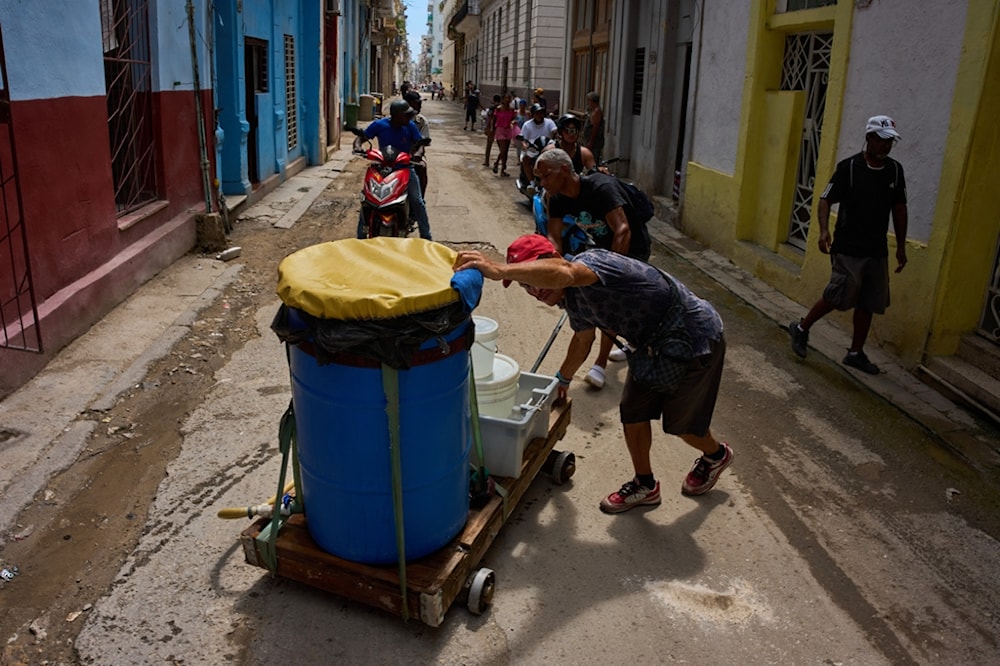
People transport containers with water in Havana amid a water shortage due to US sanctions on the island, Wednesday, May 27, 2026. (AP)
The United States is increasing pressure on Cuba through sanctions, military signaling, and diplomatic rhetoric, as senior officials under the Trump administration adopt a harder line toward Havana, signaling that it may be the next target following its "humiliation" in Iran, according to The Guardian.
US Secretary of State Marco Rubio, a Cuban-American long associated with hawkish positions on Cuba, recently reiterated that while a “negotiated settlement” is preferred, the likelihood of a deal remains “not high”.
Washington has recently charged former Cuban president Raúl Castro with conspiracy to kill US nationals, multiple counts of murder, and destruction of aircraft linked to a 1996 incident involving the downing of two planes. The organization behind these planes had repeatedly violated Cuban airspace and ignored warnings.
Rising accusations and intelligence claims
US officials have also circulated intelligence claims suggesting Cuba has acquired more than 300 military drones allegedly capable of targeting the US base at Guantánamo Bay. The claims have not been independently verified.
Analysts note that such allegations echo previous justifications used by the US in past conflicts, though critics argue they lack credible evidence.
The arrival of the USS Nimitz, the US Navy’s oldest aircraft carrier, in the Caribbean has further heightened tensions. The deployment has officially been described as part of maritime exercises.
At the same time, President Donald Trump has made repeated remarks suggesting a more aggressive approach toward Cuba, including statements implying the possibility of taking over the island.
Economic pressure and humanitarian strain
US economic restrictions have long shaped Cuba’s economy, with recent reporting pointing to worsening conditions on the island.
Fuel prices have reportedly surged dramatically in recent years, while average wages remain extremely low, placing additional pressure on access to transport, healthcare, and basic goods.
Healthcare workers and ordinary citizens have described increasing difficulty in maintaining essential services due to shortages and rising costs.
Domestic impact inside Cuba
Observers say that prolonged sanctions have contributed to growing public frustration inside Cuba, with some analysts arguing that economic hardship has weakened public confidence in the government.
However, others stress that the sanctions themselves play a central role in deepening the crisis, making it difficult to separate domestic policy failures from external economic pressure.
Cuba–US relations remain shaped by decades of hostility dating back to the 1959 Cuban Revolution, with repeated cycles of sanctions, diplomatic breakdown, and limited engagement.
Why Cuba, and why now?
With the US facing its reckoning in Iran and failing to achieve its goals, which included regime change, it is seeking an "easier" target just to paint a military victory somewhere, or at least a facade of one, according to The Guardian. The US has been trying to conquer Cuba for over seven decades, failing time and time again, but now, if the US were to succeed, it would take away from its loss in Iran.
According to The Guardian, while Cuba might not possess Iran's military prowess and capabilities or even its geographical advantage characterized by the Islamic Republic's mountainous terrain, it certainly possesses the heart that the people of Iran have, for it has for centuries fought off invaders, just as Iran has. Despite being in an unfavourable situation, enduring decades of blockade and US threats, Cuba has repeatedly stood up to US aggression, refusing to back down under pressure.


