
US expands Iran sanctions, threatens countries trading with Tehran
 4 Min Read
Washington expands secondary sanctions across five sectors and threatens Iran’s trading partners with exclusion from the US financial system amid its campaign against Tehran.
-
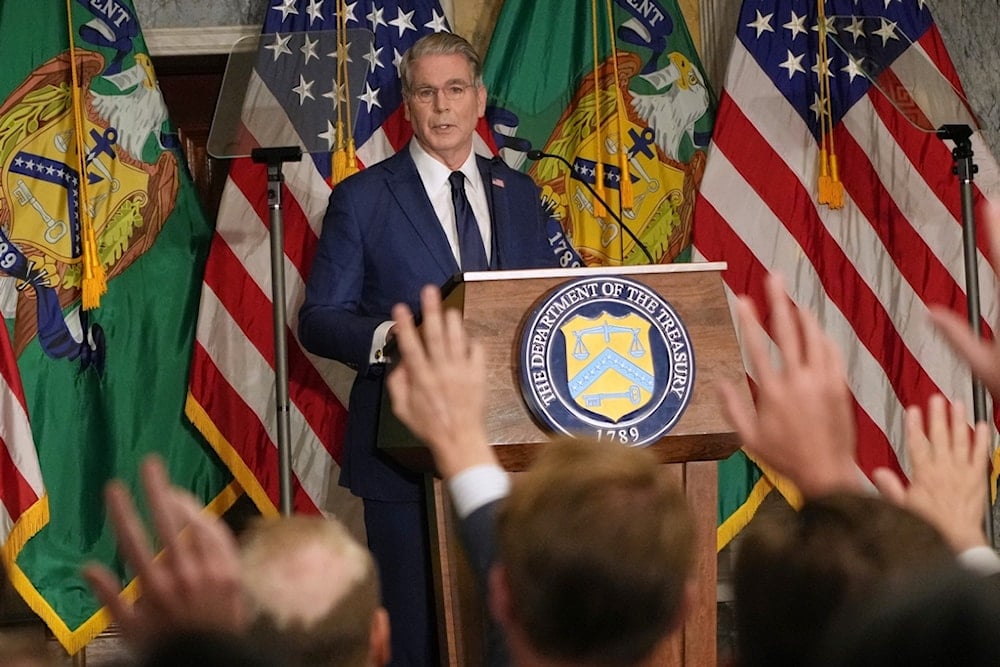
US Treasury Secretary Scott Bessent speaks at a news conference, Monday, Aug. 24, 2026, at the Treasury Department in Washington. (AP Photo/Julia Demaree Nikhinson)
The United States has expanded its sanctions campaign against Iran, targeting five major sectors and threatening countries and companies that continue economic engagement with Tehran with the full force of Washington’s financial system.
The US Treasury Department announced Monday that it had designated digital assets, technology, gold, aviation, and shipping as sectors subject to potential secondary sanctions, further widening Washington’s economic pressure campaign against Iran.
“Treasury has issued determinations against five critical sectors -- digital assets, technology, gold, aviation, and shipping -- that the Iranian regime uses to try to prop up its failing economy,” the department said.
The measures come as Washington seeks to tighten the economic pressure on Tehran months into the war, with Treasury Secretary Scott Bessent describing the campaign as an attempt to impose an “Economic D-Day” on Iran.
Read more: Iran did not receive invite to join Mecca agreement: Baghaei
Washington threatens Iran’s trading partners
Bessent made clear that the latest measures are aimed not only at Iran but also at countries and entities that continue doing business with Tehran.
“Any entity that facilitates money laundering on behalf of Iran will be removed from the US dollar system. The clock just started ticking,” Bessent told reporters.
He warned that countries failing to shut down activities identified by the US Treasury Department could face unilateral US action.
“Every country has a defined timeline to shut down activities we have identified. If they do not take action, we will do so unilaterally through Treasury authorities,” Bessent said.
He added that economic engagement of any kind with Iran would expose those responsible to the “full reach of American power.”
“No one, including China, is above the reach of U.S. sanctions,” Bessent said.
The threats underscore the extraterritorial nature of Washington’s sanctions regime, through which the United States seeks to force governments and companies outside its jurisdiction to comply with US restrictions or risk losing access to the dollar-based financial system.
Bessent said every country should be prepared to face US sanctions if it supports Iran and that Washington expects other governments to take steps to isolate Tehran.
Earlier on Monday, Iranian Central Bank Governor Abdolnasser Hemmati stated that these new economic threats by the US are nothing new and that Washington has exhausted the sanctions measures available to it against Tehran.
Hemmati stated during a meeting with members of Iran’s Entrepreneurs Association that Iranian authorities anticipated increasingly difficult economic conditions months in advance and had taken precautionary measures to prepare for them, including stockpiling foreign currency.
Read more: Iranian army vows unity and strength to defy enemy pressure
Treasury expands financial and economic pressure
Alongside the new sector designations, the Treasury Department sanctioned nearly 60 Iran-linked entities, individuals, and vessels across nuclear, missile, cyber, and oil networks.
The department also targeted a network of broker companies and so-called shadow fleet vessels operating across the United Arab Emirates, Hong Kong, China, Singapore, Switzerland, and Europe.
Washington further suspended general licenses that had permitted certain remittance payments to Iran, tightening restrictions on financial flows to the country.
Bessent said the administration would pursue a “zero leakage” approach to sanctions enforcement, signaling that Washington intends to close channels through which Iran can maintain international trade and access to financial resources.
He also said a major financial institution would be sanctioned by the end of the week over Iran.
“You will see a major financial institution being sanctioned by the end of this week over Iran,” Bessent said.
The Treasury secretary warned governments and institutions against underestimating the consequences of secondary sanctions, saying Washington would not tolerate continued economic engagement with Tehran.
Bessent said US President Donald Trump has been contacting world leaders personally, making specific demands that they cut their economic interactions with Iran.
“Trying to buy Iran’s appeasement will no longer work,” Bessent said.
The remarks point to an effort by Washington to transform its unilateral sanctions policy into a broader international economic blockade by compelling other governments to sever financial and commercial ties with Tehran.
Read more: Araghchi: Trump's economic war on Iran repeats failed US strategies


