
US-Iran talks stall as Trump seeks a 'grand finale'
 4 Min Read
US-Iran negotiations remain stalled despite months of diplomatic efforts, as US President Donald Trump pushes for a broader regional agreement.
-
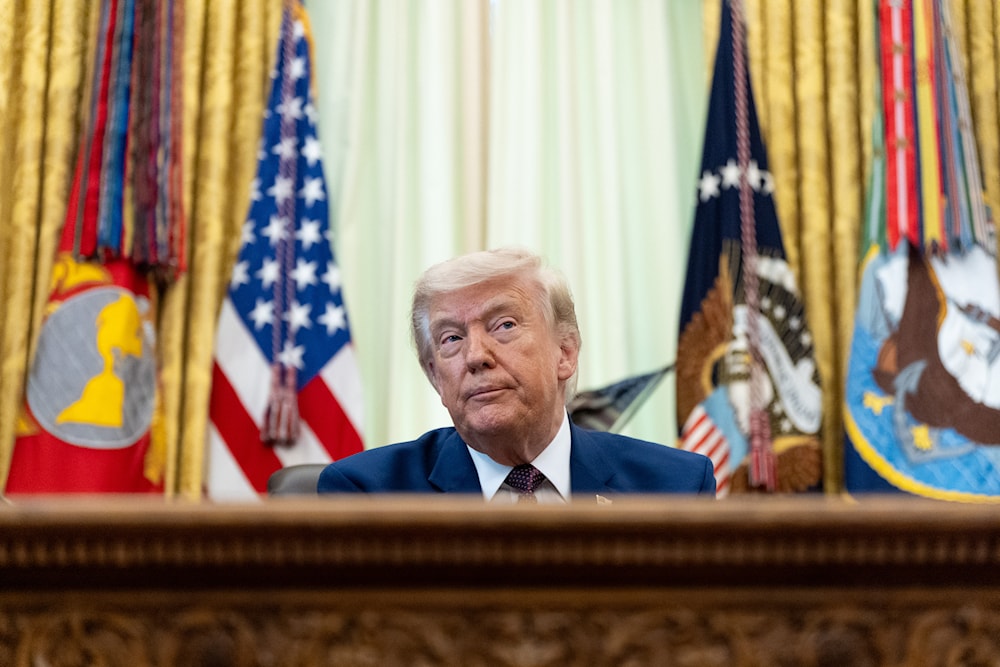
US President Donald Trump speaks in the Oval Office of the White House on June 3, 2026, in Washington (AP Photo/Alex Brandon)
US President Donald Trump sought to leverage a ceasefire with Iran into a broader regional transformation, pressing Arab and Pakistani leaders not only to back his Iran deal but also to expand the so-called "Abraham Accords", according to a report by The Atlantic on Thursday.
During a conference call involving officials from Saudi Arabia, the United Arab Emirates, Qatar, Turkey, Egypt, Jordan, Bahrain, and Pakistan, Trump reportedly attempted to secure support for a broader diplomatic initiative.
Their formal assent to continued talks contrasted with clear discomfort at normalization with "Israel", exposing the gap between the White House’s ambitions and regional political realities.
The conference-call awkwardness symbolizes a basic problem: Trump behaves as if others owe him for “taking on Iran,” but cannot translate that posture into genuine buy-in.
Plans to expand normalization agreements face regional reservations
Trump has long viewed the normalization agreements as one of the defining achievements of his foreign policy and has sought to incorporate additional countries into the framework.
According to officials cited by The Atlantic, discussions with Saudi Crown Prince Mohammed bin Salman indicated that normalization with "Israel" remains contingent on progress toward the establishment of a Palestinian state.
The response underscored the continued political sensitivities surrounding regional normalization efforts despite ongoing diplomatic engagement.
Multiple objectives complicate negotiations
What began as an effort to secure a ceasefire and stabilize relations with Iran has expanded into a far more ambitious agenda.
According to the report, negotiators are now attempting to address Iran’s nuclear program, the future of its enriched uranium stockpile, the reopening of shipping routes through the Strait of Hormuz, security guarantees for Gulf states, and broader regional realignments involving the Israeli occupation.
The growing number of issues has complicated efforts to reach a comprehensive agreement and contributed to repeated delays, all for Trump to secure his big finale.
The limits of a grand bargain strategy
This highlights a central feature of Trump’s current diplomatic approach: an attempt to consolidate multiple unresolved regional conflicts into a single comprehensive agreement.
Rather than pursuing incremental deals, the administration has sought a wide framework that includes:
- Constraints on Iran’s nuclear program
- Security guarantees for Gulf states
- Stability in maritime routes such as the Strait of Hormuz
- Expansion of normalization agreements involving “Israel”
But each layer added complexity to the already stalled talks.
Battlefield pressure, diplomatic stalemate
US and allied military operations have reportedly inflicted significant damage on Iranian infrastructure and leadership networks. Yet Tehran has retained leverage through its ability to disrupt regional shipping and withstand sustained pressure.
This has created a strategic deadlock: tactical gains on the ground have not translated into a durable diplomatic outcome. Inside Washington, officials acknowledge that the gap between military pressure and political resolution remains unresolved.
Trump has repeatedly pushed for a deal exceeding both the 2015 nuclear agreement and earlier regional normalization frameworks. But rather than converging on a final text, negotiations have expanded in scope.
What was initially framed as a narrow ceasefire-and-nuclear discussion has evolved into a multi-track effort. Each attempt to finalize terms has introduced new friction points, delaying closure.
Uncertain outlook for a final Agreement
Although officials have periodically suggested that an agreement is close, negotiations remain unresolved.
With disagreements persisting over nuclear issues, sanctions, regional security arrangements, and maritime access, the process appears likely to continue for the foreseeable future, according to The Atlantic.
Trump says Iran talks are progressing
Trump claimed on Wednesday that negotiations with Iran are "going very well", expressing optimism that a breakthrough could be reached in the coming days.
Speaking to reporters, Trump suggested that developments could occur as early as the weekend, despite contrasting reports regarding the status of discussions between Tehran and Washington over a draft agreement.
Trump indicated that the two sides may be approaching an agreement, stressing that Washington's objective remains preventing Iran from obtaining nuclear weapons. The US president also emphasized his preference for a diplomatic outcome over military confrontation.
For his part, Iranian Foreign Minister Abbas Araghchi said in an interview with Al Mayadeen that messages continue to be exchanged between Tehran and Washington, though he noted that no significant progress had been achieved in recent days. According to Araghchi, both sides are still reviewing draft texts and working toward a final version of a potential agreement.


