
US media suggests assassinating Iranian negotiators in Islamabad
 5 Min Read
As US–Iran ceasefire talks continue in Islamabad, Iranian officials warn of escalating US media rhetoric advocating assassination, coercive military measures, and regime change strategies against Iran’s leadership.
-
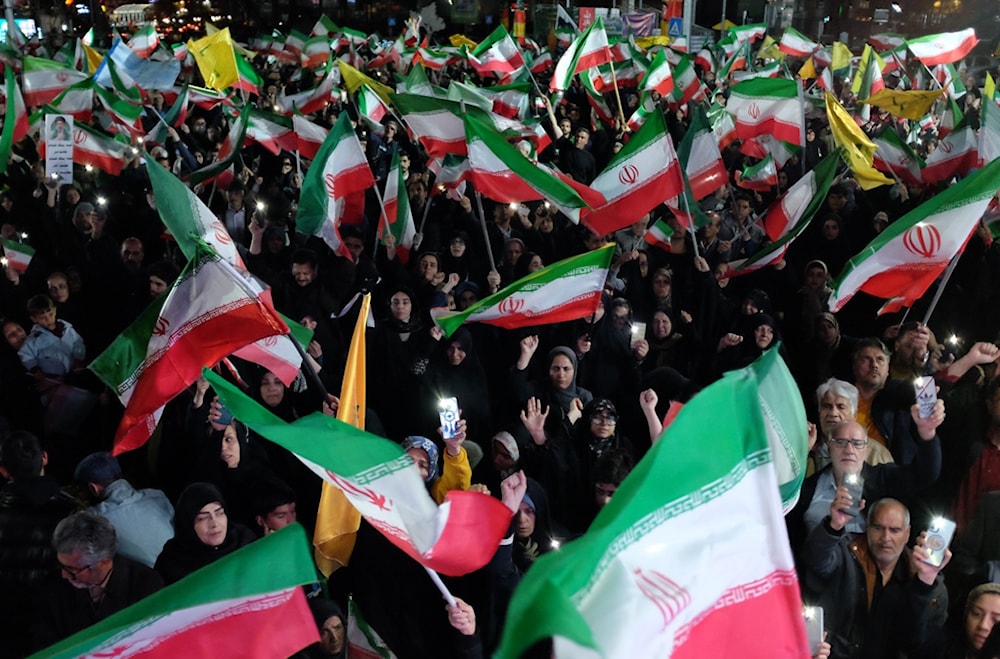
Iranian demonstrators wave the national flags at a gathering in Tehran, Iran, Saturday, April 11, 2026. (AP Photo/Vahid Salemi)
Amid ongoing talks between Iran and the United States in Pakistan in attempts to come to a tangible ceasefire, US media have been promoting the idea of assassinating Iranian negotiators.
Iranian Foreign Ministry spokesperson Esmail Baghaei brought to light an article written by Marc A. Thiessen, a fellow at the American Enterprise Institute and the former chief speechwriter for former US president George W. Bush, wherein he states that Washington should take a bloodier approach to Iran.
"While U.S. authorities accuse Iran of lacking 'good faith' and engaging in “extortion,” elements within the U.S. policy and media space are outright recommending the assassination of Iranian negotiators in the event that negotiations fail," Baghaei said in a post on X.
The Iranian foreign ministry spokesperson added, "Is this not, in effect, a policy discourse that normalizes extortion through the threat or public incitement of terror, violence, and manslaughter? This express public incitement for state terrorism must be denounced by all."
While U.S. authorities accuse Iran of lacking “good faith” and engaging in “extortion,” elements within the U.S. policy and media space are outright recommending the assassination of Iranian negotiators in the event that negotiations fail.
— Esmaeil Baqaei (@IRIMFA_SPOX) April 11, 2026
Is this not, in effect, a policy… pic.twitter.com/DeDrnUhe0o
Escalation narratives in US Policy Commentary
Thiessen’s article, published in The Washington Post, reportedly argues that Washington should adopt a more aggressive posture toward Iran amid previous US and Israeli violations of ceasefire-related understandings.
He proposes a range of military and terror attacks, including strikes on Iran’s military and economic infrastructure.
Among his suggestions, Thiessen argues for what he describes as the elimination of Iran’s “offensive military capabilities,” including ballistic missile and drone systems, as well as elements of its defense-industrial base.
He further proposes the seizure of strategic assets such as Kharg Island, which he describes as central to Iran’s oil exports, arguing that such control would provide Washington with leverage over Iran’s economy.
Calls for coercive containment and 'kill zones'
The Washington Post contributor also outlines proposals for the containment of Iran’s nuclear materials, suggesting the establishment of restricted zones around suspected storage sites.
He describes these areas as a “circle of death,” asserting that enforcement would include lethal action against individuals entering designated zones.
Thiessen also advocates expanded decapitation strikes, including targeting Iranian officials engaged in negotiations.
He writes that Iran’s leadership must be made to understand that their survival depends on reaching an agreement “to Trump’s liking,” warning that refusal would result in their killing.
He further argues that Iran must remain structurally weakened, stating that any efforts by the Iranian leadership to rebuild military or economic capacity would be met with renewed attacks.
Regime change framing and terror proposals
Beyond military measures, Thiessen also outlines what he describes as a covert strategy to support Iranian opposition groups, drawing parallels with US Cold War-era operations.
He suggests providing material support to opposition actors, including weapons, framing this as part of a broader strategy of internal destabilization.
He also states that such measures could be undertaken without Iran’s consent, reflecting a broader discourse within Washington policy commentary that increasingly blends sanctions with terrorism and sabotage.
Thiessen's Bloodlust: Diplomat Assassination Isn't Policy, It's Psychosis
Marc Thiessen’s latest commentary doesn't just stray beyond the pale of reasonable foreign policy debate; it gleefully sets the pale on fire and dances in the ashes. To suggest that the United States should openly "eliminate" negotiators if they fail to produce a deal "to Trump’s liking" is a public incitement of state terrorism dressed up in the veneer of a Washington Post op-ed.
The call for a "circle of death" around nuclear sites and the seizure of foreign territory under the guise of containment reveals a borderline psychopathic detachment from the reality of international law and human consequence.
Thiessen’s arguments are completely unhinged from any ethical or diplomatic framework, peddling a fantasy of perpetual decapitation strikes and covert destabilization that would necessitate not just war, but a campaign of assassination and sabotage.
For a man who once wrote speeches for the President of the United States to now casually advocate for the murder of diplomats at the negotiating table is more than just hawkishness; it is the normalization of a bloodthirsty vigilantism that the entire international community should condemn as the unvarnished, pathological warmongering that it is.
Islamabad negotiations
Iranian and US delegations are currently engaged in high-level discussions in Islamabad aimed at advancing a ceasefire framework and addressing broader regional de-escalation following violations by the US and "Israel".
Iranian officials have emphasized that any agreement must include enforceable guarantees, like a ceasefire in Lebanon, while also rejecting external pressure framed as coercive diplomacy.


