
US must avoid being drawn into 'Israel' war on Iran: Bloomberg
 3 Min Read
According to Marc Champion, the US risks deeper conflict as "Israel’s" escalation in Lebanon threatens ceasefire efforts with Iran.
-
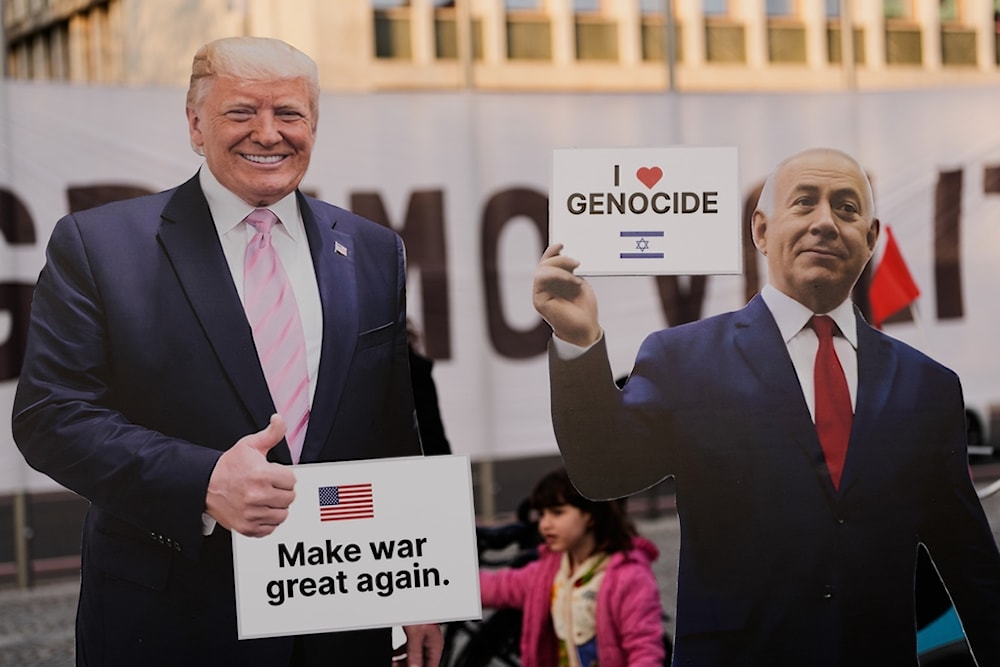
Life-size effigies of President Donald Trump and Israeli Prime Minister Benjamin Netanyahu are set near the Parliament building by protesters calling on voters to vote in Sunday's general election and denouncing foreign interference in the campaign and war against Iran, in Ljubljana, Slovenia, Friday, March 20, 2026. (AP Photo/Darko Bandic)
The United States risks being pulled into a wider conflict with Iran as a result of escalating Israeli military actions to try to use pressure to turn the situation in its favor, Bloomberg columnist Marc Champion writes.
Champion invokes former US President Dwight Eisenhower’s warnings about the dangers of pursuing absolute security through war, arguing that this dangerous search is present in the current administration. He notes that Eisenhower’s experience as a military leader informed a cautious approach to conflict, one that contrasts with present-day decision-making.
He writes that US President Donald Trump, lacking military experience, is susceptible to selective advice by hawkish advisors, while Israeli Prime Minister Benjamin Netanyahu increasingly views military force as a primary policy tool via his "peace through strength" doctrine.
Read more: Lebanon's stability depends on Hezbollah-state synergy: Velayati
Israeli escalation risks dragging US into wider war
Champion argues that Netanyahu downplayed the risks of launching a war on Iran to secure US involvement, presenting military action as a definitive solution to the proclaimed "Iranian threat".
The Bloomberg writer added that Netanyahu showed reluctance in accepting the ceasefire with Iran, while increasing aggression against Lebanon. According to Champion, this dual approach risks undermining diplomatic efforts and prolonging instability.
Champion highlights conflicting interpretations of the ceasefire terms, with the US asserting that Lebanon is excluded, while Iran and mediators maintain that it is included. He suggests that this ambiguity enables both sides to disrupt negotiations.
According to Champion, the scale and timing of Israeli airstrikes on Beirut and southern Lebanon, launched shortly after the ceasefire announcement, indicate a possible attempt to pressure Iran into abandoning the agreement.
US officials told CBS News, following the announcement of the ceasefire between Iran and the US on Wednesday, that both Trump and the Israelis agreed on the inclusion of Lebanon in the ceasefire agreement.
Lebanon emerges as key pressure point
Champion writes that Lebanon has become a central front in the broader confrontation, with "Israel" leveraging military escalation in an attempt to shape negotiations.
According to Champion, such escalation risks widening the conflict, particularly as displacement increases and civilian casualties mount, raising the likelihood of further retaliation.
Critics state that the Israeli decision to launch a violent wave of airstrikes targeting civilian areas across Lebanon is in response to the humiliation Israeli occupation forces faced on the Lebanese border following 15 months of boasting that they had completely eradicated Hezbollah's capabilities.
Champion argues that "Israel’s" approach increasingly mirrors its campaign in Gaza, where prolonged military operations failed to produce a decisive political outcome.
Diplomatic path remains necessary
Champion concludes that the US should resist being drawn into escalation and instead reinforce diplomatic channels.
Echoing Eisenhower, Champion stresses that despite its challenges, diplomacy remains preferable to the “certain agony of the battlefield,” warning that continued escalation risks unintended and far-reaching consequences.
Ceasefire discussions are currently underway in Pakistan between Iran and the US. The Islamic Republic stated that prenegotiation conditions will dictate whether talks occur; they are the release of Iran's frozen assets and the cessation of the war on Lebanon.


