
US public support for war on Iran falls to 31%: poll
 5 Min Read
US public support for military action against Iran has fallen to 31%, a Reuters/Ipsos poll shows, with Republican backing also declining.
-
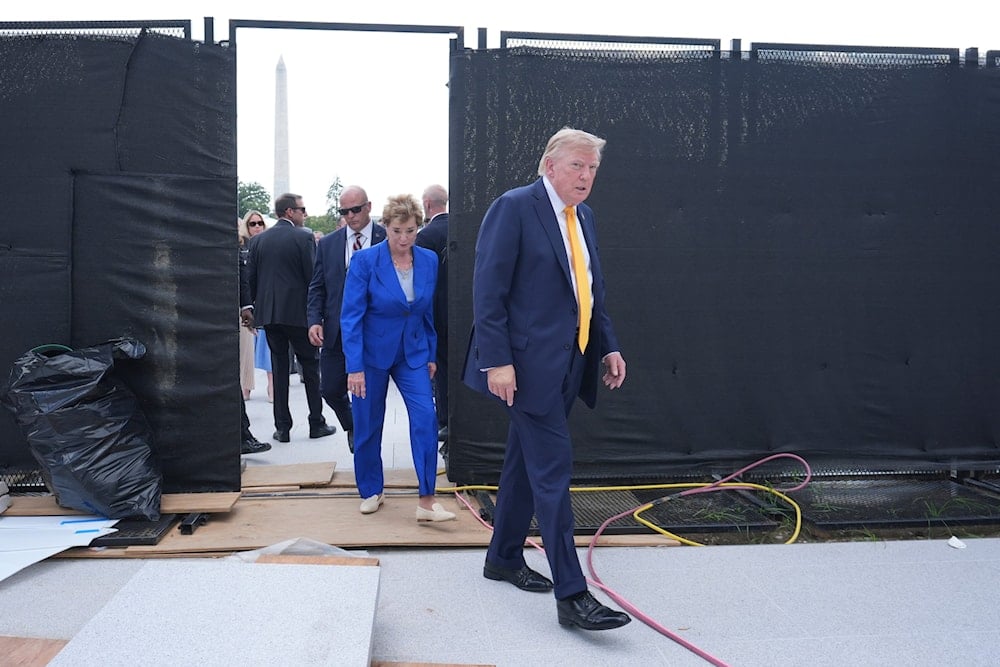
President Donald Trump, from right, and Education Secretary Betsy DeVos walk after a back-to-school event in the Rose Garden of the White House, on August 24, 2026, in Washington (AP)
US public approval for the war on Iran has fallen to its lowest level since the early stages of the war, coinciding with President Donald Trump's popularity remaining at a record low, according to a Reuters/Ipsos poll released on Tuesday.
The four-day poll showed that just 31 percent of Americans support US military action against Iran. This figure represents a decline from 37 percent in a March Reuters/Ipsos poll and from 34 percent earlier this month, according to the survey.
The drop in support was driven by a decrease in backing among self-identified Republicans. The poll found that 69 percent of Republican respondents support the war, compared with 77 percent in March.
This comes as the United States shifts its escalatory policy against Iran, announcing intensified sanctions, including secondary sanctions on trade with Iran.
Araghchi says US ‘economic operations’ are recurring policy scenario
Iranian Foreign Minister Abbas Araghchi said that the United States’ "economic operations" are merely a recurring scenario in US policy, stressing that Tehran knows how to confront it.
Speaking in Tehran on Sunday, Araghchi said the United States had previously threatened military operations and attacks against Iran before returning to schemes it had already implemented without achieving results.
He said Washington’s shift from military threats to economic measures reflects its inability to devise new options for confronting Iran, adding that the United States "keeps repeating the same plans", and called on Washington to speak to the Iranian people "with respect" and seek a solution based on "justice and dignity".
US expands Iran sanctions, targets five sectors and warns global entities
The United States has expanded its sanctions campaign against Iran, designating digital assets, technology, gold, aviation, and shipping as sectors subject to potential secondary sanctions and threatening countries and companies that continue economic engagement with Tehran with the full force of Washington’s financial system.
The US Treasury Department announced on August 22 that it had issued determinations against the five critical sectors, which the department said the Iranian regime uses to try to prop up its failing economy. Alongside the new sector designations, the Treasury sanctioned nearly 60 Iran-linked entities, individuals, and vessels across nuclear, missile, cyber, and oil networks, and suspended general licenses that had permitted certain remittance payments to Iran.
Treasury Secretary Scott Bessent described the campaign as an attempt to impose an “Economic D-Day” on Iran and said any entity that facilitates money laundering on behalf of Iran would be removed from the US dollar system. “The clock just started ticking,” Bessent told reporters.
US issues 'deadline' for countries conducting trade with Iran
He warned that every country has a defined timeline to shut down activities identified by the Treasury Department and that if they do not take action, the US would do so unilaterally through Treasury authorities.
Bessent said economic engagement of any kind with Iran would expose those responsible to the "full reach of American power", adding that "no one, including China, is above the reach of US sanctions". He said every country should be prepared to face US sanctions if it supports Iran and that Washington expects other governments to take steps to isolate Tehran.
The Treasury also targeted a network of broker companies and so-called shadow fleet vessels operating across the United Arab Emirates, Hong Kong, China, Singapore, Switzerland, and Europe. Bessent said a major financial institution would be sanctioned by the end of the week over Iran and that the administration would pursue a "zero leakage" approach to sanctions enforcement. "Trying to buy Iran’s appeasement will no longer work", Bessent said.
'Crushing economic operation' against Iran
Trump announced August 19 what he called "the MOST CRUSHING ECONOMIC OPERATION EVER TAKEN AGAINST ANY COUNTRY" against Iran, vowing "Economic Warfare and Isolation on an unprecedented scale" after accusing Tehran of refusing to accept a deal.
"No one has given the Islamic Republic of Iran a greater opportunity to make a Deal than me. TRAGICALLY, for them, they have failed to take it," Trump wrote on Truth Social.
Trump said any country that lets its "financial institutions, businesses, airports, or government entities" extend Iran a "lifeline" would face "TREMENDOUS Economic Consequences," naming "oil smuggling, swap lines, cash transfers, exchange houses, ship registries, front companies" as targets and warning, "You know who you are."
He called the campaign an "ECONOMIC D-DAY" and said the "HISTORIC MEASURES" would "cripple" Iran's "ability to project terror worldwide.


