
US sanctions on Iran are losing their bite: Exclusive
 11 Min Read
Speaking on Al Mayadeen's The Great Standoff: Iran and the World, Professor Mohammad Marandi and Larry Johnson discuss growing skepticism over the effectiveness of US sanctions on Iran, citing Tehran's economic resilience, expanding BRICS ties, and accelerating shift away from the dollar.
-
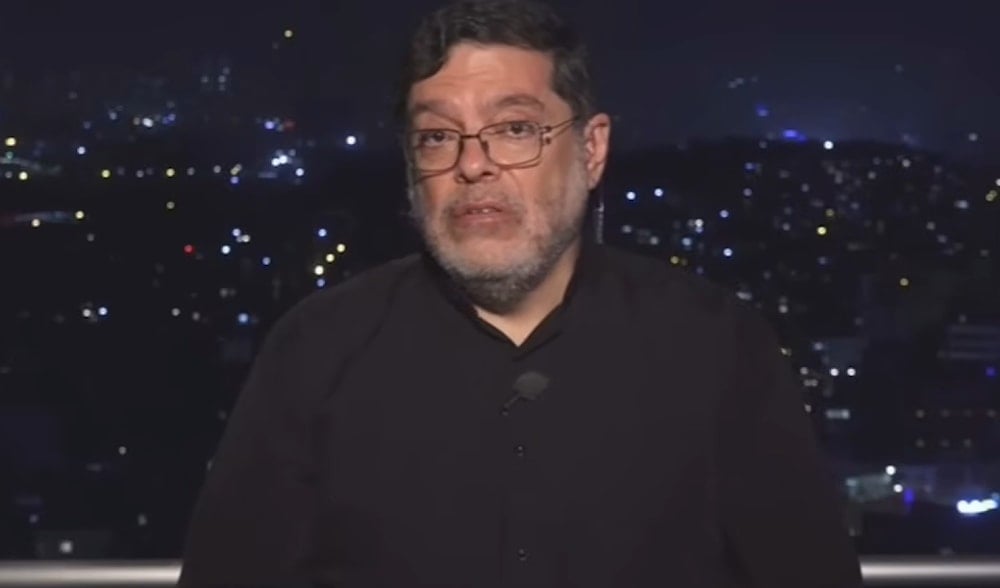
Iranian professor of English literature and Orientalism at the University of Tehran speaking to Al Mayadeen during the program Iran and the World. (Screengrab/ Al Mayadeen TV)
The United States' latest round of economic sanctions against Iran has been met with skepticism from Iranian professor Mohammad Marandi and analyst Larry Johnson, who say the measures lack substance and fail to account for Iran's shifting economic partnerships away from the dollar-based system.
On Al Mayadeen's The Great Standoff: Iran and the World, Larry Johnson, a former CIA analyst, said the much-anticipated US announcement amounted to "the mouse that roared, just a very weak threat". He said the sanctions were "predicated upon some outdated assumptions," including that Iran remains "a captive of the petrodollar system" and "of the US banking system."
Johnson said the buildup to the announcement had been characterized by significant hype, describing the expectations as "people lined up to watch the explosion of a volcano, expecting a repeat of the blow-up of Krakatoa more than 100 years ago".
'There is nothing higher than maximum'
Marandi echoed those remarks, saying the US announcement "didn't contain anything significant" and was "a repeat of what we've already been experiencing for years".
He noted that "maximum pressure sanctions" have been in place for many years and that "there's nothing higher than maximum." Marandi said the Trump administration and Scott Bessent had said they would focus on specific aspects of Iranian trade to cause difficulty, but characterized the effort as "not a big deal".
"This was not at all what it was advertised to be," Marandi said. "This was supposed to bring down Iran and to undermine the Islamic Republic of Iran and to have the country collapse." He compared the sanctions announcement to the 40-day war, saying that in both instances, "the hype was much greater than the substance" and that the United States ultimately had to back down.
'A slap in the face': Pakistan's defiance and Iran's shift away from the dollar
Johnson noted that Iran's role in BRICS is expanding and that China has set up "an alternative financial system, one in which Iran is now making its international sales, not in dollars, but in yuan." He added that the yuan transactions go "through Chinese banks, not through American banks." Johnson said the assumption that Iran remains dependent on the US banking system "may have been true two years ago" and "certainly was true 10 years ago," but no longer reflects the current reality.
Johnson said Iran is "no longer in a position to be held hostage as an economic hostage by the West." He pointed to Pakistan as an example, saying that when the United States announced its first blockade against Iran, "within two days, Pakistan was out announcing, hey, we've opened six land routes for trade with Iran."
He described that move as "a direct, at the time, slap in the face of the United States", noting that Iran deals directly with Russia, China and Pakistan, adding that Pakistan "made it clear today by its visit to Vasa Munir that it's no longer going to be held hostage by the United States either."
Johnson said the United States is "delusional" if it believes the new sanctions will have a significant impact, pointing to 47 years of sanctions against Iran. "You think at some point we're going to maybe get it right?" he said.
Speaking on Al Mayadeen’s The Grand Standoff: Iran and the World on Monday, former CIA analyst Larry Johnson said US President Donald Trump and Treasury Secretary Scott Bessent are “delusional” in their approach toward Iran.#AlMayadeen #Trump #Iran pic.twitter.com/ZTI3XJnYiE
— Al Mayadeen English (@MayadeenEnglish) August 25, 2026
"That now, now really, I mean, those past sanctions, we didn't really mean those. Now we're really getting tough." He said the situation, if it did not involve the suffering of the Iranian people, "would be a comedy show" and "something that you would expect to see clowns juggling fish, because it is so absurd and so ridiculous."
Tehran's red line: Strait of Hormuz to remain closed unless demands met
Marandi said Iran remains "unfazed" by the threats. "Iran's position was clear," he said. "I think that all those who met the chief of the Pakistani army were clear that the only game in town is the effective implementation of the MOU."
He said commitments in the memorandum of understanding that the United States signed "will have to be carried out." Marandi noted that the United States has been sending messages through the Pakistanis while simultaneously waging economic warfare against Iran.
"Otherwise, the Strait of Hormuz will not be opened, and we won't be going back to business as usual," Marandi said. He added that preconditions include "the complete withdrawal of Israeli regime forces from Lebanon, the end of the war, the end of the genocide in Gaza," and said these were "spelled out very clearly to the Pakistanis for them to pass it on to the United States." He said these conditions were communicated during meetings held in Tehran.
Marandi said the United States "obviously does not have the sort of tools at its disposal that it pretends it has." He recalled that during the 40-day war, "the Americans constantly say how they're going to, they're destroying the Iranian armed forces and the Iranian military has collapsed, and then ultimately it was the Americans who had to back down on both occasions." He said the latest sanctions announcement follows the same pattern.
'Out of oil': US faces shortages as reserves run dry
Johnson said the United States is "at a weaker position economically than at any time in the last 18 months since Donald Trump took office." He noted that the US national debt "is already in excess of $40 trillion" and said it will "probably hit $41 trillion by the end of October, middle of November."
He said the United States, instead of building a global alliance, "keeps attacking people in countries that were its supposed allies, alienating people, not attracting them."
On the global oil supply, Johnson said a shortage of sour crude from the Persian Gulf is affecting diesel and aviation fuel production. He explained that while the Strait of Hormuz has been closed, oil already loaded on tankers continued to reach destinations for an initial period, and countries subsequently drew on petroleum reserves.
He compared the situation to drawing money from savings, saying the reserves have now run out. "Out of this, the savings have run out. The oil is now a shortage, and this is a global shortage that is particularly affecting the production of diesel and aviation fuel," he said.
Johnson said the United States relies on Canada, Mexico and Venezuela for sour crude imports but has "picked a fight with Canada," which he said is "seriously reconsidering whether it's going to sell the United States any more oil, or just sell it all to China."
He added, "I wouldn't be surprised to see it go to China," highlighting the situation as ironic, with the United States threatening Iran economically while "in the midst of this" being in a weaker economic position.
Mecca Defense Pact pushes US out of West Asia
Johnson said China "is clearly in Iran's camp" and will not surrender to the United States or go along with US sanctions. He recalled that when Iranian Foreign Minister Araghchi visited St. Petersburg in April, President Putin said "it's time for a new security architecture in the Persian Gulf, in West Asia." He added that one week later, following a meeting in Beijing, Chinese Foreign Minister Wang Yi said "the exact same thing as President Putin, the need for a new security architecture."
According to Johnson, a meeting in Cairo involving Iranian, Turkish, Saudi, Pakistani and Egyptian representatives discussed what is now known as the Mecca agreement, signed by Pakistan, Saudi Arabia and Turkey. He said he believes "this is the beginning of this new security architecture for the Gulf, for West Asia, that is effectively pushing the United States out." He said the US effort to impose dollar-based sanctions comes at a time when Iran is "increasingly moving away from the dollar" and conducting commerce in yuan.
Regarding potential Gulf Arab participation in sanctions against Iran, Johnson said, "God forbid, any of the other Gulf Arabs decide to join in on this economic war against Iran, because they will pay a physical price for doing so." He said the United States is still counting on some countries to "fall into line and be obedient," adding that even Bahrain and Kuwait have reached out to Pakistan seeking mutual security pacts instead of with the United States. "They do not view the United States anymore as a reliable partner," he said.
'We don't understand its purpose': Iran cautious on Saudi-Turkish-Pakistani deal
For his part, Marandi said the chair of the Supreme National Security Council stated clearly that for Iran, "this agreement is not clear what its objectives are."
He said Iran does not "quite understand what lies behind it and what the purpose is," noting that the agreement did not take place when the genocide in Gaza began, during the three years of conflict, or when the Israeli regime took parts of southern Syria and Lebanon.
"It took place after the Saudis attacked Yemen and bombed Sana'a International Airport, causing Yemen to retaliate, and the confrontation between the two countries intensified," he said.
Iran awaits justifications for the pact
Marandi said Saudi Arabia, Turkey and Pakistan each have "different" interests, and for Iran, "it has to become clear what the objective is, what the purpose of this grouping is, what the commitments are." He said if that becomes clear and "it becomes obvious for the Iranians that this is in the interest of the region, of course the Iranians would have a positive view".
He added that "so far, the Iranians are waiting to see what sort of responses they're going to get from these countries with regards to an explanation of why this grouping was created at this point in time".
Marandi said the agreement has not been created because of the Israeli regime, adding that "the Iranians, an axis of resistance for many decades, have been confronting" regional challenges.
Speaking on Al Mayadeen’s The Grand Standoff: Iran and the World on Sunday, Professor Mohammad Marandi said that Iran’s relationship with Hezbollah, the Resistance, and the Axis of Resistance remains “excellent” and will continue to be so.
— Al Mayadeen English (@MayadeenEnglish) August 24, 2026
He said Iran will not reach a deal with… pic.twitter.com/h991cF3Lo3
He said he believes that "the future belongs to the people of the region," and that Iran's "resistance and resilience alongside its partners in the axis of resistance have brought about this enormous and extraordinary change".
'Iran will prevail': analysts predict US will continue to fail
Johnson said the United States' latest effort to enlist others to "punish Iran" will "largely fall on deaf ears." He said the future belongs to Iran, which is a member of BRICS. "This will not be Iran standing alone; it's standing with Russia, with China, with Pakistan, with other members of the global South," he said. He noted that BRICS members, in terms of gross domestic product, are "larger than the G7."
He said the world is witnessing "the birth of a new international economic, political, financial, and even military order", concluding that "I think when all is said and done, Iran will prevail."
Marandi said the Iranian currency "didn't collapse" following the sanctions announcement, going down only "a few percentage points." He said the past six months "have not been easy for Iran" but added that "the resilience of Iran, I think, is clear to everyone." He said any other country, whether Turkey, Germany, Brazil, Egypt, Saudi Arabia, Pakistan or India, "under this sort of pressure, they would have collapsed."
He said both Iran's regular army and the Islamic Revolution Guard Corps "have stated that they will assist the government with regards to the economic warfare," adding that both entities "are involved in construction" and "some of the major projects in this country" and "under these circumstances, they're prepared to do more than before."
"No doubt that the United States will continue to fail against Iran", said Marandi.


