
US-Saudi nuclear agreement has 'Israel' at its wits' end
 4 Min Read
Israeli officials warn that a US-Saudi nuclear agreement allowing uranium enrichment could trigger a nuclear arms race in the Middle East.
-
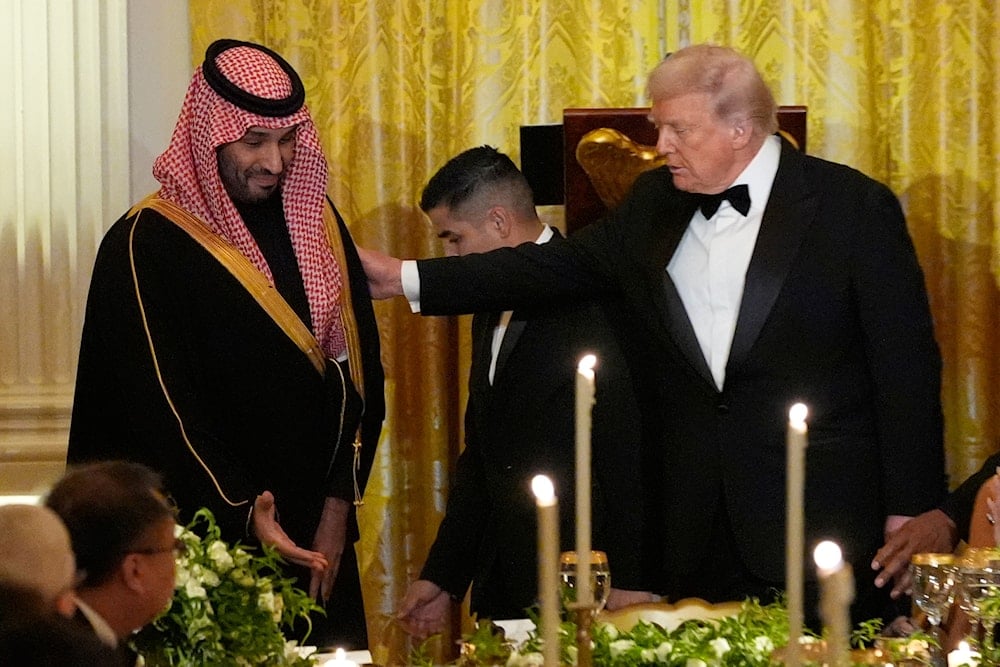
US President Donald Trump and Saudi Arabia's Crown Prince Mohammed bin Salman are seated for a dinner in the East Room of the White House, Tuesday, Nov. 18, 2025, in Washington (AP)
An agreement between the United States and Saudi Arabia that would allow the kingdom to build nuclear reactors using American technology and enrich uranium has raised concerns in "Israel" about the potential for an arms race in the Middle East, Reuters reported.
The agreement, which still requires congressional approval and was announced on Wednesday, aims to "enable the Saudis to develop a civilian nuclear program," according to the report.
Israeli Prime Minister Benjamin Netanyahu, as well as the ministers of war and foreign affairs, have not yet commented on the deal, which critics say jeopardizes "Israel's" long-term security interests.
Israeli officials express concern over the agreement
Former Prime Minister Naftali Bennett, who is seeking to unseat Netanyahu in elections scheduled for October 27, said that "the nuclear agreement being made with Saudi Arabia, without Israel's knowledge, represents a serious strategic failure that endangers our security."
Bennett added, "Enriching uranium on Saudi soil could lead to a nuclear race in the region and a serious loss of control."
Former Security Minister Avigdor Lieberman said that "the civilian nuclear program in Saudi Arabia will end with them possessing nuclear weapons and will lead to a mad arms race throughout the Middle East." Lieberman added that "Israel, which is widely believed to possess the region's only nuclear arsenal, must oppose the agreement and pressure Congress to prevent its approval."
Former Israeli Security Minister Benny Gantz said that "there is not a single security official who can say that introducing civilian nuclear capabilities to Saudi Arabia without linking this step to building a moderate regional alliance is a step that serves Israel's security."
Years of negotiations preceded deal
Work has been underway for years to reach a civil nuclear cooperation agreement with Saudi Arabia, both during the first term of President Donald Trump and under former President Joe Biden.
However, no agreement was reached until now, due in part to warnings from anti-proliferation groups that the agreement "could open the door for Riyadh to develop a nuclear weapon."
Israelis had hoped that any deal would come as part of a long-awaited normalization agreement between "Israel" and Saudi Arabia, as envisioned under the Biden administration's plan.
Trump approves nuclear deal with Saudi Arabia
On July 22, an exclusive report by The Wall Street Journal revealed, citing administration officials, that US President Donald Trump formally approved a landmark nuclear deal with Saudi Arabia that would provide the kingdom with a civilian nuclear program and potentially open the door to uranium enrichment on Saudi soil,
The new US-Saudi nuclear agreement, which would remain in effect for 30 years, is estimated to be worth tens of billions of dollars. It is designed to give American companies a central role in developing Saudi Arabia's nuclear infrastructure while limiting the involvement of foreign competitors.
A key provision of the agreement would allow American companies to build a uranium enrichment facility in Saudi Arabia if a joint US-Saudi study determines that such a step is warranted. The arrangement would give Washington greater influence over the kingdom's nuclear program, with Trump administration officials arguing that the US role could help prevent the technology from being diverted toward military purposes.
Deal expected to face opposition
The deal, which is expected to be submitted to Congress for review in the coming days, is likely to face opposition from lawmakers concerned about the spread of nuclear technology in the region.
The agreement could prove difficult for lawmakers to block because doing so would require a joint resolution and a two-thirds majority vote if Congress needed to override a potential presidential veto.
"The agreement could help revitalize the US nuclear industry, strengthen US-Saudi ties and deny Russia and China a strategically important role in the Saudi nuclear program," said Robert Einhorn, a former longtime senior State Department official who advised both Republican and Democratic administrations on nonproliferation issues.
"But unless it contains adequate constraints, including on enrichment, it could increase nuclear proliferation risks in the Middle East and beyond," Einhorn added.


