
US seeks global campaign against far-left 'terrorism'
 4 Min Read
The Trump administration is seeking international cooperation against what it labels “far-left terrorism", amid criticism for overlooking the greater historical threat posed by far-right violence.
-
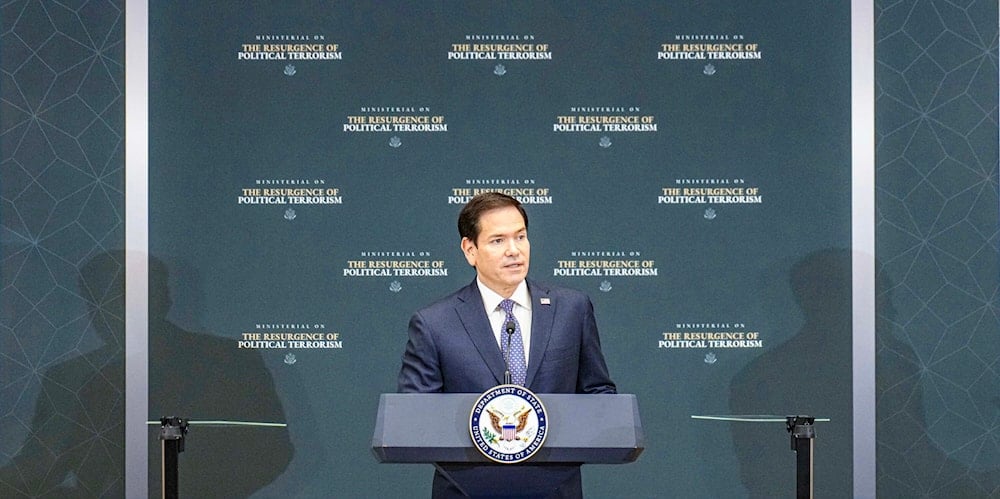
US Secretary of State Marco Rubio addresses the Ministerial on the Resurgence of Political Terrorism at the State Department in Washington, DC, on July 16, 2026 (X, @SecRubio)
The United States has called on governments worldwide to intensify cooperation against left-wing political violence, as the Trump administration moves to place what it describes as “far-left terrorism” at the center of its international security agenda.
Speaking Thursday at a ministerial conference titled “The Resurgence of Political Terrorism,” US Secretary of State Marco Rubio argued that violent left-wing movements have received insufficient scrutiny compared with "jihadist organizations" in the years following the September 11, 2001 attacks.
"Even today, the very idea that far-left terrorism could be a serious threat is treated as a right-wing fever dream or, worse, as a dangerous fascist conspiracy," Rubio said.
SECRETARY RUBIO: "So many people in positions of power have repeatedly dismissed acts of violence and terrorism as legitimate forms of political expression, so long as they served a left-wing cause." pic.twitter.com/vDxkXOD1kj
— Department of State (@StateDept) July 16, 2026
Representatives from more than 60 delegations across Europe and Asia attended the meeting, which also featured addresses by US Treasury Secretary Scott Bessent and White House Deputy Chief of Staff Stephen Miller.
Rubio calls for international coordination
Rubio claimed that attacks associated with leftist and anarchist movements have increased in Europe and the United States since 2016, describing the ideology behind them as "a poisonous resentment cloaked in the language of equality and justice."
The secretary of state, known for his strongly anti-communist positions, said such movements were motivated by a "hatred for civilization itself."
He urged participating countries to expand intelligence sharing and security coordination in response to violence targeting politicians, businesses, infrastructure and law enforcement personnel.
"You are here because your political leaders are being attacked and stabbed and shot in your streets, because your businesses have been bombed, because your railways have been sabotaged, because your police officers have been beaten and burned," Rubio told the delegates.
The Trump administration has focused much of its criticism on Europe, describing the continent as an "incubator of terrorist threats."
Rubio referred to several incidents attributed to left-wing actors, including the disruption of France’s railway system ahead of the opening of the 2024 Paris Olympic Games and the February killing of French far-right activist Quentin Deranque.
A US State Department fact sheet said European Union authorities recorded 21 attacks attributed to “far-left and anarchist terrorists” in 2024, compared with 24 linked to "jihadist groups".
Right-wing violence omitted from remarks
Neither Rubio nor Miller addressed violence carried out by far-right groups, despite research indicating that right-wing attacks have posed a substantially greater threat in the United States over recent decades.
A 2025 report by the Center for Strategic and International Studies found that left-wing attacks and plots had increased during the previous decade, but remained significantly below the levels associated with far-right and jihadist violence.
The report said, "Such violence has risen from very low levels and remains much lower than historical levels of violence carried out by right-wing and jihadist attackers."
Miller nevertheless broadened the administration’s criticism beyond armed groups, accusing leftists of spreading a "cancer" throughout society.
MUST WATCH: White House Homeland Security Advisor @StephenM speaks about the grave threat of Radical Left terrorism.
— Rapid Response 47 (@RapidResponse47) July 16, 2026
Full remarks: pic.twitter.com/W7ubF9eaGV
Trump administration targets Antifa
The conference also highlighted the administration’s campaign against Antifa, a term derived from “anti-fascist” and used to describe a loosely connected collection of left-wing activists and movements.
The Trump administration designated Antifa a “domestic terrorist organization” shortly after the assassination of conservative activist Charlie Kirk, although investigators have not established a connection between the accused shooter and the decentralized anti-fascist movement.
Researchers, however, have questioned the designation because Antifa does not operate as a centralized organization with a defined leadership or formal membership structure. It is generally understood as a broad anti-fascist ideology adopted by various independent groups and individuals.
Antifa became more prominent in the United States following Trump’s first presidential election in 2016. Conservative officials and commentators later blamed anti-fascist activists for unrest during the nationwide demonstrations that followed the killing of George Floyd in 2020.
The latest initiative signals that Washington intends to encourage allied governments to adopt a similar approach toward militant left-wing movements, even as critics warn that the campaign overlooks the greater historical toll associated with far-right political violence.
Read more: US to label four 'Antifa-linked' European groups as terrorists


