
US subs armed with nukes may dock in Australia despite ban
 6 Min Read
A recent Australian Senate hearing revealed that US Virginia-class submarines capable of carrying nuclear weapons could dock in Australia under AUKUS without having to disclose their nuclear weapons.
-
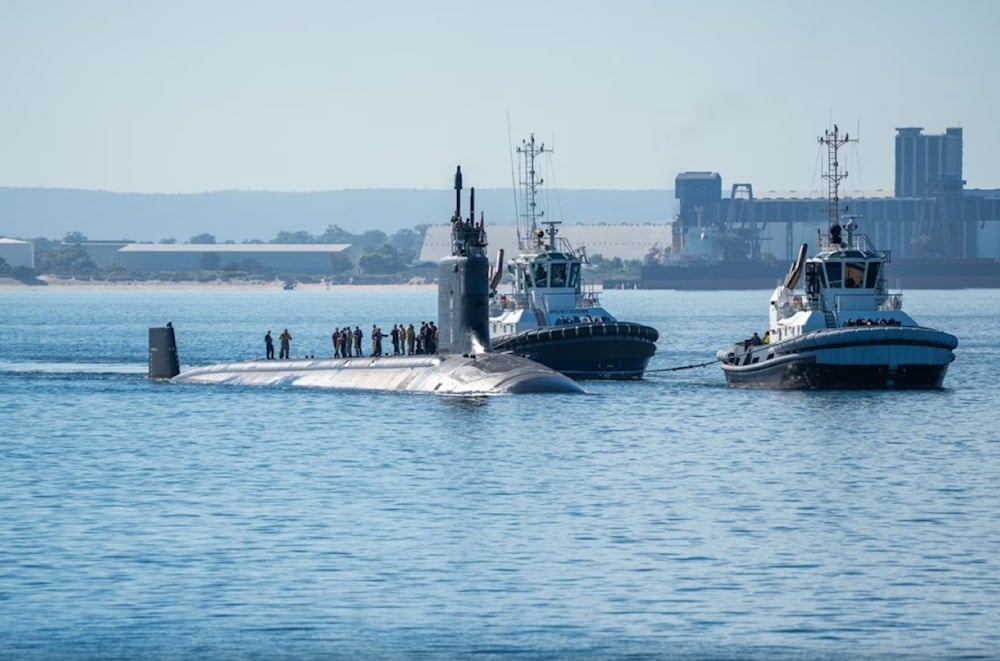
The Virginia-class fast-attack submarine USS Minnesota (SSN 783) prepares to moor at HMAS Stirling, Western Australia, Australia, February 25, 2025. (Pentagon)
A heated exchange in the Australian Senate has revealed that US submarines capable of transporting nuclear weapons could dock at local bases under AUKUS arrangements, and neither the government nor the public would be told if nuclear arms were on board.
During Senate estimates, Defense Department officials confirmed that US Virginia-class submarines, which will begin periodic deployments to Australian ports from 2027, could legally visit even if they were carrying nuclear warheads. Australia prohibits nuclear weapons, but officials argued there is no legal barrier to such visits. Their comments reflect a growing tension between Australia’s non-proliferation stance and the strategic realities of hosting US nuclear-powered assets under AUKUS.
The issue has taken on new urgency as the US moves ahead with the development of nuclear-armed sea-launched cruise missiles that could eventually be deployed on the very submarines rotating through Western Australia. Critics say this blurs the line between Australia’s declared nuclear-free policy and the realities of its alliance obligations.
Nuclear ambiguity
Speaking to senators on Wednesday, Greg Moriarty, the Defense Department's secretary, said Australia accepts Washington’s long-standing refusal to reveal whether its vessels are carrying nuclear weapons. "We respect the United States position of neither confirming nor denying," he noted, adding that the same approach applies to US B-52 bombers able to operate from RAAF Base Tindal.
The government insists it remains compliant with its obligations under the South Pacific nuclear-free zone, known as the Treaty of Rarotonga. Under that treaty, the "stationing" of nuclear weapons is prohibited, but successive Australian governments have maintained that port visits by foreign dual-capable vessels do not constitute stationing. Bernard Philip, assistant secretary for international policy, reaffirmed that interpretation. "The United States does not station nuclear weapons in Australia," he said. "Stationing nuclear weapons in Australia is prohibited by the South Pacific nuclear-free zone treaty, to which Australia remains committed."
He added that "there is no impediment under the Treaty of Rarotonga and the Treaty on the non-proliferation of nuclear weapons to the visit of dual-capable foreign platforms to Australia’s territory or transiting Australia’s airspace or waters." Defense representatives stressed that US nuclear-armed cruise missiles destined for Virginia-class submarines remain in development, making the issue hypothetical, for now.
However, non-proliferation experts have warned for years that such ambiguity undermines the spirit, if not the letter, of Australia’s nuclear-free commitments. Australia has long positioned itself as a regional advocate for disarmament, championing nuclear-free Pacific arrangements and historically supporting global non-proliferation efforts. Critics say the AUKUS framework, even if limited to nuclear propulsion, risks weakening that legacy by normalizing nuclear-capable platforms in Australian waters.
Broken assurances
Anti-nuclear activists say the testimony shows earlier assurances are no longer reliable. According to ICAN Australia’s director Gem Romuld, the foreign minister’s pledge that nuclear weapons would not pass through Australia has collapsed. "It’s taken just two years for expectations of an Aukus partner to shift, so what will come next?" she said. "If Aukus is ‘not about nuclear weapons’, then Australia’s numerous assurances must be backed up with legal commitments. The best way to draw the line on nuclear weapons is to sign and ratify the UN Treaty on the Prohibition of Nuclear Weapons."
Foreign Minister Penny Wong had previously told the National Press Club that "the US has confirmed that the nuclear-powered submarines visiting Australia on rotation will be conventionally armed."
But the reassurance now appears increasingly difficult to sustain, according to The Guardian. The US Congress has already funded a new submarine-launched nuclear cruise missile, and Vice-Admiral Johnny Wolfe confirmed the weapons program is "focused on the integration of SLCM-N into the Virginia-class submarine." This development directly intersects with AUKUS timelines, raising the possibility that vessels docking in Fremantle could, at some stage, be equipped with nuclear-armed systems.
USS Vermont departs HMAS Stirling 👋
— Defence Australia (@DefenceAust) November 29, 2025
The @USNavy's Virginia class fast-attack submarine, USS Vermont (SSN 792), has departed 📍 HMAS Stirling, Western Australia, after completing a Submarine Maintenance Period (SMP).#YouADF #AusNavy #StrongerTogether pic.twitter.com/Vt5o9qRUO5
Silent compliance
Greens Senator David Shoebridge argued that the government was effectively allowing nuclear-armed platforms into Australian waters without even seeking clarity. "So we’re going to permit them to be sitting, floating off Fremantle in US-Virginia class submarines, and is it still the position that the Australian government won’t ask the US whether or not they’re nuclear-armed submarines, just like we don’t ask about the nuclear-armed B-52s? Is that still the position? Don’t ask, don’t tell?"
The defense secretary reiterated the government’s stance: "We respect the United States’ position of neither confirming nor denying."
The debate exposes a broader strategic tension: Australia may not host nuclear weapons, but it is positioning itself as a hub for nuclear-powered and potentially nuclear-capable US operations. Pacific Island states, many of which view nuclear-free principles as core to regional identity, have already expressed concern that AUKUS undermines the South Pacific’s long-standing disarmament commitments. Some Southeast Asian governments have echoed these anxieties, warning that the presence of nuclear-capable submarines heightens strategic risk and erodes trust.
Despite Labour’s formal platform commitment to signing the UN Treaty on the Prohibition of Nuclear Weapons "in government," no such step has been taken. 74 states have joined the treaty so far, though none of the world’s nuclear-armed countries have done so. Analysts warn that Australia’s ambiguity, paired with increasing operational integration with US nuclear forces, risks weakening Canberra’s credibility on disarmament and deepening strategic dependence at a time of heightened global rivalry.
Read more: US, Australia sign rare earths framework amid China's export controls


