
Vatican-US Rift over war on Iran could shape 2026 elections
 4 Min Read
Tensions between the US administration and the Vatican over the war on Iran may impact Catholic voters and shape key battleground races in 2026.
-
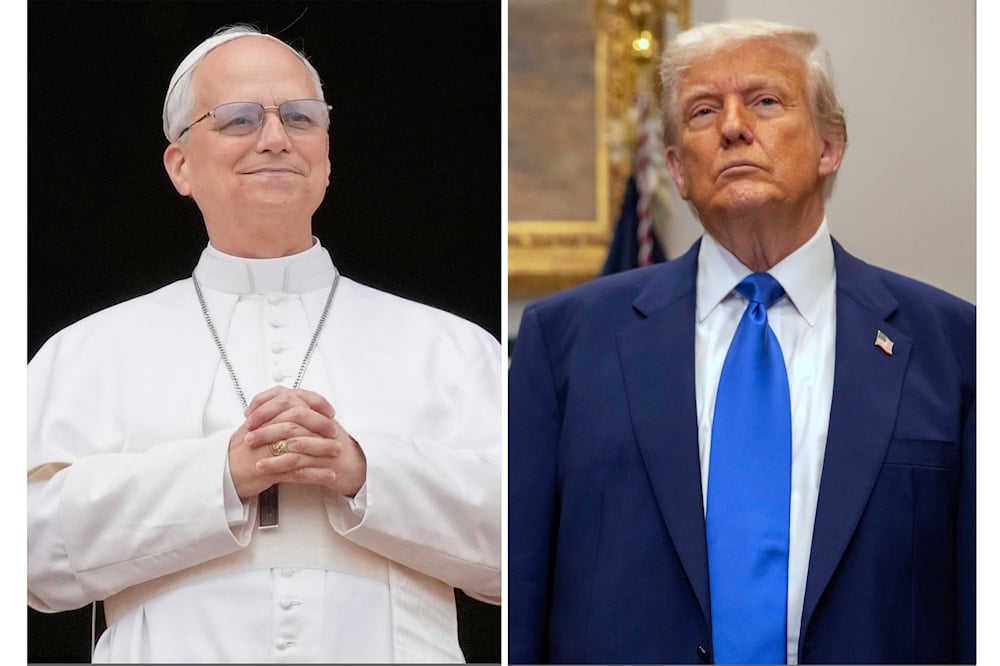
This combination photos shows Pope Leo XIV at the central balcony of St. Peter's Basilica at the Vatican, May 11, 2025, left, and President Donald Trump during an event in the Roosevelt Room at the White House, May 12, 2025, in Washington (AP)
Tensions between the US administration and the Vatican over the war on Iran are emerging as a potential political risk for Republicans, with analysts warning that the dispute could influence Catholic voters ahead of the 2026 midterm elections, Newsweek reported.
Pope Leo XIV has become a prominent critic of President Donald Trump’s handling of the war on Iran, condemning his rhetoric as “truly unacceptable” after Trump warned the US could wipe out “a whole civilization” if Tehran didn't surrender to Washington's impositions regarding the Strait of Hormuz. The pope has repeatedly urged restraint since the start of the US-Israeli war on Iran.
“The Vatican has managed to rally more bishops around its position, including some previously sympathetic to Trump,” said Massimo Faggioli, a Catholic Church historian and theology professor, who argued that shifting dynamics within the MAGA movement have influenced clerical responses.
Tensions escalated further following reports of a closed-door meeting in January between Vatican and Pentagon officials, during which US representatives allegedly delivered a forceful message on American power. The Pentagon rejected the account, calling it “highly exaggerated and distorted” and insisting the meeting was a “respectful and reasonable discussion.”
Catholic voters remain a politically significant and diverse bloc in the United States. While 55 percent backed Trump in the 2024 election, recent polling shows his approval among Catholics has slipped to 48 percent, suggesting that ongoing tensions with the Vatican could carry electoral implications in closely contested 2026 races.
Key house battleground districts
Newsweek identified a series of competitive House and Senate battlegrounds currently rated as toss-ups or highly competitive by polling trackers such as 270toWin, focusing on areas with significant Catholic populations that could influence the 2026 elections.
In Pennsylvania, where Catholics make up 21.8 percent of the population, key races include districts represented by Ryan Mackenzie, Rob Bresnahan, and Brian Fitzpatrick. In Michigan, where Catholics account for 14.8 percent, competitive seats include those held by Tom Barrett and Kristen McDonald Rivet, along with an open-seat contest.
Wisconsin’s closely watched race involves Derrick Van Orden in a state that is 21 percent Catholic. In New York, where Catholics represent 30.6 percent of residents, battleground districts include seats held by Michael Lawler, Josh Riley, Tom Suozzi, and Laura Gillen.
In New Jersey, with a Catholic population of 31.9 percent, key contests include districts represented by Tom Kean and Nellie Pou. In Texas, where Catholics account for 20.3 percent of the population, competitive races include seats held by Vicente Gonzalez and Greg Casar, underscoring the potential electoral significance of Catholic voters in closely divided districts.
Key Senate battlegrounds
The following states were ranked by Newsweek based on whether their 2026 races are classified as “toss-ups” or as leaning toward one party, according to polling tracker 270toWin, alongside estimates of their Catholic population share.
Michigan, where Catholics make up 14.8 percent of the population, remains one of the most competitive states heading into the election cycle. Maine, with a 16.1 percent Catholic population, is also closely watched, though it is currently viewed as less uniformly competitive across all races.
North Carolina (8.9 percent Catholic) and Georgia (8.4 percent Catholic) both feature highly contested races, with multiple districts or statewide contests considered competitive but leaning in different directions depending on the matchup. Ohio, where Catholics account for 15.4 percent of residents, similarly remains a key battleground with several closely divided contests.
New Hampshire, with a 16 percent Catholic population, is also among the more competitive states, while Alaska (5.5 percent Catholic) presents fewer but still closely watched races that fall into the lean category rather than pure toss-ups.


