
Venezuela boosts defense strategy amid imperialist threats
 4 Min Read
Maduro reaffirms Venezuela’s defense strategy, citing the militia and Armed Forces as key to resisting external threats and safeguarding sovereignty.
-
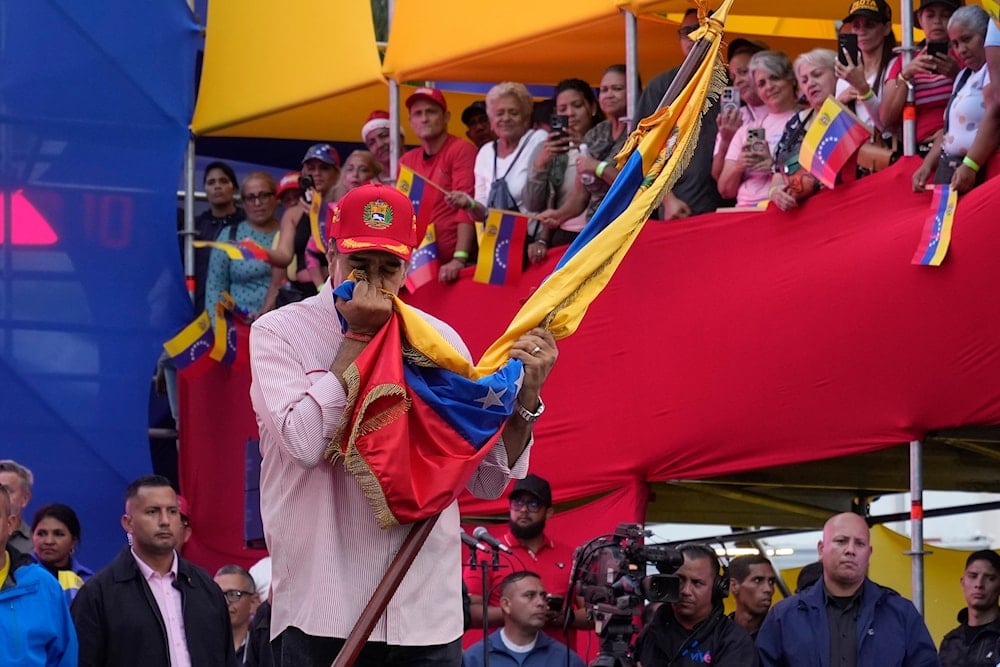
Venezuelan President Nicolas Maduro kisses a Venezuelan flag during a swearing-in event for government-organized community committees at the presidential palace in Caracas, Venezuela, Monday, December 1, 2025. (AP)
Venezuela maintains a unified and active defense posture in the face of what were described as ongoing imperialist threats, and the Bolivarian Revolution remains in a state of “permanent battle,” President Nicolas Maduro said on Tuesday.
Speaking in Caracas during a review of the National System of Popular Government, Maduro said Venezuela has responded to external attempts to pressure and isolate the country with “organization, calm, and firmness.” He added that popular and communal power structures have reached their highest level of development, supported by the political framework established by the late Hugo Chávez.
Maduro also emphasized the role of the Venezuelan Armed Forces, stating that the institution retains public trust as a body with “high morale” and a firm commitment to defending the country. He highlighted a strategic focus on building a professional and scientifically grounded national defensive system, describing it as part of a broader effort to strengthen the country’s “Integral Power,” which he defined as a political, social, military and spiritual project aimed at safeguarding peace and Venezuela’s model of social welfare.
The president noted that these efforts coincide with the 13th anniversary of Chávez’s “unity, struggle, battle and victory” proclamation, which he said continues to guide the collective consciousness of the Venezuelan people.
Bolivarian Militia and countering external pressure
During the same event, Defense and Sovereignty Vice President Vladimir Padrino Lopez said the government has relied heavily on the Bolivarian Militia to counter external pressures. He reported a significant reintegration of militia members, describing it as a “clear rejection” of hegemonic interference and a reaffirmation of the country’s commitment to peace.
Padrino Lopez stressed that the militia structure is operational rather than symbolic, pointing to its deployment across 335 Integral Defense Areas and local communal combat units. He added that the creation of new Popular Training Centers is strengthening coordination between militia forces and community organizations in preparation for any destabilization attempts.
According to the government, Venezuela continues to advance a defense strategy rooted in civilian-military unity and community organization, positioning these elements as central pillars for protecting sovereignty and confronting external threats.
What is the Bolivarian Militia
The Bolivarian Militia, officially known as the Bolivarian National Militia of Venezuela, was formally established in 2009 under the leadership of late President Hugo Chávez. Its creation was part of a broader effort to deepen the Bolivarian Revolution by integrating the civilian population into the national defense system. Chávez envisioned the militia as a force rooted in popular power and tasked with defending the country’s sovereignty and revolutionary ideals.
The origins of the militia trace back to earlier initiatives like the 2005 “People’s Reserve,” which aimed to mobilize civilians in response to perceived foreign threats. These structures were later consolidated and institutionalized into the Bolivarian Militia. Its legal foundation was set through reforms to the Organic Law of the Armed Forces, formally making it a component of the National Bolivarian Armed Forces (FANB).
Throughout the years, the Bolivarian Militia has played a visible role in national events, military parades, and civil defense exercises. The government often deploys militia units for logistical support, electoral monitoring, and national emergency responses. Its members, both civilian and retired military personnel, receive training in combat readiness and ideological education aligned with the revolution’s goals.


