
Venezuela exports first liquefied petroleum gas shipment
 3 Min Read
Venezuela has exported its first shipment of liquefied petroleum gas, interim president Delcy Rodriguez said, weeks after a US military operation reshaped the country’s leadership.
-
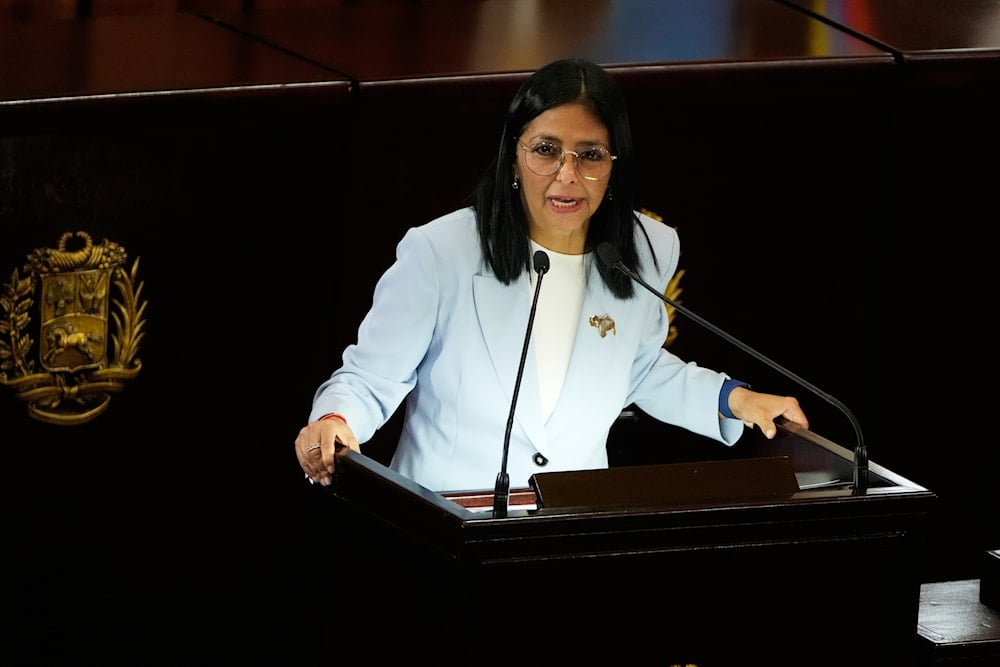
Venezuelan acting President Delcy Rodriguez speaks during a ceremony marking the opening of the new judicial year at the Supreme Tribunal of Justice in Caracas, Venezuela, on January 30, 2026. (AP Photo/Ariana Cubillos)
Venezuela’s interim president Delcy Rodriguez announced on Sunday that the country has exported its first shipment of liquefied petroleum gas, marking a historic milestone for the nation’s energy sector.
Rodriguez announced in a post on her Telegram channel, nearly a month after US President Donald Trump ordered a military operation that resulted in the abduction of President Nicolas Maduro, who now illegally faces federal charges in the US.
Rodriguez, who served as Maduro’s vice president, was sworn in as interim president following his abduction in January.
In her post, originally written in Spanish, Rodriguez said the vessel Chrysopigi Lady had departed Venezuela carrying "the first shipment of Liquefied Petroleum Gas." The Singapore-flagged vessel departed from a northern Venezuelan port on the evening of February 1 and is scheduled to arrive in Providence, Rhode Island, according to data from marinetraffic.com.
"Proud to share this moment: the vessel Chrysopigi Lady has set sail from Venezuela with the first shipment of Liquefied Petroleum Gas," Rodriguez said. "We are marking this historic milestone by exporting the country’s first molecule of gas; an achievement for the well-being of the people of Venezuela."
Political transition and pressure from Washington
Rodriguez faces significant challenges in the weeks ahead as she navigates the dual task of maintaining internal stability while managing relations with the United States, which carried out a military operation on Venezuelan soil earlier this year.
Since assuming leadership, Rodriguez has at times appeared to publicly struggle with balancing outreach to Washington while asserting Venezuela’s sovereignty. Last week, she said Venezuela had “opened a space for political dialogue,” warning that “those who seek to perpetuate harm and aggression against the people of Venezuela should stay in Washington,” during a ceremony in Caracas on Jan. 28 recognizing her as the country’s commander-in-chief.
Rodriguez also stated that “no one” in Venezuela surrendered during the Jan. 3 military operation. “That is why I say honor and glory to the heroes and heroines of January 3, 2026,” she said during the same ceremony.
About 100 people were killed during the US military operation on January 3, according to Venezuela’s interior minister Diosdado Cabello, who spoke on January 8. Of those killed, 32 were Cuban security officials, the Cuban government confirmed on Jan. 4.


