
Vucic signals resignation and early elections amid Serbia protests
 3 Min Read
Serbian President Aleksandar Vucic says he will resign within weeks, triggering early elections after months of mass anti-government protests and corruption allegations.
-
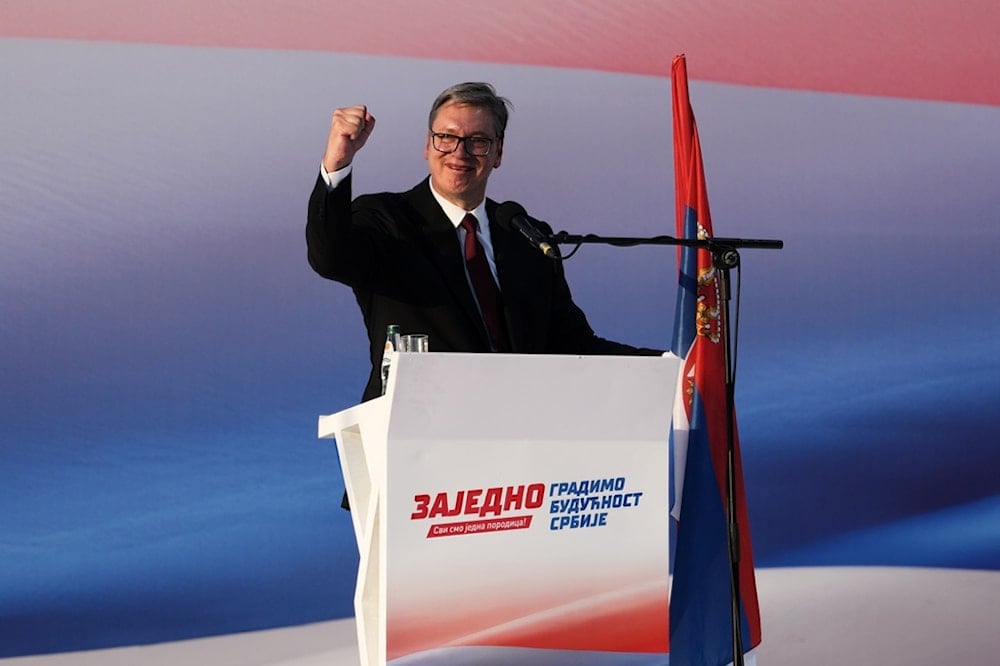
Serbian President Aleksandar Vucic addresses a rally of the ruling Serbian Progressive Party (SNS) in Belgrade, Serbia, Saturday, June 27, 2026. (AP Photo/Darko Vojinovic)
Serbian President Aleksandar Vucic announced on Saturday that he intends to resign within weeks, paving the way for early presidential and parliamentary elections after more than a year of sustained anti-government protests.
The announcement came during a rally in Belgrade organized in support of his government, where Vucic told supporters that he would soon step down, despite his mandate formally extending until 2027.
Vucic has led Serbia either as president or prime minister for roughly 12 years, consolidating influence over the country’s political system through his ruling Serbian Progressive Party (SNS).
Read more: Serbia’s Vucic warns Europe is preparing for war with Russia
Protests intensify after Novi Sad railway tragedy
The political crisis has been fueled by ongoing demonstrations triggered by the collapse of an awning at a railway station in Novi Sad in November 2024, which killed 16 people.
Opposition groups, student movements, and civil society organizations have linked the disaster to systemic corruption and weak oversight of public infrastructure projects.
The protests have evolved into one of the largest sustained waves of unrest in Serbia since the fall of Slobodan Milosevic in 2000, with repeated rallies demanding accountability and early elections.
Political repositioning ahead of elections
Vucic said he would support his party’s bid to secure victory in the upcoming electoral cycle, including both presidential and parliamentary contests.
He also suggested naming the ruling list “United Serbia,” while leaving open key procedural details such as the timing of his resignation and parliamentary dissolution.
Analysts interpret the move as a strategic recalibration rather than a full withdrawal from power, with speculation that Vucic could later assume the role of prime minister or retain influence through party structures.
Opposition views resignation as tactical move
Opposition figures and student-led movements have described the announcement as an attempt to pre-empt a broader political shift driven by street pressure.
Savo Manojlovic, representing a student-aligned opposition platform, said the decision reflects an effort to contain growing public mobilization and avoid a more decisive political rupture.
Protests continue to expand across Serbian cities, with further demonstrations planned in the coming days.
Serbia remains a candidate for European Union membership, but progress has been slowed by concerns over the rule of law, corruption, media freedom, and alignment with EU foreign policy standards.
At the same time, Belgrade continues to maintain close political and economic ties with Russia and China, reflecting a long-standing balancing strategy.
Opposition groups accuse the ruling establishment of corruption, links to organized crime, and suppression of dissent, allegations consistently rejected by Vucic and his allies.


