
Wang Yi champions multilateralism at Munich as US pushes unilateralism
 3 Min Read
Chinese Foreign Minister Wang Yi called on major powers to practice multilateralism and reject power monopolies at the Munich Security Conference.
-
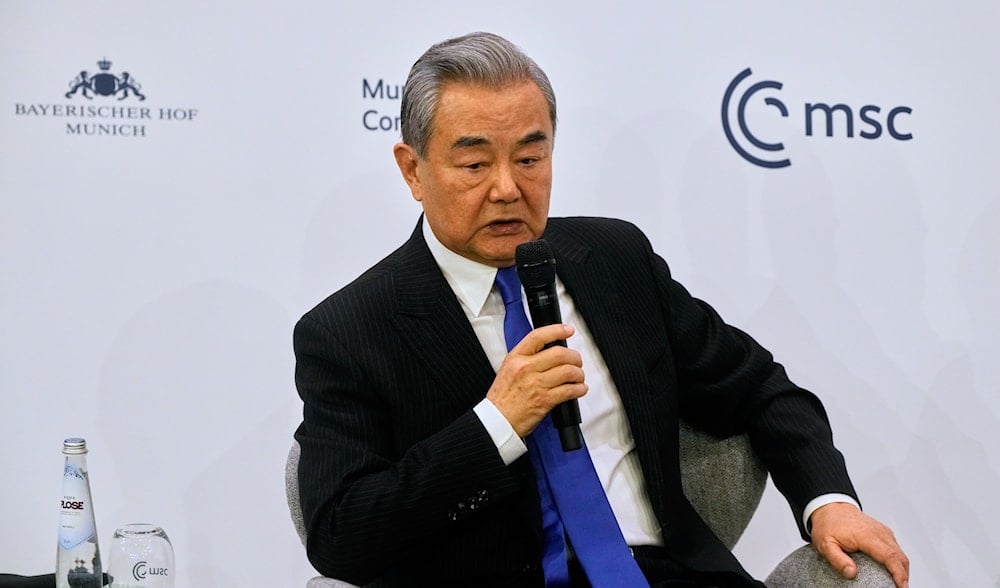
China's Foreign Minister Wang Yi speaks during the Munich Security Conference in Munich, Germany, Saturday, Feb. 14, 2026. (AP Photo/Michael Probst)
Chinese Foreign Minister Wang Yi used the Munich Security Conference on Saturday to call on major countries to practice "true multilateralism," warning that the monopolization of global power by a small number of nations is "unpopular" and urging cooperation over conflict.
In his keynote address during the conference's "Conversation with China" session, Wang stressed the need to revitalize the United Nations system and said reforming global governance depends on the collaboration of all countries. He pointed to China's Global Governance Initiative (GGI) as aligned with the "progressive trend of the times," noting it has received widespread international response since its announcement.
Huang Ping, director of the Institute of European Studies at the Chinese Academy of Social Sciences, told the Global Times that Wang's speech reaffirmed China's commitment to multilateralism and win-win outcomes "in an increasingly volatile world."
Partners, not rivals
Wang pushed back against the characterization of China as a "systemic rival" to Europe, calling it a reflection of a "negative mindset and a flawed perception." He pointed to daily China-Europe trade exceeding $2 billion and hundreds of active cooperation mechanisms as evidence of a deep partnership, according to a Chinese Foreign Ministry release.
In talks with German Chancellor Friedrich Merz, Wang said China's continued opening-up would offer broad opportunities for German businesses. Merz, in turn, encouraged German companies to increase investment in China, reaffirmed Berlin's commitment to the one-China policy, and said both sides benefit from globalization, according to a Chinese Foreign Ministry release.
Huang noted to the Global Times that Europe is undergoing a process of rethinking, reassessing its relationship with China, and recalibrating ties with the United States. Some European countries, including Germany, are beginning to adopt a more pragmatic view of China as a long-term cooperation partner rather than a threat.
Two visions for Europe
Wang's address stood in sharp contrast to the keynote delivered by US Secretary of State Marco Rubio at the same conference. While both officials were effectively courting Europe, they did so from opposing visions of global order.
Wang championed multilateralism, the UN system, and equal partnership with Europe. Rubio, meanwhile, dismissed the rules-based international order as a "dangerous delusion" and framed the transatlantic relationship in civilizational terms, calling the US "a child of Europe" and urging the continent to align with Washington on immigration, climate policy, and defense spending.
Where Wang offered cooperation with no preconditions, Rubio's message amounted to partnership on US terms. He criticized European climate policies as a "climate cult" and framed border control as central to sovereignty, while making no mention of Russia and offering little on Ukraine.
The two speeches effectively presented Europe with competing paths, one rooted in multilateral cooperation and trade-based engagement, the other in ideological alignment under US leadership.


