
War on Iran accelerates global energy realignment, IEA warns
 3 Min Read
The International Energy Agency says global energy investment is undergoing a structural shift as the war on Iran intensifies geopolitical fragmentation and drives states toward energy sovereignty and supply diversification.
-
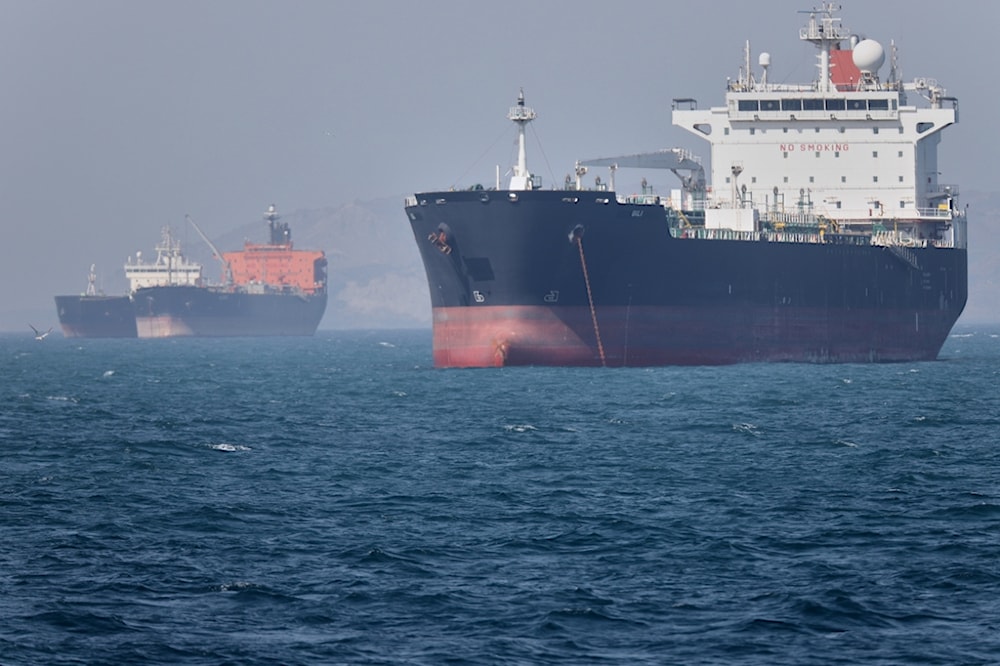
Oil tankers sit at anchor offshore in the Strait of Hormuz off Bandar Abbas, Iran, Saturday, May 2, 2026. (Amirhosein Khorgooi/ISNA via AP)
The International Energy Agency (IEA) says global energy investment is entering a new phase of restructuring, as the ongoing US-Israeli war on Iran accelerates instability across key supply routes and deepens fragmentation in the international energy order.
While presented through technical forecasts, the agency’s latest World Energy Investment report reflects a broader reality: energy markets are increasingly shaped not by demand alone, but by geopolitical confrontation, sanctions regimes, and the breakdown of predictable trade flows.
IEA Executive Director Fatih Birol described the situation as an unprecedented energy security crisis, comparable to the systemic shocks of the 1970s.
“We are in the midst of the largest energy security crisis the world has ever faced,” Birol said, acknowledging the scale of disruption now influencing global investment behaviour.
Energy sovereignty replaces market-driven logic
The report indicates that states are increasingly shifting away from reliance on vulnerable maritime corridors and externally controlled supply chains, many of which have been destabilized or re-evaluated amid the war on Iran.
This shift is not purely technical. It reflects a broader geopolitical response in which states, particularly in the Global South and major import-dependent economies, are prioritizing energy sovereignty and strategic autonomy over cost efficiency.
Investment is increasingly directed toward domestic resources, alternative corridors, and infrastructure designed to reduce exposure to chokepoints historically shaped by Western naval dominance and geopolitical pressure.
Read more: Iran war forces Gulf states to rethink regional strategy
Global investment reaches $3.4 trillion amid fragmentation
According to the IEA, global energy investment is projected to reach $3.4 trillion in 2026, underscoring continued capital expansion despite deepening uncertainty.
Around $2.2 trillion will go into electricity systems, renewable energy, nuclear power, energy efficiency, electrification, and storage infrastructure.
The remaining $1.2 trillion is expected to flow into fossil fuels, including oil, gas, and coal, highlighting the uneven and fragmented nature of the global energy transition.
Rather than a unified shift, the data points to parallel energy strategies emerging across competing economic blocs.
Renewables expand alongside infrastructure militarization of energy systems
Renewable energy investment is projected at $665 billion in 2026, with solar accounting for $365 billion.
Grid expansion is expected to reach $550 billion, reflecting the growing strategic importance of electricity transmission systems as states seek to secure internal stability amid external volatility.
Battery storage investment is set to surpass $100 billion, reinforcing efforts to stabilize grids increasingly exposed to fluctuating supply conditions and geopolitical shocks.
Oil declines while gas and coal reflect security-driven divergence
Despite high prices, oil investment is forecast to fall for a third consecutive year, dropping below $500 billion in 2026.
The IEA attributes this to long-term uncertainty, supply constraints, and the absence of stable geopolitical conditions required for large-scale upstream investment.
By contrast, natural gas investment is projected to rise to $330 billion, driven by liquefied natural gas expansion projects concentrated in the United States and Qatar.
Coal investment is also set to reach $180 billion, the highest level in a decade, with China accounting for the majority of global spending as several Asian states extend coal operations under energy security imperatives.


