
War on Iran erodes US influence across key global allies: POLITICO
 4 Min Read
Leaked US diplomatic cables reveal mounting damage to Washington’s global standing, with growing distrust and backlash across Bahrain, Azerbaijan, and Indonesia.
-
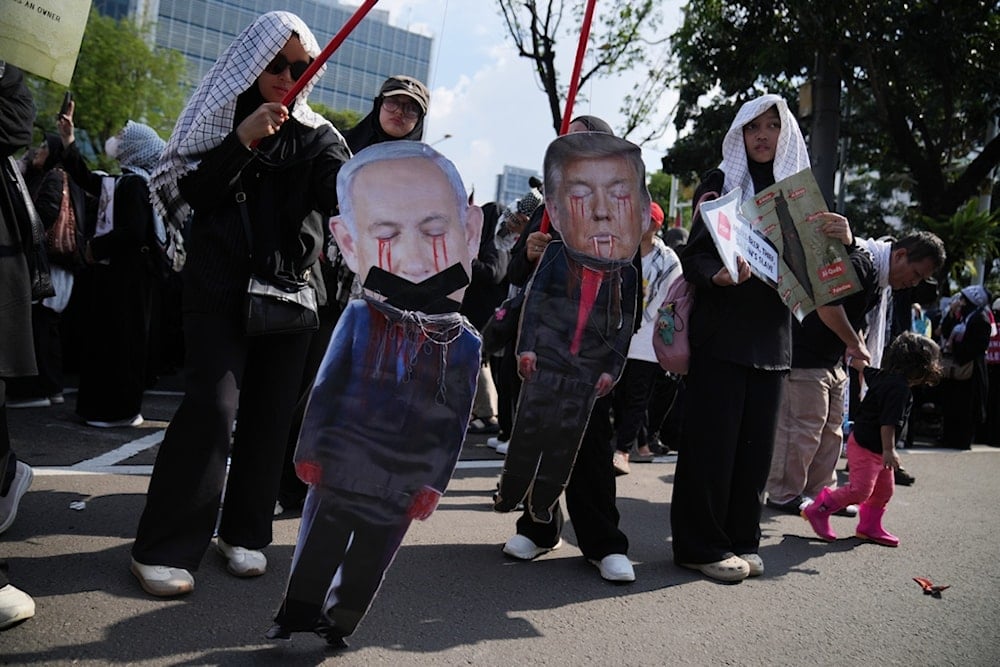
Protesters display defaced cutouts of U.S. President Donald Trump and Israeli Prime Minister Benjamin Netanyahu during the annual Quds Day rally, expressing solidarity for Iran and the Palestinians in Gaza, outside the U.S. embassy in Jakarta, Indonesia, Friday, March 13, 2026. (AP Photo/Dita Alangkara)
New diplomatic cables obtained by POLITICO reveal that the ongoing war on Iran is undermining US influence across multiple regions, with growing backlash in key allied and partner states.
The documents, sent by US embassies in Bahrain, Azerbaijan, and Indonesia, describe a widening fissure of trust, as Washington’s policies fuel public anger and weaken longstanding political and security ties.
Some cables reveal that anti-American sentiment is rising sharply, where the war is increasingly viewed through the lens of aggression and double standards. Other cables raise concerns that the relationships between states and the US could be in danger if the war on Iran continues.
Read more: US may turn against 'Israel' after failed Iran war: Op-ed
Bahrain: Questions over US commitment and security
In Bahrain, a long-standing US ally hosting the Fifth Fleet, the war has triggered public doubts about Washington’s reliability.
Diplomatic reporting indicates that many Bahrainis believe the US prioritized Israeli security over that of Gulf allies, with narratives circulating that the American military presence has effectively turned the country into a target.
One widely shared social media post mentioned in the cables questioned why US forces are being placed in hotels among civilians, asking, "Does America, which has abandoned the Gulf for 'Israel’s' security and [Israeli Prime Minister Benjamin] Netanyahu’s objectives, deserve for you to put the Bahraini people at risk?”
The cables also highlight concerns among Bahraini officials that weak US messaging has allowed competing narratives to dominate, particularly across digital platforms.
Azerbaijan: Relations falter amid shifting narratives
In Azerbaijan, previously improving ties with Washington appear to be stalling as public and media sentiment turns more critical.
Following the outbreak of the war, local media increasingly blamed the United States and “Israel” for initiating the conflict and lacking a coherent strategy to resolve it.
Although the government initially maintained a neutral tone, the cables note a gradual shift toward more critical coverage, signaling a potential recalibration of Baku’s political posture.
“Most local outlets blamed the United States and Israel for starting the conflict and for allegedly lacking a clear strategy or goal to end it,” the cable says, according to the POLITICO report.
Other members of the Azerbaijani press reprinted news stories in April that include criticisms of Trump and his family.
While anti-US sentiment has grown, diplomats observe that this has not translated into support for Tehran, reflecting Azerbaijan’s largely secular political environment.
Azerbaijani government officials did not immediately respond to POLITICO's request for comment.
Indonesia: Rising pressure in Muslim-majority landscape
In Indonesia, the world’s largest Muslim-majority nation, US diplomats warn of a significant erosion of influence.
The cables reveal that Iranian influence is growing via social media, with themes of Muslim solidarity and anti-colonialism to challenge US positioning in the region, acting in Tehran's favor.
Iranian diplomatic outreach has intensified, with increased engagement among political, religious, and social elites, while its messaging has gained traction across platforms such as Telegram and Facebook.
POLITICO's report reveals that the Iranian Embassy’s posts “now generate thousands more views, positive comments, and pick-ups from local media” than before.
The cables reveal that “the most dangerous near-term risk is not that Iranian messaging will be believed wholesale, but that it will amplify existing anti-American sentiment to a degree that constrains President Prabowo’s political room to continue to maneuver on regional security cooperation."
Read more: Republicans anxious over war on Iran, but block efforts to end it: WSJ
Internal constraints limit US response
The cables also reveal structural limitations facing US embassies, which have been restricted from producing independent messaging on the war.
POLITICO's report reveals that cables also carried requests for the Trump administration to free up US embassies to combat negative narratives spreading online and in traditional media.
Diplomatic posts are largely confined to amplifying approved narratives from Washington, limiting their ability to respond dynamically in fast-moving information environments.
One embassy stressed the need for “flexible, quick and proactive” communication tools to counter competing narratives in an increasingly crowded digital space
Read more: Rubio pushes 'trade over aid' declaration to replace humanitarian aid


