
US may turn against 'Israel' after failed Iran war: Op-ed
 5 Min Read
An analysis in the New Statesman warns that the United States may turn against "Israel" following the failed war on Iran, as growing anti-Israeli sentiment across both parties and Israel's loss of credibility could spell the beginning of the end for the US-"Israel" partnership.
-
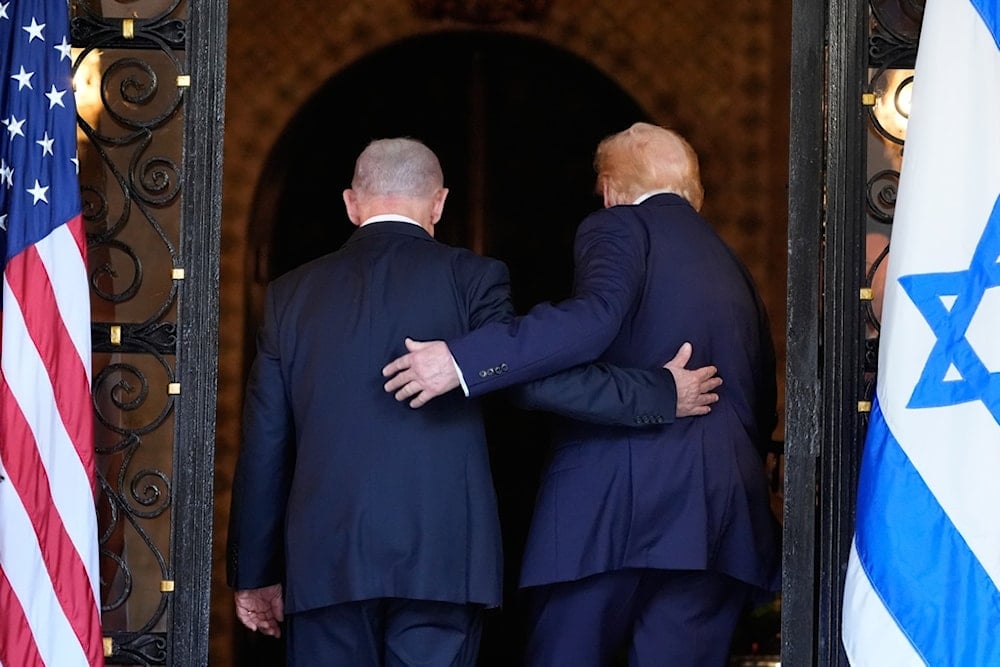
President Donald Trump and Israeli Prime Minister Benjamin Netanyahu walk into Trump's Mar-a-Lago club, Monday, Dec. 29, 2025, in Palm Beach, Fla., after an arrival greeting. (AP)
The United States may turn against "Israel" following the failed war on Iran, according to an opinion piece published in the New Statesman. Freddie Hayward writes that what was supposed to be another Venezuela has instead become an "American Suez," and a scapegoat will eventually be needed to blame for the disastrous conflict.
Hayward writes that on February 11, Israeli Prime Minister Benjamin Netanyahu walked into the White House Situation Room and tried to persuade Donald Trump to launch a war against Iran. According to The New York Times, Netanyahu promised the president that they could assassinate the Supreme Leader of Iran, that Mossad could foment a popular rebellion, and that Iran would be too weak to close the Strait of Hormuz. Trump was on board, and Operation Epic Fury was launched shortly afterwards.
But the war did not work out as promised. 41 days later, the analysis notes, the Iranian leadership is still in control, Iran is charging tolls for ships to pass through the strait, and "Israel" is waging immense aggression in Lebanon. Trump, the piece argues, was "willingly mis-sold" on what the war could achieve.
Trump is now trying to extricate himself from the mess, Hayward writes. His potential successors, Marco Rubio and JD Vance, were reportedly never keen on the war in the first place and will want to distance themselves from the fallout. The vice president and the secretary of state, or their teams, likely briefed the Times about their opposition to the war in order to make it clear that they were skeptical from the start. Rubio reportedly described Israeli intelligence about regime change as "bull****."
Eventually, a scapegoat will be needed to blame for the war, and "Israel" increasingly fits the bill. Hayward asks: "Is this the beginning of the end of the US-Israel partnership as we know it?"
"Israel's" growing unpopularity
The deterioration in the relationship has been ongoing for a long time, the analysis states. Polls show widespread anti-Israeli sentiment on both sides of the aisle. 60 percent of Americans now have an unfavorable view of "Israel," up from 53 percent last year and 42 percent in 2022. In both parties, a majority of those under 50 have a negative view of the country.
Within the Democratic Party, the analysis notes, the political spectrum shifted following the genocide in Gaza, which has disgusted many establishment figures, not just far-left activists. Hayward argues that opposing "Israel" has become a test by which Democrat activists judge the moral rectitude of their leaders.
On the MAGA right, the perception that "Israel" is manipulating its American ally for its own ends has gained currency. Hayward writes that Tucker Carlson is "pumping out instantly viral criticisms of Israel every day."
For others, the damage done to the relationship is practical, the analysis continues. "Israel" cannot achieve the things it claims it can achieve. One administration official explained to Hayward that the policy Netanyahu had been advocating for decades, regime change in Iran, has failed. "Israel" has therefore lost credibility in the eyes of American foreign policy makers.
A new generation with completely different views on "Israel" will become ever more prominent in American life. Trump has taken US military cooperation with "Israel" to fresh heights. He has tested the thesis that "Israel" is a reliable ally, and the results have come back negative.
A ceasefire breaking down
Now, Trump's ceasefire is breaking down because the Israeli government has continued its bombardment of Lebanon. Iran, Pakistan and others say the ceasefire covers Lebanon, while the US says no such promise was made.
This will only cement the perception that "Israel" is working against America's national interests and keeping the country engaged in unwise wars in the region in order to pursue its own course. The two nations have had different war aims from the start.
Hayward concludes that we might look back on Operation Epic Fury as the "high water mark of the real special relationship." It could all be downhill from here.
As the war on Iran enters its seventh week with no end in sight, and as American public opinion continues to shift against "Israel," the alliance that has defined US policy in West Asia for decades may be entering its final phase. For the Biden and Trump eras of unconditional support for "Israel," the reckoning may finally be at hand. And as Hayward notes, it could all be downhill from here.


