
War on Iran rattles Dubai’s Asian wealth safe haven status: Bloomberg
 5 Min Read
Asian investors are reconsidering their exposure to Dubai as the war on Iran raises security concerns, testing the city’s status as a global wealth hub.
-
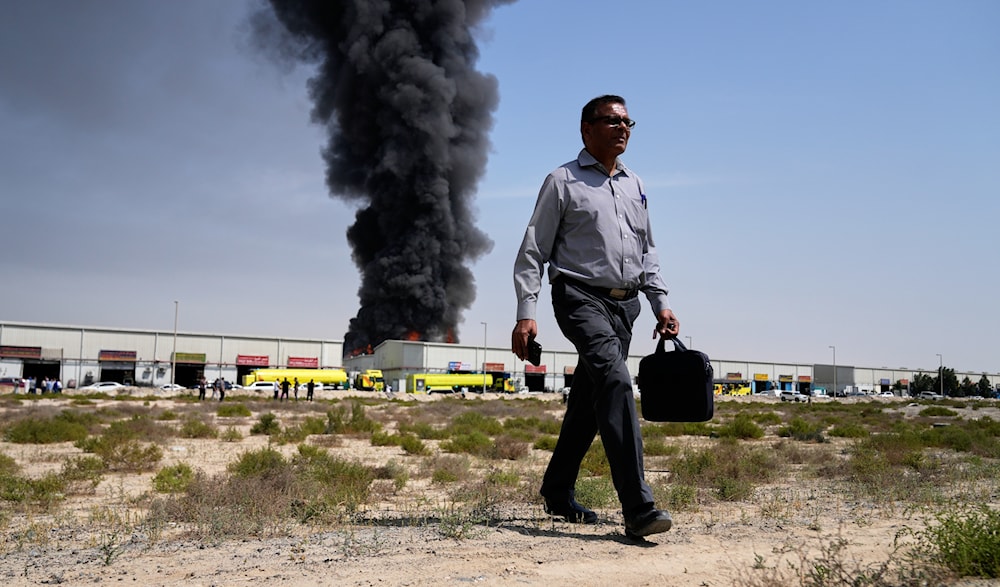
A man walks away after watching a black plume of smoke rising from a warehouse in the industrial area of Sharjah City, United Arab Emirates, Sunday, March 1, 2026. (AP)
Many of Asia’s richest families are reconsidering their financial exposure to Dubai as the war on Iran rattles the regional hub, Bloomberg News reported.
According to Bloomberg, consultants have begun receiving calls from clients seeking to delay relocation plans, while others are exploring ways to reduce investments in the city that has drawn billions of dollars from wealthy individuals across the region. Those already based in Dubai are also preparing contingency plans in case the situation escalates.
Nick Xiao, chief executive officer of Hong Kong-based multi-family office Annum Capital, told Bloomberg that Asian investors who previously moved capital to the Middle East are now reconsidering those decisions. “Asia investors who went to the Middle East for investment opportunities and tax advantages are re-thinking their decisions and probably moving their money back to Hong Kong or Singapore,” Xiao said.
A financial hub put to the test
Bloomberg reported that Dubai’s rapid rise as a financial and wealth hub is now being tested as the US-Israeli war on Iran intensifies across the region. Fighting has entered a second week, with renewed attacks reported in several countries and a drone strike that caused a fire near the US consulate in Dubai last week. Thousands of flights to the region have also been canceled, though airlines are attempting to resume operations.
Despite the turmoil, Bloomberg highlighted the scale of Dubai’s recent growth. Citing Boston Consulting Group, the outlet noted that about $700 billion in overseas assets were booked in the United Arab Emirates in 2024, while family offices in Dubai alone control more than $1.2 trillion.
Asian wealth has played a major role in that expansion. Bloomberg reported that roughly a quarter of the more than 2,270 foundations established in the UAE have Asian ownership, according to Yann Mrazek, managing partner at Dubai-based wealth advisory firm M/HQ. The Dubai International Chamber also said Asia accounted for 47% of multinational companies attracted to the city in 2025.
Investors reassess despite growth
Still, Bloomberg said the war has prompted a reassessment among many investors. “It’s definitely a wake-up call,” Felix Lai, principal of Hong Kong-based multi-family office JMS Group, told Bloomberg. “People might need to rethink their decision to move to the Middle East with their family and money, though it is too early to make a decision.”
Lai also described how some clients have already taken steps to leave the region. “They don’t even care about the pricing,” he said after arranging a private jet costing about $300,000 to fly 15 clients from Oman to Hong Kong. “They just want to leave.”
Bloomberg also reported that business activity has begun slowing amid the uncertainty. Tamour Pervez, who relocated to Dubai less than two years ago to manage money for a Pakistani agricultural family, said planned deals have already been affected.
“We were looking to close a deal this month, but that is now on hold,” Pervez said. “If it lasts for several weeks, deals could start falling through.”
Some observers warned that a prolonged conflict could affect Dubai’s reputation as a safe base for global wealth. Patrick Tsang, who runs his own family office and founded the Ambassadors Club in Hong Kong, told Bloomberg that a sustained war could trigger an expatriate departure.
“I think there will be a migration,” Tsang said. “If you’re an expat, why would you take the risk with your family?”
At the same time, Bloomberg noted that some investors are taking a cautious wait-and-see approach. Clients at private banking arms of lenders including DBS Group Holdings and Oversea-Chinese Banking Corp. are closely monitoring developments rather than making immediate moves.
Market reacts to the fallout
Market reactions have already emerged, after the Dubai Financial Market General Index fell 4.7% after trading resumed following a two-day closure, marking the sharpest decline since May 2022.
Despite the current tensions, some investors told Bloomberg that the UAE’s infrastructure and governance could help the country recover once the conflict subsides. Analysts also suggested that any long-term retreat from Dubai will largely depend on how long the war continues.
“If uncertainty drags on for a few weeks, some companies may pause expansion in the interim,” said Nirbhay Handa, chief executive officer of migration service Multipolitan, adding “Stability is likely to return quickly to Dubai as the situation eases.”


