
West's influence declining on global stage: Zakharova to Al Mayadeen
 4 Min Read
Zakharova says developments in Venezuela and Iran signal deterioration of the global order and declining Western influence.
-
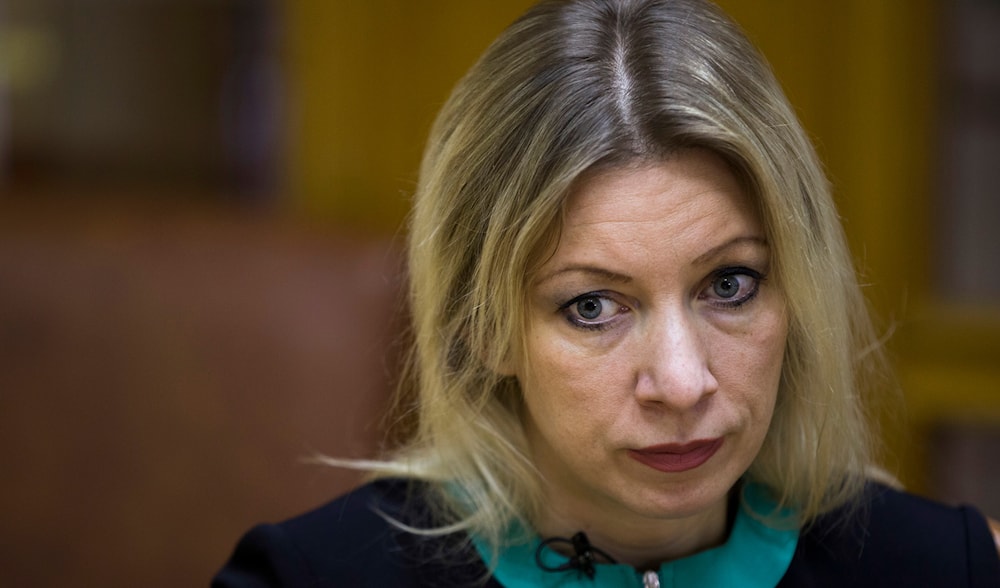
Russian Foreign Ministry spokeswoman Maria Zakharova listens to a question during her interview for the Associated Press in Moscow, Russia, Tuesday, Dec. 1, 2015 (AP)
The developments in the Venezuela and Iran files indicate a deterioration of the global order, said Russian Foreign Ministry Spokesperson Maria Zakharova.
Speaking to Al Mayadeen on Thursday, Zakharova asserted that Western countries are making strenuous efforts to maintain their hegemony after perceiving a decline in their influence on the global stage.
She further described Western actions as “hostile” and criticized the West for failing to adhere to international law.
In particular, the Russian spokesperson accused the United States of disregarding international law altogether, stating that Washington is now "seeking to revive the behavior of colonial empires," adding that US officials "do not even bother to hide this."
Iran prepared for any scenario: Araghchi
This comes as nuclear talks between Iran and the United States enter their third round, as Tehran continues pushing for diplomacy, while Washington continues to mix its diplomatic invites with threats of war against Iran.
Iranian Foreign Minister Abbas Araghchi warned that any direct conflict with the United States could quickly escalate into a “devastating” regional war involving multiple Middle Eastern states.
Speaking in an exclusive interview for India Today TV, Araghchi emphasized that Tehran is prepared for multiple scenarios as diplomatic pressure builds ahead of the third round of indirect talks in Geneva scheduled for Thursday.
Meanwhile, US Vice President JD Vance told Fox News’ America’s Newsroom that former President Donald Trump continues to favor a diplomatic approach toward Iran and hopes Tehran will enter Thursday’s talks with a similar mindset. Vance stressed that Trump has been clear that Iran must not obtain a nuclear weapon, while maintaining that the goal should be achieved through diplomacy. He also noted that the US has other tools available if needed.
“We’re sitting down having another round of diplomatic talks with the Iranians trying to reach a reasonable settlement,” Vance said, expressing hope that Tehran takes Trump’s preference for diplomacy seriously. His remarks come amid heightened rhetoric and renewed scrutiny following Trump’s recent State of the Union address, in which Iran featured prominently in the administration’s foreign policy agenda.
Venezuelan front
The lawyer for Venezuelan President Nicolas Maduro has accused Washington of actively preventing Venezuela from paying for the president’s legal defense amid ongoing US pressure and judicial actions against the Venezuelan leader.
Barry Pollack, Maduro’s defense attorney in the United States, said that a US authorization allowing Venezuela to pay his legal fees was revoked hours after it was granted, effectively blocking the transfer of funds needed to cover his defense costs.
What happened
In early January 2026, US forces launched an aggression on Venezuela’s capital, Caracas, in which Maduro and his wife, Cilia Flores, were seized and taken out of the country. The operation involved airstrikes and specialized troops infiltrating Maduro’s residence area, culminating in his abduction and transfer to the United States to face legal charges.
Maduro has pleaded not guilty in US courts, contending he was “captured” unlawfully and remains the legitimate president of Venezuela. His legal team has challenged the legitimacy of his arrest on grounds of sovereignty and international law.
International reactions
The US actions in Venezuela sparked widespread controversy. Many governments and international actors condemned the abduction as a violation of international law and Venezuelan sovereignty. Venezuela formally appealed to the United Nations to pressure for Maduro’s release, denouncing the military action as illegal


