
White House reviews candidates to replace Deputy War Secretary
 4 Min Read
The White House has reviewed potential candidates to replace US Deputy Secretary of Defense Steve Feinberg, according to Reuters, as the Pentagon faces continued staff turnover.
-
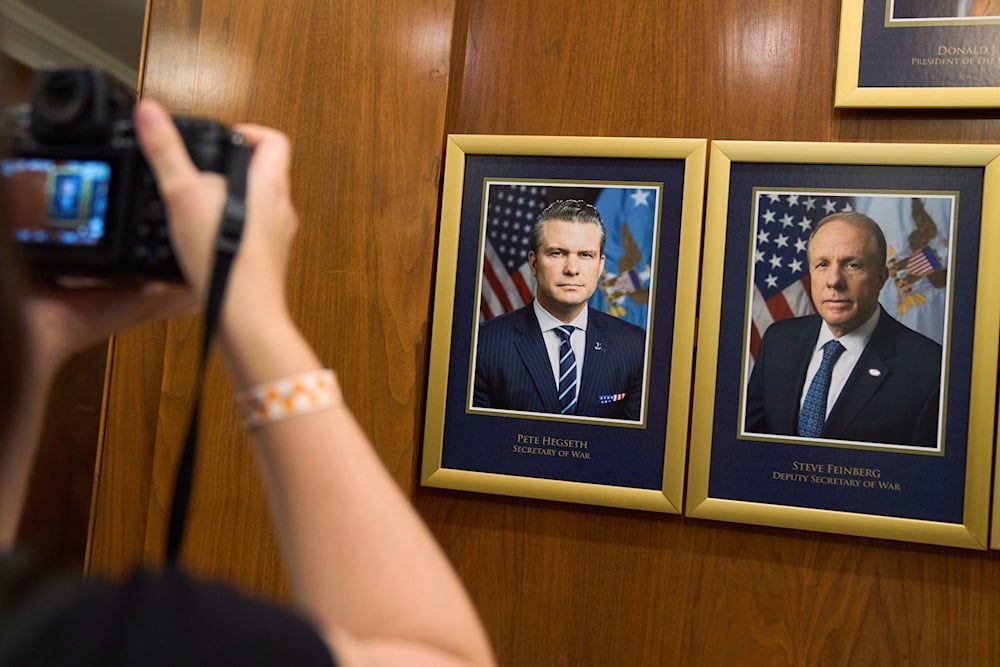
A photographer makes an image of department leadership portraits at the Pentagon, after President Donald Trump signed an executive order aiming to rename the Department of Defense the Department of War in Washington, Tuesday, Sept. 9, 2025. (AP)
The White House has reviewed candidates to potentially replace US Deputy Secretary of War Steve Feinberg, three people familiar with the discussions told Reuters, signaling that further leadership changes could be imminent for a Pentagon already experiencing unusually high staff turnover.
The effort, which was underway in June, has included conversations with senior lawmakers in the Senate about whether the administration's picks would have enough support to be confirmed, according to two of the people. One of the sources added that the review was still ongoing as of late August.
The three sources said no decision has been made to remove Feinberg from his post. They did not specify why the White House is reviewing potential replacements or which candidates are being considered.
White House dismisses reports, Hegseth says Feinberg 'isn't going anywhere'
White House spokesperson Anna Kelly dismissed the reports. "These so-called anonymous 'sources' have no idea what they are talking about," she said.
"President Trump appreciates the work of Secretary Hegseth, Deputy Secretary Feinberg, and the entire Department of War, whose record of success in Operation Epic Fury, Operation Absolute Resolve, and Operation Midnight Hammer speaks for itself," Kelly added, referring to US military operations in Iran and Venezuela.
The Pentagon denied that a process is underway to replace Feinberg. Asked for comment by Reuters, Secretary of War Pete Hegseth said in a statement that Feinberg has his full support and "isn't going anywhere."
A departure by Feinberg, the billionaire co-founder of private equity firm Cerberus Capital Management, would mark the most senior staff change for a department that has already seen a string of high-profile departures under Hegseth.
Pentagon's overhaul marks Hegseth's tenure
The Pentagon is experiencing significant leadership upheaval, with a series of high-profile departures and personnel changes marking Secretary of War Pete Hegseth's tenure.
Army Secretary Dan Driscoll resigned on September 2, 2026, after 18 months in the position, becoming the latest senior official to leave amid reported tensions with Hegseth.
Trump appointed Adam Telle as acting head of the US Army on September 3, 2026, following Driscoll's resignation. Telle previously oversaw Army infrastructure projects and served as an aide to Republican lawmakers.
Two dozen generals, admirals, fired from their posts
Since the start of Trump's second term, Hegseth has fired or forced out approximately two dozen generals and admirals, according to reports. These include Army Chief of Staff General Randy George, who stepped down on April 15, 2026, Navy Secretary John Phelan, who was dismissed on April 29, 2026, and General Christopher Donahue, commander of US forces in Europe and Africa, who was removed on July 3, 2026.
The turnover has drawn criticism from Republican senators. Sen. Thom Tillis of North Carolina accused Hegseth of "inept management" on August 15, 2026, and called on President Trump to fire him.
"I have never witnessed more inept management of the brave men and women who serve our country," Tillis posted on social media, adding that Hegseth is "intimidated by competence and retreats to ginning up culture wars instead of soberly attending to the vital work of our national defense".
House Armed Services Committee Chair Mike Rogers expressed concern about the instability on August 20, 2026, stating, "I'm tired of all the churn. I want to see some stability".
The leadership changes come as the United States remains engaged in a protracted conflict with Iran, which has now stretched for more than six months. Critics have pointed to the absence of permanent leadership in key Army positions as a concerning development during active military operations.
Pentagon officials have defended Hegseth's actions. Chief spokesperson Sean Parnell stated on August 25, 2026, that the secretary has the "statutory authority" to review and approve promotion rosters and that senior military leaders "serve at the pleasure of the president and secretary".


