
Xi, Putin condemn US 'bullying' during Beijing summit
 4 Min Read
Chinese President Xi Jinping and Russian President Vladimir Putin called for deeper strategic coordination in Beijing while criticizing unilateral pressure and US-led hegemonic policies.
-
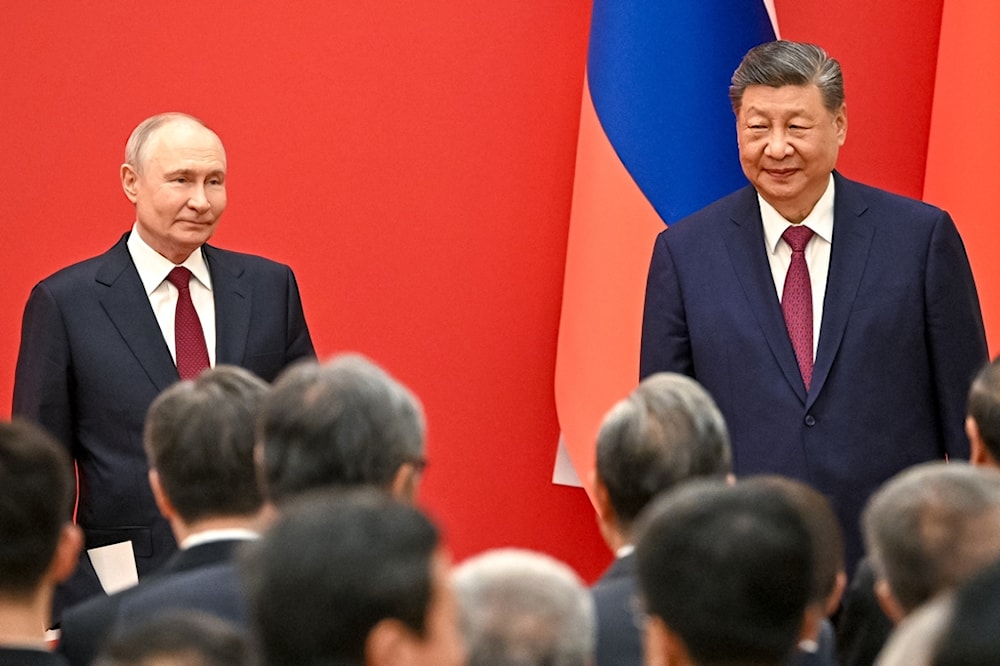
Russian President Vladimir Putin and Chinese President Xi Jinping attend an opening ceremony of the China-Russia Years of Education at the Great Hall of the People in Beijing, Wednesday, May 20, 2026. (Kristina Solovyova, Sputnik, Kremlin Pool Photo via AP)
Chinese President Xi Jinping and Russian President Vladimir Putin used their latest summit in Beijing to reinforce political, economic, and strategic coordination between the two powers, while issuing indirect criticism of US foreign policy and Western pressure campaigns.
During talks held on Wednesday in the Chinese capital, Xi said China and Russia must jointly oppose “all unilateral bullying and actions that reverse history,” in remarks widely interpreted as criticism of Washington’s escalating confrontational posture toward both countries.
According to Chinese state media, Xi warned that the current international climate is being shaped by “intertwined turbulence and transformation,” while “unilateral hegemonic currents are running rampant.”
The Chinese president stressed that Beijing and Moscow should deepen “comprehensive strategic coordination” in response to mounting global instability.
Putin, in turn, praised his relationship with Xi, calling the Chinese leader “my dear friend” at the opening of bilateral talks.
“We are truly delighted to see you,” Putin said. “We keep in constant touch, both personally and through our aides in the government.”
Xi revives 'Thucydides Trap' warning toward Washington
The summit came only days after Xi hosted US President Donald Trump in Beijing, where the Chinese leader delivered a pointed warning regarding relations between rising and established global powers.
During that meeting, Xi referenced the concept of the “Thucydides Trap,” a geopolitical theory suggesting that conflict often emerges when an emerging power challenges an existing hegemon.
“The world has come to a new crossroads,” Xi said during Trump’s visit. “Can China and the United States transcend the so-called ‘Thucydides Trap’ and forge a new paradigm for major-power relations?”
The remarks were widely viewed as a warning against further escalation between Washington and Beijing, particularly as economic confrontation, military tensions, and sanctions disputes intensify.
Xi’s subsequent meeting with Putin reinforced the growing strategic convergence between China and Russia against what both countries portray as US-led unilateralism and geopolitical coercion.
Energy cooperation remains central to Moscow-Beijing ties
Energy cooperation featured prominently during the talks, particularly as global markets continue to experience instability linked to war on Iran and disruptions in the Strait of Hormuz.
Putin described the energy relationship between the two countries as a cornerstone of bilateral cooperation.
“The driving force behind economic cooperation is Russian-Chinese collaboration in the energy sector,” Putin said.
He added that Russia continues to serve as “a reliable supplier of resources,” while China remains “a responsible consumer of these resources.”
The two sides reportedly renewed discussions on expanding a long-delayed natural gas pipeline linking Russia and China, a project that has gained renewed urgency as both countries seek to reduce dependence on Western-controlled financial and trade systems.
Since the escalation of the Ukraine war in 2022, China has emerged as Russia’s largest trading partner, maintaining commercial relations despite sweeping sanctions imposed by the United States and European powers.
Beijing has repeatedly stated that it remains neutral regarding the Ukraine conflict while opposing sanctions and external pressure campaigns.
Beijing warns against prolonged regional escalation
Chinese state media reported that Xi also stressed the need for a “complete cessation of hostilities” in West Asia, warning that prolonged conflict threatens global energy markets and international trade flows.
“An early end to the conflict will help reduce disruptions to energy supply stability, the smooth flow of industrial and supply chains, and international trade order,” Xi said.
The comments come as the US-Israeli war on Iran continues to destabilize shipping routes, energy supplies, and commodity markets worldwide.
The Beijing summit underscored the extent to which China and Russia increasingly frame themselves as defenders of a multipolar international order against what they describe as US domination and coercive foreign policy.


