
Zakharova urges EU to address problems instead of militarizing
 4 Min Read
The Russian spokeswoman urges the EU to focus on domestic challenges instead of pursuing militarization and nuclear deterrence plans.
-
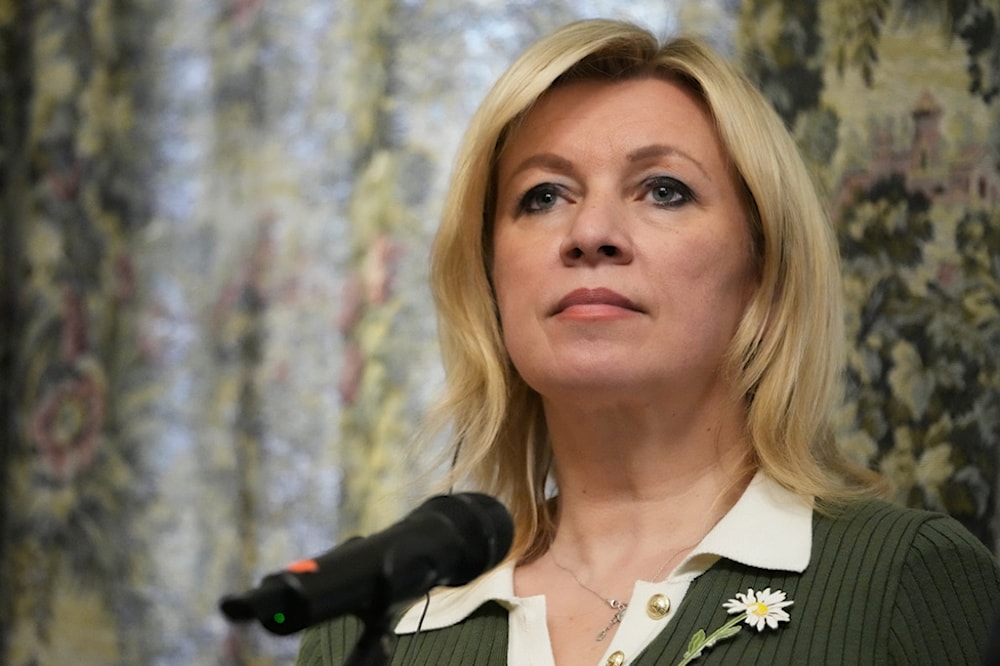
Russian Foreign Ministry spokeswoman Maria Zakharova attends a joint news conference of Egyptian FM Badr Abdelatty and Russian FM Sergey Lavrov following their meeting at Zinaida Morozova's Mansion in Moscow, April 3, 2026 (AP)
Russian Foreign Ministry spokesperson Maria Zakharova said on Wednesday that the European Union should prioritize addressing pressing internal challenges rather than pursuing militarization, including discussions surrounding a potential European nuclear deterrent.
Speaking to Sputnik Radio, Zakharova argued that Brussels should focus on existing issues instead of "inventing non-existent ones."
"The European Union has real pressing problems that it should address and pay increased attention to, rather than inventing non-existent ones," she said. "Rather than creating new dangerous trends and getting carried away with militarization. Now it is not just militarization, it is militarization with a nuclear component."
Moscow criticizes European nuclear discussions
Zakharova criticized recent discussions led by France regarding the possibility of extending a nuclear umbrella to European partners, warning that such proposals could draw more Western European countries into a dangerous security trajectory.
She characterized the debate as "suicidal philosophizing" and said the European Union should instead work to reduce the consequences of its existing policies.
According to Zakharova, the bloc faces numerous domestic and regional challenges, including the spread of weapons supplied to Ukraine, trafficking, organized crime, "black transplantology", and the erosion of Europe's security architecture.
She said addressing those issues should be the EU's immediate priority if it hopes to preserve its political and security achievements.
Russia reiterates concerns over EU nuclear plans
Zakharova's remarks follow previous warnings from Russian officials over growing European discussions on nuclear deterrence.
In late July, Russia's permanent representative to the United Nations in Geneva, Gennady Gatilov, told RIA Novosti that some European countries had begun developing their own deterrence mechanisms amid concerns over continued reliance on the US nuclear umbrella, pointing to expanding nuclear cooperation involving France, Germany, and Poland.
Russian Foreign Minister Sergey Lavrov has also criticized proposals to extend France's nuclear umbrella to European Union and NATO members, arguing that such measures would not enhance regional security.
NATO expands eastern flank air presence
Zakharova's criticism of European militarization comes as NATO continues expanding its military presence along its eastern flank, including through the deployment of additional fighter jets and air defense assets in Eastern Europe.
NATO announced that the air forces of Italy, Spain, and Turkey would deploy fighter aircraft to support the alliance's air patrol and air defense operations along its eastern borders.
"The Italian Air Force, Spanish Air and Space Force and Turkish Air Force will deploy their fighter jets to contribute to the security of NATO airspace along the Eastern Flank, as part of the NATO Air Defence mission," the alliance said in a statement.
NATO said the deployments are aimed at strengthening deterrence, protecting allied airspace, and improving military readiness amid heightened tensions across Europe.
Turkey, Italy, and Spain deploy fighter jets
As part of the deployment plan, Turkey will send five F-16 fighter jets and around 80 personnel to Estonia's Amari Air Base for the first time, contributing to NATO's air policing mission in the Baltic region.
Italy will deploy four Typhoon fighter jets and more than 100 personnel to Lithuania's Siauliai Air Base, while Spain will send seven F-18 fighter jets and around 200 personnel to Romania's Mihail Kogalniceanu Air Base.
Spain's deployment will also include an A400 mln aircraft for aerial refueling and three NH-90 helicopters assigned to counter-drone operations.
The new forces will replace Portuguese, Romanian, and French units currently participating in NATO's eastern flank air defense mission.
Russia warns over NATO military buildup near Baltic region
The deployments come as Russia has repeatedly criticized NATO's growing military presence near its borders.
Earlier this year, Russian officials accused the alliance of expanding military activities in the Baltic Sea region, particularly near the Kaliningrad region, warning that increased NATO operations could heighten tensions and threaten regional stability.
Artem Bulatov, a special envoy at the Russian Foreign Ministry, said NATO was strengthening its combat capabilities and military infrastructure near Kaliningrad through a series of initiatives.
Bulatov pointed to NATO's Baltic Sentry mission, launched in January 2025, which the alliance said was aimed at protecting critical infrastructure in the Baltic Sea. He argued that the mission, alongside expanded air patrols and military exercises, reflected a broader NATO military buildup in the region.


